Robert Kaplan - Imperial Grunts
Здесь есть возможность читать онлайн «Robert Kaplan - Imperial Grunts» весь текст электронной книги совершенно бесплатно (целиком полную версию без сокращений). В некоторых случаях можно слушать аудио, скачать через торрент в формате fb2 и присутствует краткое содержание. Город: New York, Год выпуска: 2005, ISBN: 2005, Издательство: Random House, Жанр: Публицистика, nonf_military, на английском языке. Описание произведения, (предисловие) а так же отзывы посетителей доступны на портале библиотеки ЛибКат.
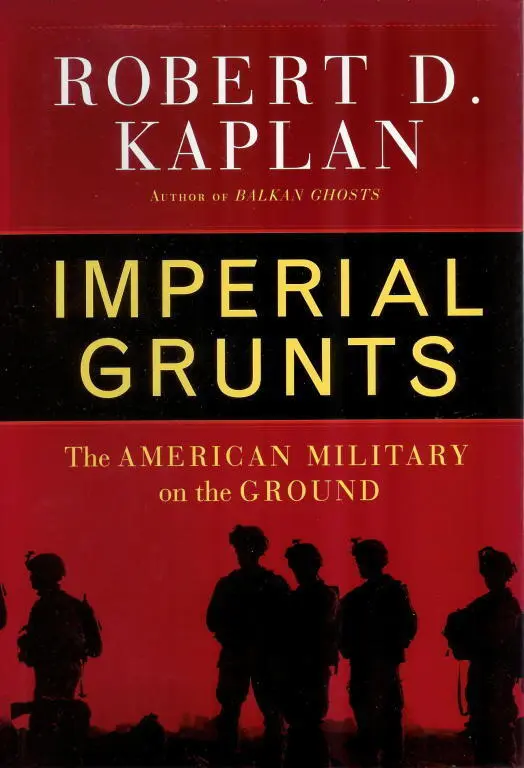
- Название:Imperial Grunts
- Автор:
- Издательство:Random House
- Жанр:
- Год:2005
- Город:New York
- ISBN:978-0-307-27850-0
- Рейтинг книги:5 / 5. Голосов: 1
-
Избранное:Добавить в избранное
- Отзывы:
-
Ваша оценка:
Imperial Grunts: краткое содержание, описание и аннотация
Предлагаем к чтению аннотацию, описание, краткое содержание или предисловие (зависит от того, что написал сам автор книги «Imperial Grunts»). Если вы не нашли необходимую информацию о книге — напишите в комментариях, мы постараемся отыскать её.
Imperial Grunts — читать онлайн бесплатно полную книгу (весь текст) целиком
Ниже представлен текст книги, разбитый по страницам. Система сохранения места последней прочитанной страницы, позволяет с удобством читать онлайн бесплатно книгу «Imperial Grunts», без необходимости каждый раз заново искать на чём Вы остановились. Поставьте закладку, и сможете в любой момент перейти на страницу, на которой закончили чтение.
Интервал:
Закладка:
But while the lower levels of the Russian military, according to Wilhelm, were dealing with the reality of contemporary conflict, the general staff in Moscow remained locked in a Cold War mindset. In fact, it was becoming even more conservative because of the bitterness over an American-dominated unipolar world. It saw missions like Iraq not as potential learning experiences, but as deployments to be opposed simply because the Americans were leading them.
In the spring of 1996, Wilhelm left Bosnia. By the fall he was back in Tajikistan.
The next day we entered a landscape of rolling hills speckled with scree and yellow stubble grass. Between the blackest shadows, grazing in an ethereal light, was a herd of bighorn argali, or Marco Polo sheep—the “supreme trophy of a sportsman’s life,” according to Roy Chapman Andrews, because even in the 1920s they were so rare. 34A hunting license in Mongolia for one of them now cost $20,000. They were as large as horses almost. Wilhelm was ecstatic: “All we need now is to see a snow leopard.” We followed them in the UAZ to the edge of a range of clay hills, where below us the great Mongolian plain fell away as if into the sky. Wilhelm gave me his Russian-made monocular to get a closer look. It was like peering back in time, as if seeing the light of a distant star. Marco Polo had seen these sheep in his travels through the Gobi. He described their horns as a “good six palms in length.” 35They were now practically extinct, and would certainly be so if this desert were exploited for its oil and coal. A little while later we saw a khulan, a wild ass with large, funny ears that was also extremely rare.
That day Wilhelm and I had to endure large meals at six zastafs, with vodka toasts at every one. This was in addition to drinking the blood of a black-tailed gazelle that Col. Ranjinnyam had shot with his Makarov pistol from the UAZ. Having swallowed a glass of blood and eaten the animal’s testicles and eyeballs, Wilhelm told me, “Like I said, this is better than rush-hour traffic on I-395 en route to the Pentagon.” He never tired, never stopped laughing and slapping the Mongolian officers on the back. Maj. Altankhuu confided to me, “Col. Wilhelm is a great man. He makes us like America so much.”
According to Mongolian lore, the three manly sports are horse racing, archery, and wrestling. 36At the turn of the twenty-first century, racing gazelles with a UAZ and target shooting with Makarovs and AK-47s had become variations of horse racing and archery; thankfully, I had no wrestling to endure. But we stopped for a marksmanship contest at a spot in the desert where we all got ticks, so we didn’t reach the next border regiment until 11:30 p.m. As I threw my pack on the bed, in the adjacent dining room I heard Wilhelm let out yet another maniacal laugh. Walking over I saw a large roasted pig, head and eyes and all, placed on the table, and Col. Ranjinnyam imploring us to eat. “The liver of the gazelle I shot will be served to you at breakfast,” he said, apologizing.
“You have to understand,” Wilhelm told me, “that in this culture food is a gift. And they are showing respect for us and for America by showering us with gifts.”
Thus, we ate, again.
The next morning, while eating the gazelle liver, Wilhelm talked about his second posting to Tajikistan. It began in October 1996 when he became America’s first defense attaché to the newly independent post-Soviet republic, whose four-year-old civil war had finally begun to wind down. The ethnic Pushtun Taliban had just captured the capital of Kabul in neighboring Afghanistan. Central Asian leaders, not to mention Russia and the Shiite clerisy of Iran, were fearful that the Taliban, aided by Pakistan and Saudi Arabia, would try to spread its ideology of Sunni fundamentalism throughout the region. Thus, they demanded an end to the Tajik civil war because it was getting in the way of containing the new Taliban regime: Tajikistan was now needed as a rear base to help the ethnic Tajik guerrilla leader Ahmad Shah Massoud recapture Afghanistan. The fact that the civil war in Tajikistan had descended into localized warlordism gave the various faction leaders, who were fast losing control, a further incentive to stop the fighting.
But the Tajik capital of Dushanbe still constituted one of the lower circles of hell when Wilhelm arrived back there. Much of his time was spent keeping up with the activities of a colorful cast of warlords: Rakhmon “Hitler” Sanginov, Jagga “the Sweeper” Mirzoyiev, Makhmud “the Black Robin Hood” Khudoberdiev, Abdumalik “the Shark” Abdullojonov, Khurshed “Tyson” Abdushukurov, and Yakub Solimov, who played the theme song from The Godfather whenever he received guests at his home.
The Tajik economy consisted of a cotton monoculture, one aluminum smelting plant, and heroin, which all of these men fought over. “In Tajikistan,” Wilhelm said, “I learned that warlords are not the products of great, scheming political minds. Our intellectuals have described them as far more complicated than they really are. They are just simple opportunists, who aren’t distracted by larger thoughts about national security or anything else.” For example, Makhmud Khudoberdiev, a captain in the Soviet army in Afghanistan in the 1980s, happened to have the keys to the armory in Kurgan-Tyube in southern Khatlon Province. “The fact that he had the keys to the armory made him a warlord. He got three tanks running; that’s all it took to make him famous.”
Wilhelm attended the “final” fall of the town of Tursunzade near the border with Uzbekistan three times, once lying in a ditch in a vicious firefight. “On the firing range, bullets make one kind of sound; when they’re coming at you they make another.” Wilhelm’s wife, Cheri, and their two young children, Parker and Daley Alice, had come with him to Tajikistan. “I had been separated from them for so long because of the deployment in Bosnia and other assignments. We were all finally together in a war zone. There was no electricity, no heating; it was so cold we all slept together in the same bed to keep warm. The tap water was the color of Coca-Cola. We shared a toilet with our armed guards. I went boar hunting occasionally. It was the greatest time of our lives.”
As the war ended and the infamous Sodirov brothers—Rizvon and Bahrom—were cut out of the peace deal, they began taking Western hostages. The Wilhelms were evacuated two times. During one of the evacuations, Wilhelm was sent to Tampa, Florida, the headquarters of Central Command, which was soon to incorporate the former Soviet Central Asian republics into its domain. Wilhelm was summoned to meet the CENTCOM commander in chief, Marine Gen. Anthony Zinni. [27] When Zinni’s term ended, he was succeeded by Army Gen. Tommy Franks.
“I found Zinni in the weight room, pumping iron,” Wilhelm related. “A typical Marine general, I thought. He had only one question for me, the big one. Given that I was a force protection risk—after all, my family and I had to be evacuated—what was I doing in Tajikistan in the first place that made me so necessary there? I told him that I was the only guy that he had on the ground in a country with a civil war and next to a country where the Taliban were fighting a collection of warlords called the Northern Alliance. Fine, he told me. Go back to Tajikistan then. That’s a good general: If he gets the right answer to the right question he’s finished with you. He trusts you to figure out the rest.”
Wilhelm returned with his family to Tajikistan one last time, until a contract was put out on his life, forcing them to leave for good. He had been promoted to lieutenant colonel. He then found out that he had been short-listed for a battalion command, placing him in the top 10 percent of his peer group. He never got that battalion command. But the fact that he had risen from the bottom 20 percent—unselected for the Command and General Staff College at Fort Leavenworth—to the top 10 percent through
Читать дальшеИнтервал:
Закладка:
Похожие книги на «Imperial Grunts»
Представляем Вашему вниманию похожие книги на «Imperial Grunts» списком для выбора. Мы отобрали схожую по названию и смыслу литературу в надежде предоставить читателям больше вариантов отыскать новые, интересные, ещё непрочитанные произведения.





Обсуждение, отзывы о книге «Imperial Grunts» и просто собственные мнения читателей. Оставьте ваши комментарии, напишите, что Вы думаете о произведении, его смысле или главных героях. Укажите что конкретно понравилось, а что нет, и почему Вы так считаете.