Robert Kaplan - Imperial Grunts
Здесь есть возможность читать онлайн «Robert Kaplan - Imperial Grunts» весь текст электронной книги совершенно бесплатно (целиком полную версию без сокращений). В некоторых случаях можно слушать аудио, скачать через торрент в формате fb2 и присутствует краткое содержание. Город: New York, Год выпуска: 2005, ISBN: 2005, Издательство: Random House, Жанр: Публицистика, nonf_military, на английском языке. Описание произведения, (предисловие) а так же отзывы посетителей доступны на портале библиотеки ЛибКат.
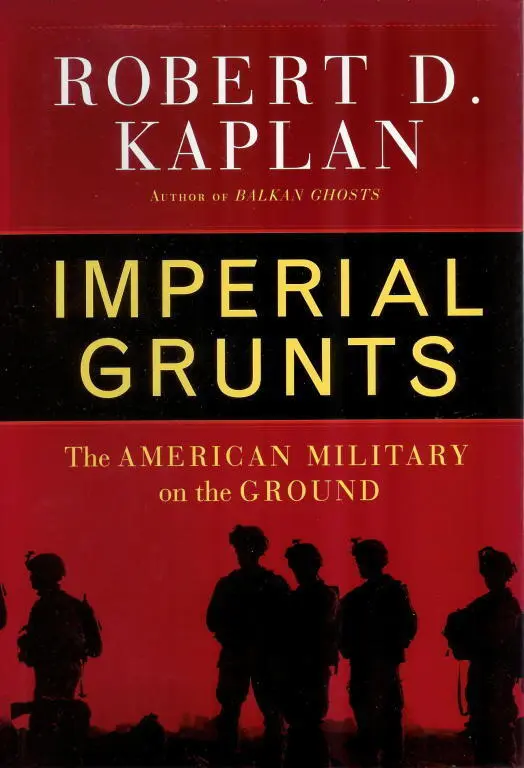
- Название:Imperial Grunts
- Автор:
- Издательство:Random House
- Жанр:
- Год:2005
- Город:New York
- ISBN:978-0-307-27850-0
- Рейтинг книги:5 / 5. Голосов: 1
-
Избранное:Добавить в избранное
- Отзывы:
-
Ваша оценка:
Imperial Grunts: краткое содержание, описание и аннотация
Предлагаем к чтению аннотацию, описание, краткое содержание или предисловие (зависит от того, что написал сам автор книги «Imperial Grunts»). Если вы не нашли необходимую информацию о книге — напишите в комментариях, мы постараемся отыскать её.
Imperial Grunts — читать онлайн бесплатно полную книгу (весь текст) целиком
Ниже представлен текст книги, разбитый по страницам. Система сохранения места последней прочитанной страницы, позволяет с удобством читать онлайн бесплатно книгу «Imperial Grunts», без необходимости каждый раз заново искать на чём Вы остановились. Поставьте закладку, и сможете в любой момент перейти на страницу, на которой закончили чтение.
Интервал:
Закладка:
The new station building sat like a stage prop against the gravel steppe. Waiting for us at the foot of the platform in the freezing April cold were three Mongolian officers wearing dress greens, leather coats down to their ankles, and ridiculously large service caps in standard Soviet style, dubbed “satellite dishes.” They shunted us into a Russian-made jeep called a UAZ, short for the Uralski Aftomobilni Zavod (Ural Automobile Factory). Noting that it was a large-sized and late-model UAZ, Wilhelm declared, “Looks like we’ll be living in tall cotton.” The UAZ was about as big as a small SUV, but without the amenities and with none of the comfort.
Our hotel was two hundred yards farther along the railroad tracks, a poured concrete blockhouse with hard beds, hideous furniture, and cracked windows. Wilhelm quickly changed into his BDU with its Ranger and paratrooper insignias, and black beret with the U.S. Army flash, along with an eagle, the insignia of his colonel rank. [24] The black berets were introduced by the then–Army Chief of Staff, Eric Shinseki.
We all gathered in Wilhelm’s room. Col. D. Battsengel, the leader of the Mongolian delegation, ordered breakfast brought up: buuz, or mutton ball dumplings in goulash, fatty cold cuts, and salty camel’s milk tea. We cleaned the plates.
“The American military will eat anything, anywhere, anytime,” Wilhelm pronounced to our hosts. Maj. Altankhuu translated. (Though Wilhelm’s Russian was fluent, his Mongolian was basic.) They all laughed. Asking the name of a Mongolian officer a second time, Wilhelm apologized, “I always ask for a name twice. When I remembered a woman’s name the first time, I knew she would be my wife.” Laughter again. Wilhelm’s friendly banter and broad smile never let up.
After small talk about wrestling and martial arts, Col. Battsengel told us he was from northeastern Mongolia, where Genghis Khan was born and was likely buried. Col. Battsengel told us he was opposed to the current search for Genghis’s remains by archaeologists, saying it was bad luck. I noticed the endless knot of eternity, a Mongolian shamanistic symbol, on his dress greens. Wilhelm, pointing to another shamanistic symbol on Battsengel’s uniform, mentioned that it appeared on a cloth given him by an old man who had traveled to the U.S. Embassy from an outlying village. The symbol, according to the old man, would force “your Iraqi enemies to bow down to you in supplication.” [25] As it happened, that prediction proved correct for Operation Iraqi Freedom, but not for the insurgency that followed.
Formally welcoming us to East Gobi Province, Col. Battsengel said that the tempo of development was about to pick up dramatically with the establishment of an economic free zone, manufacturing plants, and a casino on the border that would increase the population of Zamyn-Uud from ten thousand to thirty thousand. The Chinese were pushing hard for a casino gambling industry in Mongolia, which favored their business acumen and organizational skills. The Chinese had other plans, too.
The Chinese wanted to start large-scale animal husbandry operations in southern and eastern Mongolia, which would ruin the earth’s last uninhabited steppe. They had their eyes on the Gobi’s mineral deposits. They wanted to build a modern road network into Mongolia’s Gobi Desert from Inner Mongolia, and they were underbidding everyone else for construction projects. Meanwhile, northern Mongolia was being deforested; every other freight train we saw was filled with logs headed for China.
Despite seven decades of virtual Soviet occupation, Mongolians were less afraid of the Russians than of the Chinese. This was less because of the long Manchu occupation in the eighteenth and nineteenth centuries than because of the threat China now represented. Russia’s was the disintegrating empire, China’s the rising one, with the Chinese migrating in large numbers into adjacent Russian Siberia. [26] The Siberian city of Chita, northeast of Mongolia, was reportedly 40 percent ethnic Chinese by 2003.
Having once conquered Mongolia by moving the line of cultivation northward, China was poised to conquer Mongolia through globalization. The Chinese border post was in eyesight of our hotel: a brightly lit, well-engineered arc, signifying the post-industrial monolith encroaching on Zamyn-Uud’s sprawl of felt tents and scrap iron huts.
The Chinese had flooded Inner Mongolia with Han Chinese immigrants, just as they had flooded Tibet and the Turkic Uighur areas of western China’s Sinkiang Province. The Mongolians worried that they would be next. Uppermost in their minds was the fate of the Tibetans, co-religionists with whom they shared the same form of Buddhism. Mongolia’s national security doctrine had a phrase about “ethnic purity,” reflecting its fear of Manchu-like penetration.
The paranoia in Mongolia about SARS, a disease which seemed to come from China, was telling. In Mongolian minds, it might take only one epidemic to wipe out a substantial part of this sparsely populated country, easing the path for another Chinese demographic conquest. The Mongolians had been particularly grateful for American diplomatic support in encouraging the Dalai Lama’s visit to Ulaanbaatar the previous November, a visit the Chinese tried to block by temporarily cutting rail and air links to Mongolia.
“In my blood I don’t like the Chinese,” declared a high-ranking Mongolian official in an interview I had conducted in Ulaanbaatar. “The Russians dominated our politics for seven decades but did not incorporate us into the Soviet Union. The Chinese have the possibility to absorb us utterly.” I recalled Gen. Stilwell’s comment in 1923 about the Mongols’ determination never again to be incorporated into China. 29
But greater than the fear of a strong China among Mongolians was the fear of an internally weak China, or a breakup of China even.
To wit, to Mongolia’s southwest lay China’s Sinkiang Province, populated heavily by Muslim Uighur Turks, who harbored a Balkan-like hatred of their Han Chinese overlords. Throughout history, China’s control of this desert region bordering Pakistan, Afghanistan, and the ex-Soviet Stans ebbed and flowed. In the minds of Muslim Uighurs, western China was really “East Turkestan.” In the early twentieth century the Uighurs had even set up an Independent Muslim Republic of East Turkestan headquartered in Kashgar, in western China, with hazy Pan-Islamic ideals. 30A weakened China, along with continued instability in the former Soviet Stans and the North Caucasus, spelled trouble for Mongolia, we were told. It conjured up the prospect of Central Asian terrorism and drug trafficking spearheaded by Uighurs and Chechen criminals.
Col. Battsengel drove us beyond the last border checkpoint. Here in no-man’s-land there was only a plinth marking the frontier. A Chinese officer a few feet away on the other side of the plinth watched silently as Col. Wilhelm in his BDU and black beret went right up to it, careful not to step beyond for fear of provoking a diplomatic incident. Cameras clicked away at us from a window on the Chinese side.
This was a border that mattered. It would matter more as China loomed over the horizon—beyond the present conflagrations in the Middle East—as the greatest conventional challenge to American power. Yet America’s response was often subtle, as I would see.
We returned to Zamyn-Uud, where, in a nondescript house amid a sprawl of gers and huts, we found a long line of Mongolians waiting in a hallway in traditional dels, or robes. Many were children accompanied by their parents. In an adjacent room, U.S. Air Force Tech. Sgt. Dan Elliot of Huntington Beach, California, greeted us. He was the chief of a four-person dental mission dispatched to this side of the Mongolian-Chinese border by Pacific Command. The mission fell within the humanitarian component of Col. Wilhelm’s three pillars strategy. By treating an average of a hundred patients daily in this and nearby border towns, Mongolians saw the benefits of American self-interest.
Читать дальшеИнтервал:
Закладка:
Похожие книги на «Imperial Grunts»
Представляем Вашему вниманию похожие книги на «Imperial Grunts» списком для выбора. Мы отобрали схожую по названию и смыслу литературу в надежде предоставить читателям больше вариантов отыскать новые, интересные, ещё непрочитанные произведения.







Обсуждение, отзывы о книге «Imperial Grunts» и просто собственные мнения читателей. Оставьте ваши комментарии, напишите, что Вы думаете о произведении, его смысле или главных героях. Укажите что конкретно понравилось, а что нет, и почему Вы так считаете.