Robert Kaplan - Imperial Grunts
Здесь есть возможность читать онлайн «Robert Kaplan - Imperial Grunts» весь текст электронной книги совершенно бесплатно (целиком полную версию без сокращений). В некоторых случаях можно слушать аудио, скачать через торрент в формате fb2 и присутствует краткое содержание. Город: New York, Год выпуска: 2005, ISBN: 2005, Издательство: Random House, Жанр: Публицистика, nonf_military, на английском языке. Описание произведения, (предисловие) а так же отзывы посетителей доступны на портале библиотеки ЛибКат.
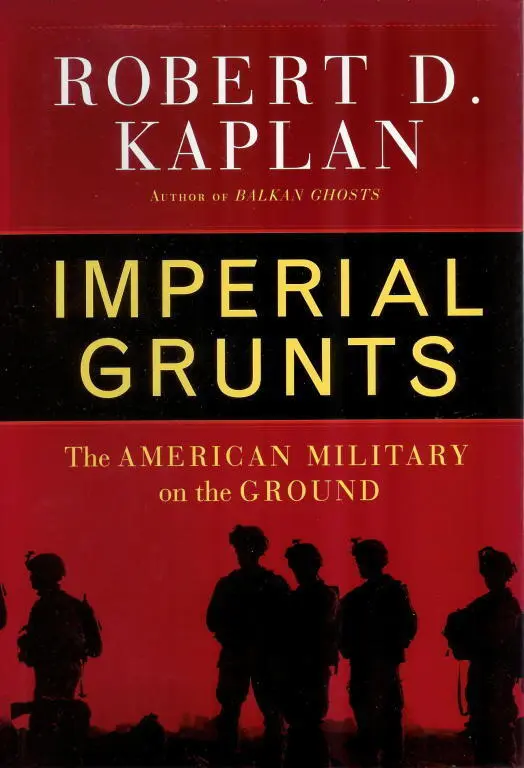
- Название:Imperial Grunts
- Автор:
- Издательство:Random House
- Жанр:
- Год:2005
- Город:New York
- ISBN:978-0-307-27850-0
- Рейтинг книги:5 / 5. Голосов: 1
-
Избранное:Добавить в избранное
- Отзывы:
-
Ваша оценка:
Imperial Grunts: краткое содержание, описание и аннотация
Предлагаем к чтению аннотацию, описание, краткое содержание или предисловие (зависит от того, что написал сам автор книги «Imperial Grunts»). Если вы не нашли необходимую информацию о книге — напишите в комментариях, мы постараемся отыскать её.
Imperial Grunts — читать онлайн бесплатно полную книгу (весь текст) целиком
Ниже представлен текст книги, разбитый по страницам. Система сохранения места последней прочитанной страницы, позволяет с удобством читать онлайн бесплатно книгу «Imperial Grunts», без необходимости каждый раз заново искать на чём Вы остановились. Поставьте закладку, и сможете в любой момент перейти на страницу, на которой закончили чтение.
Интервал:
Закладка:
Karakorum was visited by the Franciscan William of Rubruquis, who set out from Constantinople in May 1253 on a mission from Louis IX of France (Saint Louis) to Mongka Khan, yet another of Genghis’s grandsons, who had taken up the Nestorian faith and turned his grandfather’s empire into a functioning bureaucratic state. By mid-summer, Rubruquis had traveled east from the Black Sea and Crimea, penetrating the heart of the Mongol imperial domain at its western edge in present-day Kazakhstan. In late autumn, he had rounded Lake Balkhash, and crossed into northwestern China and then Mongolia proper. Having arrived at the ordu (tented palace) of Mongka Khan, Rubruquis was granted an audience with the sovereign on January 4, 1254. In his account, he writes:
when the felt before the doorway was raised we entered, chanting…. This place was all hung with cloth of gold. In the middle stood a brazier in which burned a fire of thorns, wormwood roots, and cattle dung. The grand khan was seated on a little bed, dressed in a rich furred robe which glistened like the skin of a seal. He was a man of middle height, aged about forty-five, with a somewhat flattened nose. The khan ordered us to be served with cerasine, made of rice, as clear and sweet as white wine. He then sent for many kinds of birds of prey, which he set upon his fist and viewed attentively for some time. After that he ordered us to speak. He had a Nestorian as his interpreter. 15
Karakorum, which Rubruquis would reach the following April, and where he would meet a Parisian goldsmith, represented, along with Kublai Khan’s Cambuluc, the high-water mark of medieval Mongol civilization, when the empire founded by Genghis stretched from Hungary to Korea, and as far south as the Persian Gulf and Vietnam: the largest land empire in history.
Later the Mongol Empire unraveled to the point where the Mongolian heartland itself became disunited by tribalism. By the end of the seventeenth century it was incorporated into Manchu China. There Mongolia languished until the seismic political shocks of the early twentieth century: the crumbling of the Manchus’ Qing dynasty in 1911 and the Bolshevik Revolution in 1917 that tore imperial Russia apart.
The weakening of central authority in both Beijing and St. Petersburg led to Outer Mongolia declaring its independence, even as Inner Mongolia to the south remained a part of China. It would be in Inner Mongolia in the following decade where the celebrated American explorer and China scholar Owen Lattimore, in the words of his son, David, experienced “a kind of epiphany.” 16Seeing a camel caravan alongside a railway track, Lattimore wrote:
There lay the loads, between the lines of camels and the lines of railway wagons: a distance of two paces, perhaps four paces, bridging a gap of two thousand years, between the age when caravans had padded back and forth into the obscure distances dividing the Han Empire from the Roman Empire, and the age of steam, destroying the past and opening the future. 17
In Outer Mongolia, that steam-driven future had already led to a political maelstrom. First the Chinese tried to reclaim it. Then in 1921 came the “Mad Baron,” Roman Nicolaus Fyodorovich von Ungern-Sternberg, a thirty-four-year-old Baltic soldier-baron, Buddhist convert, and paranoid alcoholic. Ungern-Sternberg, who with his disheveled blond hair and exhausted expression resembled a figure in a Byzantine icon, believed himself the reincarnation of Genghis Khan brought back to earth in order to re-create Greater Mongolia.
The Mad Baron’s ragged army of Cossacks, czarist White Guards, Austro-Hungarian prisoners of war, and other war-criminal types pillaged Urga, the Outer Mongolian capital, after having driven out the Chinese. He and his troops gang-raped women to death, baked people alive in ovens and in the boilers of locomotives, fed ethnic Chinese to wolves, and stripped Jews naked in the bitter cold and mutilated their children, among other well-documented atrocities. 18
Yet, by ousting the Chinese from Outer Mongolia, the Mad Baron unwittingly opened the door to Lenin’s Red Army. Though he vowed to erect an “avenue of gallows” from Urga to Moscow, from which would “swing Bolshevik and Jew alike,” the Bolsheviks captured and executed him later in 1921 in the course of establishing the Mongolian People’s Republic. 19Urga thus became known as Ulan Bator, “Red Hero,” more recently spelled as Ulaanbaatar. For seven decades thereafter, Mongolia languished in the limbo of a Soviet satellite, the second country in the world after Russia itself to become communist.
It was in the turbulent period of 1922–30, a time when the Soviets were still establishing themselves in Mongolia—when the Gobi was still accessible to Americans—that Roy Chapman Andrews of the Museum of Natural History in New York conducted several expeditions there, scouring the desert for dinosaur fossils. Chapman Andrews was a charismatic, larger-than-life big-game hunter and scholar-adventurer who uncovered the first skeleton of Velociraptor, the star dinosaur in Steven Spielberg’s movie Jurassic Park. Chapman Andrews would later become the prototype for the fictional archaeologist-explorer Indiana Jones in the movies of George Lucas. 20
Three quarters of a century later, after central authority had once again dissolved in Russia upon the dissolution of the Soviet Union, even as China was continuing to reemerge as a great power, an American Army officer in the style of Roy Chapman Andrews was dispatched to Mongolia to make it a military ally of the United States. The deployment of this particular American officer occurred against the following backdrop.
Mongolia, with one of the world’s lowest population densities, was being threatened by the latest of Eurasia’s great historical migrations—that of an urban Chinese civilization determined to move north. The Chinese coveted the oil, coal, uranium, and empty grasslands of their former Manchu possession. Given that a resurgent China had already absorbed Tibet, Macau, and Hong Kong on the mainland, Mongolia, which on the map looked like a big piece of territory that had been bitten away from China, was fast becoming a trip wire for judging future Chinese intentions.
Cognizant of Mongolia’s geographic encirclement by Russia to its north and by China to its south, west, and east, the American secretary of state James Baker III had pointedly told Mongolians during a visit in July 1991 to consider the U.S. “your third neighbor.” But that bold vision languished for a decade, until the arrival of regular Army Lt. Col. Thomas Parker Wilhelm.
Lt. Col. Wilhelm was determined to make the descendants of Genghis Khan the “peacekeeping Gurkhas” of the American Empire. It was an apt metaphor. The Gurkhas, the fighting tribes of Nepal which had won the respect of the British on account of their toughness and adaptability, were originally of Mongolian origin. 21
Of average height with a sturdy, fireplug build, Tom Wilhelm was a perpetually exploding canister of energy. His forceful manner and animated voice communicated ready, aim, fire in each sentence. He walked fast and his train of thought was faster still. Either way, I found it hard keeping up with him. Everything about him was a series of exclamation points. His eyes under his dark, short, slightly receding hair literally drank up the Gobi landscape. He could quote from memory Robert Service’s poetry of adventure and wanderlust. In e-mails to me before I came out to Mongolia, he went on about Central Asian history and the medieval traveler William of Rubruquis, before ending his missives with “GO ARMY, BEAT NAVY! CHEERS FROM THE STEPPE, TOM.”
Wilhelm had a maniacal laugh. In his office at the American Embassy in Ulaanbaatar he kept two saddles and a tent. He hunted. He fished. He owned a World War II–vintage motorcycle with a sidecar. He traveled with a jar of McIlhenny’s Tabasco Brand Pepper Sauce that he used liberally. I remember him popping hot green peppers into his mouth at a Mongolian border post while talking up the benefits of Harris Falcon-II Series tactical hand-held radios to a Mongolian colonel. “They’re the best radios in the world, they’ll last forever, you’ll love them,” he said. “Tom Wilhelm,” a friend of his in Washington had warned me, “is what happened when Huck Finn grew up.”
Читать дальшеИнтервал:
Закладка:
Похожие книги на «Imperial Grunts»
Представляем Вашему вниманию похожие книги на «Imperial Grunts» списком для выбора. Мы отобрали схожую по названию и смыслу литературу в надежде предоставить читателям больше вариантов отыскать новые, интересные, ещё непрочитанные произведения.



Обсуждение, отзывы о книге «Imperial Grunts» и просто собственные мнения читателей. Оставьте ваши комментарии, напишите, что Вы думаете о произведении, его смысле или главных героях. Укажите что конкретно понравилось, а что нет, и почему Вы так считаете.