Robert Kaplan - Imperial Grunts
Здесь есть возможность читать онлайн «Robert Kaplan - Imperial Grunts» весь текст электронной книги совершенно бесплатно (целиком полную версию без сокращений). В некоторых случаях можно слушать аудио, скачать через торрент в формате fb2 и присутствует краткое содержание. Город: New York, Год выпуска: 2005, ISBN: 2005, Издательство: Random House, Жанр: Публицистика, nonf_military, на английском языке. Описание произведения, (предисловие) а так же отзывы посетителей доступны на портале библиотеки ЛибКат.
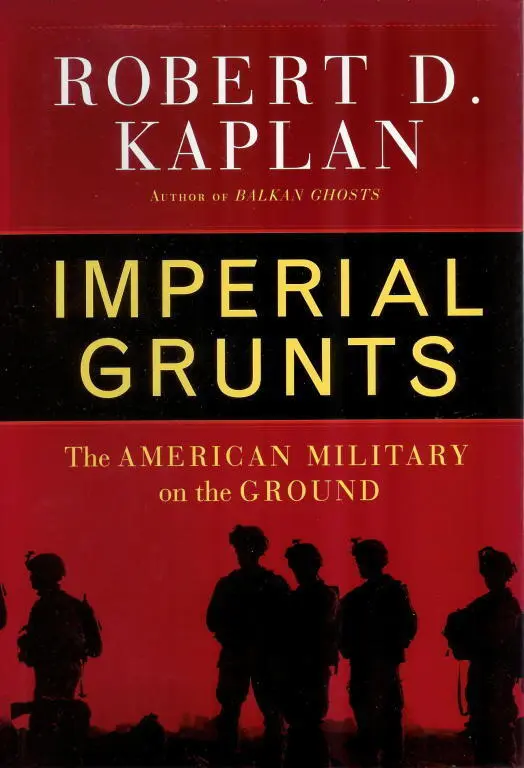
- Название:Imperial Grunts
- Автор:
- Издательство:Random House
- Жанр:
- Год:2005
- Город:New York
- ISBN:978-0-307-27850-0
- Рейтинг книги:5 / 5. Голосов: 1
-
Избранное:Добавить в избранное
- Отзывы:
-
Ваша оценка:
Imperial Grunts: краткое содержание, описание и аннотация
Предлагаем к чтению аннотацию, описание, краткое содержание или предисловие (зависит от того, что написал сам автор книги «Imperial Grunts»). Если вы не нашли необходимую информацию о книге — напишите в комментариях, мы постараемся отыскать её.
Imperial Grunts — читать онлайн бесплатно полную книгу (весь текст) целиком
Ниже представлен текст книги, разбитый по страницам. Система сохранения места последней прочитанной страницы, позволяет с удобством читать онлайн бесплатно книгу «Imperial Grunts», без необходимости каждый раз заново искать на чём Вы остановились. Поставьте закладку, и сможете в любой момент перейти на страницу, на которой закончили чтение.
Интервал:
Закладка:
I concluded that the deployment of Special Forces to train host country troops in Arauca was more of a political statement by the Bush administration in support of President Uribe than it was a substantive attempt to break the back of decades of guerrilla control in this scraggly back-of-beyond.
I found a bunk beside two Army civil affairs specialists who were here to jump-start various education and health programs: Maj. Mike Oliver of Derby, Connecticut, and Capt. Carl Brosky of Plant City, Florida. Brosky had served in Bosnia and Rwanda. He had dark hair and a permanent introspective manner. He told me about families digging up the graves of loved ones in Bosnia following the Dayton Peace Accords and moving them to places where they wouldn’t be mutilated by people from a hostile ethnic group returning to the area. In Rwanda he had been in charge of water purification for a refugee encampment. He spoke softly about how he had watched a family of five come to the yard outside his office to die, because they knew that a truck would properly transport their bodies to a gravesite. They were on the verge of death by starvation, he said, and “they knew—just knew—they were all going to die. When the town was covered by mud from a volcano it was the best thing that ever happened to it.” Like other soldiers I had met who spoke the truth, he did not mean it cynically. He just didn’t know how to dissemble for the sake of making a proper impression on a stranger. His blunt honesty left him with stores of idealism for the work he was doing.
He and Maj. Oliver had books strewn all over their bunks. They said that civil affairs in the U.S. military really had its origins during the Mexican War with Gen. Winfield Scott. I started reading a book they gave me on the subject, but was so tired I fell asleep on the pages.
After years of drifting through lonely hotel rooms, I found barracks life a pleasure. You could leave your valuables about and not worry about locking your room, since everything was safe with these guys. They were not rambunctious young recruits. They were married, had families, and some of their wild years were behind them: you had to have served in the regular Army before you could even apply for Special Operations. Camaraderie was a constant. Like a family, someone was always willing to help you or lend you what you needed. If you wanted company, there was always somebody to talk to. If you were bored, there was always a DVD to watch on one of the laptops. If you wanted to be left alone to read or write, people always gave you your space.
The town of Saravena was even more violent than Arauca; thus the most violent in the country. The very extremity of the situation granted further insights into what the Green Berets could and could not accomplish.
It lies only seventy miles to the west, along the border. But as this was Injun Country, we flew. A half hour later I was on the tarmac in Saravena, greeted by Capt. Gil Ferguson of Jackson, Mississippi. The first thing he did was point out to me the remains of the terminal building blown up by guerrillas the previous summer with four cylinder bombs. A 40-pound empty propane gas cylinder, he explained, would be slipped inside a 120-pound one to serve as the mortar launcher. The 40-pound cylinder would then be stuffed with standard explosives—in addition to bits of nails, screws, scrap metal, broken glass, and human feces—and fired out of the 120-pound cylinder with a gunpowder charge. The rampa, as Colombians called it, could hit a target three thousand meters away. The broken glass was forbidden by the Geneva Convention.
Saravena was so violent that the Green Berets never left the base here. “I’ve been here for months and I have never seen the town of Saravena,” Capt. Ferguson said. The sandbags at the compound were piled higher than at Arauca; the strands of concertina wire were laid thicker. It was dustier and hotter here, too. Amplifying the claustrophobic atmosphere, the three dozen Green Berets and support staff were not even permitted under the rules of engagement to patrol the area beyond the base, known to be friendly to the insurgents and within the range of the rampas— for which the compound’s corrugated roof provided little protection.
“The ELN and the FARC are too smart to fight us,” Master Sgt. Jose Cabrera told me, shaking his head. “If they want to kill us, they’ll just use cylinder bombs.”
“It’s like Iwo Jima,” Duke Christie observed, “no place to hide,” referring to the February 1945 battle on a bare volcanic island in the western Pacific where U.S. Marines were rained upon by Japanese shells.
Following the destruction of the Marine barracks in 1983 in Beirut, and of military apartments at Khobar Towers in Saudi Arabia in 1996, U.S. generals and civilian politicians needed a saying, I thought: Thou Shalt Not Be Sitting Ducks. American troops, particularly elite units, should never be concentrated in any place where they could not patrol the immediate environs aggressively. Yet that was the situation here. The current rules of engagement which limited the Green Berets to training details only might have placated the U.S. Congress and made for smooth bilateral relations with Colombia, but they were dumb tactics. And they were morally wrong, since they denied the troops the means of self-defense.
The first night here Duke spent several hours listening to complaints about the restricted rules. He allowed everybody to talk, letting himself get beaten up. Morale at Saravena was genuinely bad. The boredom was reflected in the long evening hours spent weight lifting; everybody joked that it was like prison. Saravena was the classic case of a deployment for the sake of political symbolism, in which the military logic had not been properly thought through.
“If they would just loosen the ROEs, give us the assets and some helicopter platforms, this whole guerrilla siege of Arauca Province would be over in six months,” Capt. Ferguson said. He wanted to do what he had been trained to do: fight, go into battle with the Colombian forces he was training. A graduate of the Air Force Academy, Gil Ferguson had switched over to the Army the moment he learned that he couldn’t be a fighter pilot. Once in the Army he gravitated to Special Forces. From Mississippi, he adored the New York City lingo of television’s Law & Order. His crony was his team sergeant, Master Sgt. Cabrera, a native of the Dominican Republic via New York City.
Jose Cabrera, forty-two, in the Army for twenty-two years, was the ultimate sergeant: the nucleus of the United States military and why it was so good. Cabrera had a refrigerator-thick build. He was street-smart, ambitious, intellectually curious, and proactive to the extent that he had practically developed his own little native intelligence service for Saravena run from inside the barracks. Trained as a combat diver, he was a veteran of America’s war against the Cali drug cartel, and also of Just Cause, the 1989 invasion of Panama to oust dictator Mañuel Noriega. Based in Cali in the 1980s, he worked in photographic intelligence. In Just Cause, his job was to interrogate pro-Noriega lawyers and policemen. He had also served in Ecuador, Peru, Bolivia, and Paraguay. Because of Sgt. Cabrera and others like him, SOUTHCOM was a model of the kind of linguistic and area expertise that all the area commands required in an age of imperial responsibilities.
Over a dinner of ham, fried rice, and Gatorade at the Colombian officers’ club, Cabrera summed up the local situation: “murder, extortion, blowing up power lines, and yet there is no opposition, no sign of a communal spirit. People struggle only to survive or to reach the next rung, where they can skim too. There are better places to grow coca,” he went on; “the ELN is here in such numbers only because of the oil.” Oil had not brought development but terrorism.
Читать дальшеИнтервал:
Закладка:
Похожие книги на «Imperial Grunts»
Представляем Вашему вниманию похожие книги на «Imperial Grunts» списком для выбора. Мы отобрали схожую по названию и смыслу литературу в надежде предоставить читателям больше вариантов отыскать новые, интересные, ещё непрочитанные произведения.





Обсуждение, отзывы о книге «Imperial Grunts» и просто собственные мнения читателей. Оставьте ваши комментарии, напишите, что Вы думаете о произведении, его смысле или главных героях. Укажите что конкретно понравилось, а что нет, и почему Вы так считаете.