Robert Kaplan - Imperial Grunts
Здесь есть возможность читать онлайн «Robert Kaplan - Imperial Grunts» весь текст электронной книги совершенно бесплатно (целиком полную версию без сокращений). В некоторых случаях можно слушать аудио, скачать через торрент в формате fb2 и присутствует краткое содержание. Город: New York, Год выпуска: 2005, ISBN: 2005, Издательство: Random House, Жанр: Публицистика, nonf_military, на английском языке. Описание произведения, (предисловие) а так же отзывы посетителей доступны на портале библиотеки ЛибКат.
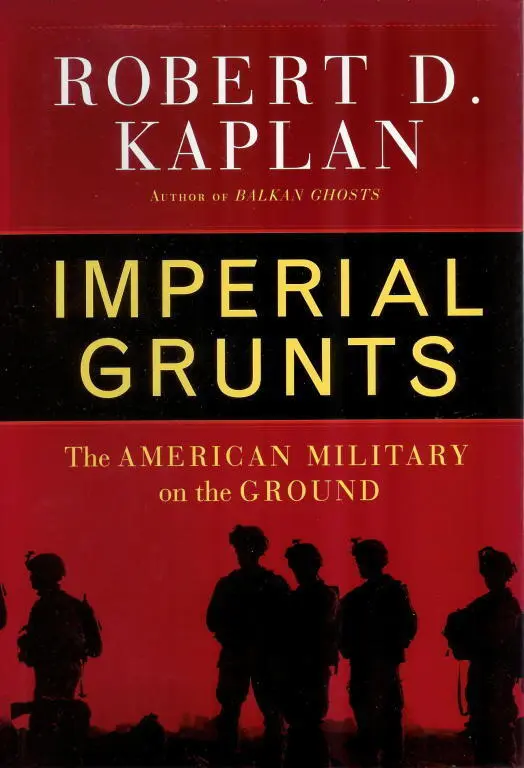
- Название:Imperial Grunts
- Автор:
- Издательство:Random House
- Жанр:
- Год:2005
- Город:New York
- ISBN:978-0-307-27850-0
- Рейтинг книги:5 / 5. Голосов: 1
-
Избранное:Добавить в избранное
- Отзывы:
-
Ваша оценка:
Imperial Grunts: краткое содержание, описание и аннотация
Предлагаем к чтению аннотацию, описание, краткое содержание или предисловие (зависит от того, что написал сам автор книги «Imperial Grunts»). Если вы не нашли необходимую информацию о книге — напишите в комментариях, мы постараемся отыскать её.
Imperial Grunts — читать онлайн бесплатно полную книгу (весь текст) целиком
Ниже представлен текст книги, разбитый по страницам. Система сохранения места последней прочитанной страницы, позволяет с удобством читать онлайн бесплатно книгу «Imperial Grunts», без необходимости каждый раз заново искать на чём Вы остановились. Поставьте закладку, и сможете в любой момент перейти на страницу, на которой закончили чтение.
Интервал:
Закладка:
Just over the treetops now, shacks and sagging clotheslines gave way to rutted roads in dry, reddish savanna. Maj. William “Bill” White, commander of five Special Forces detachments in the towns of Arauca and Saravena, met us at plane-side flanked by Green Berets in Kevlar and full kit, inside a Humvee that was fitted with a mounted MK-19 40mm grenade launcher. [20] “Humvee” is, in fact, another acronym: high mobility multi-wheeled vehicle.
As I stepped off the tarmac, two Colombian soldiers, badly wounded in a car bomb detonated the hour before in nearby Arauquita, in which the explosive device was coated with human feces to cause further infection, were being carried off a Russian-made Mi-17 helicopter on stretchers. They were taken to an infirmary where one of Maj. White’s Special Forces medics was waiting to treat them. Half of their bodies were caked with blood. The day before in Arauca, White informed me, the Colombian police had managed to deactivate two other bombs. The day before that there had been an assassination attempt on a local politician. The day before that an electricity tower was bombed, knocking out power in the region. Going back more days in Arauca Province there had been the usual drumroll of roadside kidnappings, street-corner bicycle bombs, grenade strikes on police stations, and mortar attacks against Colombian soldiers with propane cylinders packed with nails, broken glass, and feces. White had prepared a list of violent incidents over the past thirty days in the province. It was single-spaced and ran more than two pages.
Maj. Bill White, thirty-seven, was an Army brat who had grown up in Fayetteville, North Carolina, next to Fort Bragg. His sense of humor was as dry and pale as his complexion. “I don’t look a day over forty,” he quipped.
The journey from the airstrip to the army base was only a few hundred yards along a public road. So were the Kevlar, Humvee, and mounted gun really necessary? I asked. “Yes,” White said, staring intently at the road. The tension here was noticeably higher than at Larandia.
Near the Green Beret compound we passed two young men being led away in handcuffs. They were the ELN operatives accused of setting off the car bomb in Arauquita by remote control with a cell phone. They smirked like real punks. Next in my line of sight came the Colombian army barracks, with its concrete trench used for washing clothes and mess kits, and for pissing and shitting. A medic described the Colombian troops inside as “nice little soldiers full of parasites, fungus, and jock itch.”
The Green Beret compound was hidden behind three layers of black sandbag walls and concertina wire. An entire shipping container was used to store ammo. Special Forces was ready for a siege. Maj. White brought
me to a baking-hot corner of the barracks where he had a laptop and blank wall arranged for a PowerPoint briefing. “I keep it real hot in here,” he joked; “that way you’ll ask fewer questions and we’ll get through this thing faster.” I thanked him for his consideration. I had seen the same PowerPoint briefing about Arauca twice already, at Fort Bragg and at SOUTHCOM in Miami.
Still, he had some new information for me. The day before in Arauca forty people had been killed in action during a shoot-out between left- and right-wing paramilitaries. The FARC was moving back and forth across the border with help from the Venezuelan national guard. The oil spills from ELN satchel bombs had caused an ecological disaster, an issue that might have been better publicized in the U.S., because, as one Green Beret deadpanned, “You can bet that people back home will get more upset about despoiling the environment than about Colombians being shot and tortured.”
Disgust about Colombian democracy and human rights laws, which made it particularly hard to prosecute car bombers and other narcoterrorists, was greater here than at the other Green Beret compounds. “The FARC has an intelligence operation one block from the police station in Arauca town,” Maj. White explained, “but the intelligence gathered by the police against the FARC is still insufficient for a court-ordered phone tap. Meanwhile, the mayor’s been killed, the airfield’s been bombed, and the governor’s personal assistant has been assassinated. My Colombian counterpart whose troops we’re training,” White continued, “doesn’t want to know more than two hours in advance about our plans for visiting the airfield or the town, since he doesn’t trust his own staff not to leak it to the FARC. Come on, let’s go see the town.”
“Yeah,” I responded. All the briefings in the world were not as revealing as the indefinable essences gleaned from visual contact.
Under vast skies and pummeling mid-afternoon heat, the armored car and Humvee equipped with a mounted gun rolled through the town of Arauca, a desultory, low-level gridwork of scrap iron and red-tiled roofs, blotched walls, cafés with molded plastic chairs, and awnings made of the same plastic material used for garbage bags. The few decent-looking dwellings had iron grates over the doors and windows. Weeds, garbage, and rusted shacks mixed with flowers, agaves, and sagging banana leaves. Sidewalks disappeared into scraggly bush. I saw half-naked people with unreadable expressions wearing thongs and baseball caps.
Every parked car and bicycle looked deadly. The steel armored doors, Kevlar, and weaponry offered some protection. But they were also a pretense. The enemy was invisible and could incinerate us at any moment. The only defense in this terrorist environment was offense, which the restrictive rules of engagement forbade. After a truck had unexpectedly pulled out into the street, slowing our convoy, causing us to scan the rooftops and parked vehicles, and causing me to sweat more than usual in the fetid climate, Duke Christie remarked, “If five firemen get killed fighting a fire, what do you do? Let the building burn? I wish people in Washington would totally get Vietnam out of their system.” Translation: he and his men were willing to take quite a few casualties in Colombia to defeat the narco-terrorists; it was the politicians who were afraid of casualties, not the American military.
Lifting his eyes on this ratty hellhole of a town, Maj. White asked rhetorically, “Where has all the oil money gone? Tell me. You see any signs of development here?”
Occidental Petroleum received 8 percent of the annual oil profits from the Arauca region, leaving 92 percent in Colombian hands. That 92 percent, assuming honest administration, should have been $30 million annually. Even in 2001, when the pipeline was shut down for two hundred days because of sabotage, there still should have been enough millions in profits “to build a brand-new town,” White calculated in his dry and laconic way.
For generations, the wealthy urban sophisticates in the highlands had barely been aware of this malarial outback. “If you lived here, you’d be ELN or FARC, too,” another Special Forces officer remarked. “That is, if they didn’t rape, murder, and extort money from you, and from the local authorities. The truth,” he went on, “is that everyone here is just scared. Everyone thinks the government will eventually give up and leave the area back in the hands of the rebels.”
Our convoy reached the Arauca River at the edge of town, one of those unhappy, bile-colored, sluggish rivers so common in the third world. The collapsed mud banks were partially supported by sandbags. Venezuela lay on the other side a hundred feet away, where there were more weeds, clotheslines, and scrap iron hutments. Officially there was a border here; in fact, there was none. The narco-terrorists crossed easily, back and forth, getting help from Chavez.
Later I spoke with an American intelligence officer in the area. He worried that “the Colombian military was following America’s Vietnam strategy: building up troop levels while avoiding risk. The Colombian army, police, air force all think Black Hawk helicopters are the answer to everything,” he went on; “that’s the way we used to think. They’re not sufficiently improving their noncommissioned officer class, while their generals are content to play it safe. Thus, little happens. In Peru, [Alberto] Fujimori told his generals that they couldn’t retire until the war with the Shining Path [terrorists] was won. Here Uribe talks tough, but you don’t see the follow-through in the field with aggressive, small unit tactics like you did in Peru.”
Читать дальшеИнтервал:
Закладка:
Похожие книги на «Imperial Grunts»
Представляем Вашему вниманию похожие книги на «Imperial Grunts» списком для выбора. Мы отобрали схожую по названию и смыслу литературу в надежде предоставить читателям больше вариантов отыскать новые, интересные, ещё непрочитанные произведения.



Обсуждение, отзывы о книге «Imperial Grunts» и просто собственные мнения читателей. Оставьте ваши комментарии, напишите, что Вы думаете о произведении, его смысле или главных героях. Укажите что конкретно понравилось, а что нет, и почему Вы так считаете.