Robert Kaplan - Imperial Grunts
Здесь есть возможность читать онлайн «Robert Kaplan - Imperial Grunts» весь текст электронной книги совершенно бесплатно (целиком полную версию без сокращений). В некоторых случаях можно слушать аудио, скачать через торрент в формате fb2 и присутствует краткое содержание. Город: New York, Год выпуска: 2005, ISBN: 2005, Издательство: Random House, Жанр: Публицистика, nonf_military, на английском языке. Описание произведения, (предисловие) а так же отзывы посетителей доступны на портале библиотеки ЛибКат.
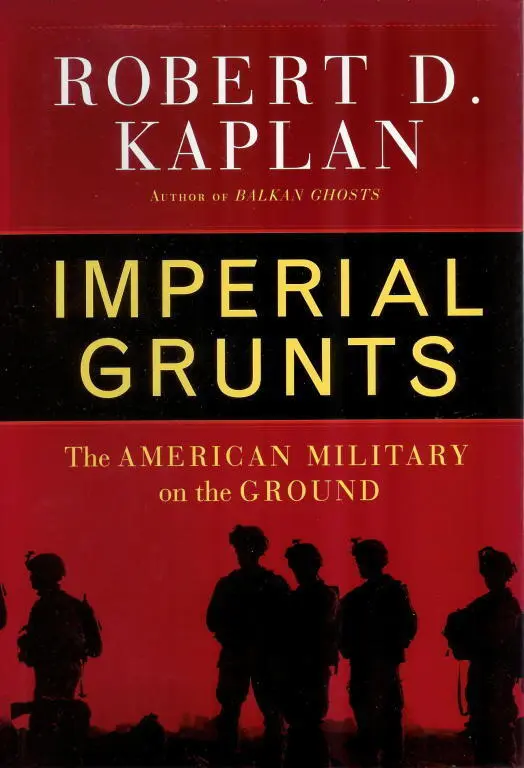
- Название:Imperial Grunts
- Автор:
- Издательство:Random House
- Жанр:
- Год:2005
- Город:New York
- ISBN:978-0-307-27850-0
- Рейтинг книги:5 / 5. Голосов: 1
-
Избранное:Добавить в избранное
- Отзывы:
-
Ваша оценка:
Imperial Grunts: краткое содержание, описание и аннотация
Предлагаем к чтению аннотацию, описание, краткое содержание или предисловие (зависит от того, что написал сам автор книги «Imperial Grunts»). Если вы не нашли необходимую информацию о книге — напишите в комментариях, мы постараемся отыскать её.
Imperial Grunts — читать онлайн бесплатно полную книгу (весь текст) целиком
Ниже представлен текст книги, разбитый по страницам. Система сохранения места последней прочитанной страницы, позволяет с удобством читать онлайн бесплатно книгу «Imperial Grunts», без необходимости каждый раз заново искать на чём Вы остановились. Поставьте закладку, и сможете в любой момент перейти на страницу, на которой закончили чтение.
Интервал:
Закладка:
At 7 p.m. that night the bureaucratic process restarted, with a “warning order” for the next day, followed by a “plan” at 9 p.m., a “written order” at 12:30 a.m. February 14, an “op order” at 5 a.m., and an “up-top intel update” at 6:10. This was all before Maj. Roberts’s classified brief that morning which I had been barred from attending. Finally, at 10:45 a.m. they were boarding the helicopter to go to the crash site, where they established a 360-degree security perimeter while the ATF team inspected the equipment on board the Cessna, which, it turned out, had been sufficiently destroyed by the crew members before their capture. Photos of the “crime scene” also had to be taken for use by the FBI and Colombian prosecutor’s office. Everyone thought that the designation of a war zone as a civilian “crime scene” was quixotic. For years such legal fictions had tied the Colombian government in knots in its war against narco-terrorists.
“What was the terrain like?” I asked.
“Pothole heaven,” Sgt. Perez said. “You move only in a zigzag, sixty-degree inclines all over, no shade. Great guerrilla country. But here is what the higher-ups miss, for the same reason it’s great anti-guerrilla country. A half dozen SF guys, fluent in Spanish, traveling load-lite, living off the land, with good comms and helicopter locations for infil and exfil, and we’d find out a lot more in a few days than a whole battalion clunking around.”
Braun, Perez, and Wynn were three well-spoken men with tattoos, guns, and serious reading material all over their hootch: Braun had been dipping into the complete works of James Fenimore Cooper. Wynn, though frustrated by the timid military-diplomatic policy of the previous days, nevertheless told me that “everyone has his place and I accept mine. I’m just happy being a sergeant. What do I know?” His tone was truly humble.
I was beginning to love these guys. They had amassed so much technical knowledge about so many things at such a young age. They could perform minor surgery on the spot. Yet each had such a reduced sense of self compared to everyone I knew in the media and public policy worlds. In the barracks, egotism was expressed purely in terms of team pride. [19] See David Brooks’s insightful commentary about the reduced sense of self in the part of America that voted for George Bush in the 2000 election: “One Nation, Slightly Divisible,” The Atlantic Monthly, December 2001, p. 63.
Here hierarchy and authority were looked upon as supreme virtues, giving each officer and noncom a role and a function in a noble cause. Everybody had read Stephen Ambrose’s Band of Brothers, and related more to the World War II paratroopers in the story than to their contemporaries in civilian life. 24
By mid-morning, the mood at the base had subtly shifted from an emergency to a long-haul operation. I hitched a ride back to Bogotá with Brig. Gen. Remo Butler on the Casa 212. Brig. Gen. Butler, an African-American, was a huge, gregarious, delightfully profane man. “I helped approve your trip down here,” he told me, “but I had no idea who you were!” Thank God for the majors on his staff, I thought.
I had an embarrassing moment on the flight back. In Larandia, before taking off, I had drunk a lot of water because of the heat, and suddenly at fourteen thousand feet with my body fast cooling I desperately needed to urinate. There were no facilities.
I spoke to the pilot. He said, “No problem, I’ll open the hatch, piss out the back.”
“Are you kidding? I’ll get sucked out.”
“You’ve been watching too many movies, man. This plane isn’t pressurized; you won’t get sucked out. I’ll open the hatch.”
I wasn’t brave enough. I took a discarded mineral water container and used that, capped it, and flung it out. The pilot counted a few seconds and said, “It must be frozen by now at this altitude.” A projectile of frozen piss falling over FARC country. Gen. Butler laughed.
A few days later I was back at fifteen thousand feet in the unpressurized Casa. Duke and I were headed northeast to Arauca Province, on Colombia’s border with Venezuela. Arauca, the size of New Hampshire, was the most violent region of Colombia, the heart of Injun Country. America’s imperial destiny was to grapple with countries that weren’t really countries. No place in Colombia, and few places in the world, illustrated that as much as Arauca, where the Green Berets had several teams deployed.
In Arauca Province three generations of people had grown up loyal to the insurgents. Kidnappings and car bombings occurred on a daily basis. There were twelve thousand hectares of coca fields set to be targeted by the counter-drug program. Big oil was here: Occidental Petroleum had a pipeline from Arauca northwest to the Caribbean, which was frequently attacked by terrorists. Arauca boasted a strategic location abutting Venezuela, where the radical-populist (yet democratically elected) president, the ex–Army general Hugo Chavez, was providing Colombian guerrillas with rear bases. Control of Arauca gave the Colombian guerrillas a corridor for exporting narcotics to Venezuela, in exchange for weapons and munitions that, in turn, were smuggled into the region by Arab gangs based in the Venezuelan port of Maracaibo. 25There were credible reports that Hamas and Hezbollah had established havens on the Venezuelan island of Margarita near Caracas. 26Venezuelan authorities were providing thousands of local identity cards to Syrians, Egyptians, and Pakistanis. 27
A supporter of Fidel Castro in Cuba and Saddam Hussein in Iraq, Venezuelan president Chavez had fingerprints all over the narco-terrorist operation in South America. U.S. intelligence found that the small GPS systems carried by FARC gunrunners constantly indicated positions inside Venezuela. With help from Venezuela, the ELN narco-terrorists had learned how to sabotage the oil pipeline with satchel bombs.
The stakes for the U.S. were high. It was getting 34 percent of its oil imports from Venezuela, more than from the entire Middle East. The economic threat posed by Chavez was, to a degree, more important and more insidious than that posed by radical regimes in the Arab world. Chavez had an interest in FARC and ELN attacks on Colombian oil installations, since it made the U.S. even more dependent on Venezuelan oil.
In late 2002 the Bush administration had dispatched several Special Forces A-teams to the border towns of Arauca and Saravena, where President Uribe was building new police stations to be patrolled by forty-six-man units, also trained by American Special Forces. Uribe had targeted the whole province as a “rehabilitation” zone, to be pacified and governed directly from Bogotá. Arauca symbolized how the counter-drug war had, following September 11, been transformed into a regional war for governance. And it wasn’t just the Venezuelan border area that required help; the FARC was also importing arms and precursor chemicals, and exporting drugs, over the Brazilian and Peruvian borders.
Descending through the clouds I saw a pool-table-flat lesion of broadleaf thickets, scrap iron settlements, and gravy-brown rivers. There was something frightening and uncharted about Arauca. As a young traveler in the 1970s in Cairo, I had met an American couple my own age who had recently arrived in the Middle East by cargo ship from South America. They had hitchhiked and taken buses all the way down through Central America into Colombia, and then continued by road into Ecuador, Peru, Bolivia, and Argentina, before boarding a ship in Buenos Aires. It had been grueling and adventurous, but not suicidal, as such a trip would be today along significant parts of the same route. I myself had just been in Yemen, which was far more dangerous to travel through now than it was when I first visited there in the mid-1980s. For those who rarely ventured beyond the cocoon of the post-industrial Western democracies, the world was liberalizing and becoming more convenient. But many parts of the planet had become more dangerous and out of reach.
Читать дальшеИнтервал:
Закладка:
Похожие книги на «Imperial Grunts»
Представляем Вашему вниманию похожие книги на «Imperial Grunts» списком для выбора. Мы отобрали схожую по названию и смыслу литературу в надежде предоставить читателям больше вариантов отыскать новые, интересные, ещё непрочитанные произведения.


Обсуждение, отзывы о книге «Imperial Grunts» и просто собственные мнения читателей. Оставьте ваши комментарии, напишите, что Вы думаете о произведении, его смысле или главных героях. Укажите что конкретно понравилось, а что нет, и почему Вы так считаете.