Robert Kaplan - Imperial Grunts
Здесь есть возможность читать онлайн «Robert Kaplan - Imperial Grunts» весь текст электронной книги совершенно бесплатно (целиком полную версию без сокращений). В некоторых случаях можно слушать аудио, скачать через торрент в формате fb2 и присутствует краткое содержание. Город: New York, Год выпуска: 2005, ISBN: 2005, Издательство: Random House, Жанр: Публицистика, nonf_military, на английском языке. Описание произведения, (предисловие) а так же отзывы посетителей доступны на портале библиотеки ЛибКат.
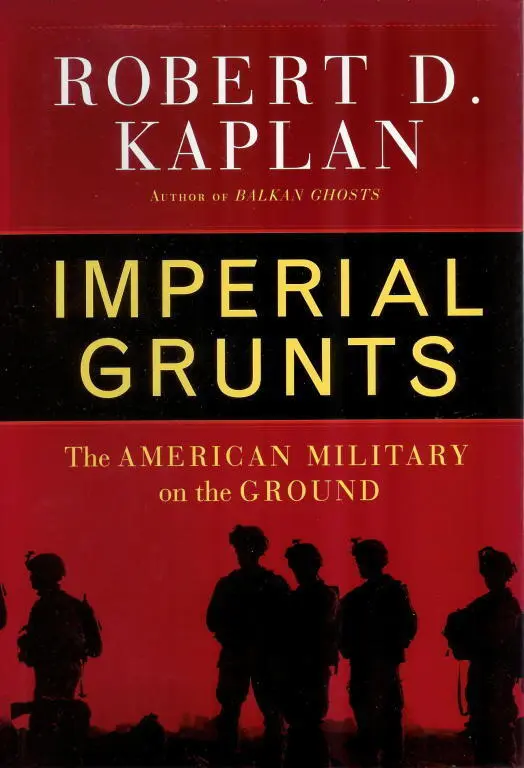
- Название:Imperial Grunts
- Автор:
- Издательство:Random House
- Жанр:
- Год:2005
- Город:New York
- ISBN:978-0-307-27850-0
- Рейтинг книги:5 / 5. Голосов: 1
-
Избранное:Добавить в избранное
- Отзывы:
-
Ваша оценка:
Imperial Grunts: краткое содержание, описание и аннотация
Предлагаем к чтению аннотацию, описание, краткое содержание или предисловие (зависит от того, что написал сам автор книги «Imperial Grunts»). Если вы не нашли необходимую информацию о книге — напишите в комментариях, мы постараемся отыскать её.
Imperial Grunts — читать онлайн бесплатно полную книгу (весь текст) целиком
Ниже представлен текст книги, разбитый по страницам. Система сохранения места последней прочитанной страницы, позволяет с удобством читать онлайн бесплатно книгу «Imperial Grunts», без необходимости каждый раз заново искать на чём Вы остановились. Поставьте закладку, и сможете в любой момент перейти на страницу, на которой закончили чтение.
Интервал:
Закладка:
I got a lift to the airfield. In the hangar an American flag had been hung in preparation for the arrival of the bodies. Amid the jigs and jack stands, I waited, along with a medic and some of the contractors, for the helicopters to return. The conversation drifted. I learned that the way you get a cow to jump out of a plane was simply to prod it, while a donkey required a halter; cows and donkeys had been regularly dumped out of planes to provide food for pro-American insurgents throughout the Cold War.
After an hour the helicopter that had gone to retrieve the bodies finally landed. The medic and one of the contractors pulled on purple gloves and went out to help the DynCorp rescue team load the two body bags onto “Israelis” and carry them, ducking under the rotors and out of the man-made wind into the hangar. Only one of the dead was American; the other was the lone Colombian crew member.
The medic broke open the first body bag. A 7.62mm AK-47 assault rifle bullet shot at the skull from such close range causes a hydrostatic explosive effect, which made the victim momentarily difficult for even a friend to identify. It was an execution. The dead contractor, Thomas Janis, fifty-six, of Montgomery, Alabama, had been the recipient of a Bronze Star for valor in Vietnam. He had a son and a step-grandson in Kuwait, both waiting to be deployed to Iraq. It emerged later that rather than run into the trees for cover, as he had instructed the others, he stayed behind to destroy the sensitive equipment on board; that’s where the FARC found him. Talk about making sacrifices for your country!
The other body was that of Luis Alcides Cruz, a noncommissioned Colombian intelligence officer based here in Caquetá Province. His body did not look as bad as Janis’s, though he might have suffered more. His neck was dislocated and a rifle bullet had gone through his back.
The previous morning, the Cessna, in the midst of mapping coca fields for eradication, had developed catastrophic engine trouble. The pilot, Thomas Janis, brilliantly glided the plane down to a belly flop at the edge of a ridge. Though only a few minutes’ flying time from Larandia, the small mapping team was in the midst of FARC territory. Janis and Cruz, to judge by the medic’s examination, had not been injured in the crash. There might have been a shoot-out with guerrillas, who saw the plane come down and rushed to the scene. The two men had been murdered and their bodies dumped in the first wooded area north of the crash site. The bullet in the back indicated that Cruz may have been trying to run away. The other three, all Americans, were taken hostage.
When news of the crash reached Bogotá, Lt. Col. Christie immediately mobilized the two ODAs in southern Colombia and ordered them to helicopter fields. But the rules of engagement did not permit A-teams to go on such a mission in enemy territory. Duke knew this. Yet, as he later told me, “Since we had an SF capability so close by, I wanted to give my superiors the option of changing the ROEs for this extraordinary circumstance.” Indeed, one of the teams, ODA-776, had been specifically trained for this type of search-and-rescue mission.
But twenty-four hours would go by before the two ODAs would get permission from the higher-ups to board the helicopters. In a hostage situation, akin to a kidnapping, the first twenty-four hours are crucial, particularly the first night following the abduction. It may be the only time when a rescue squad can effectively keep the perpetrators from moving their prey out of the vicinity. All the satellite and other high-tech surveillance that the Americans would subsequently bring to bear on the crisis would never make up for that original twenty-four-hour delay. The middle-level officers had been ready to move, but then “Washington” took over.
When I returned to ODB-780’s barracks that evening, thirty-six hours had gone by since the three had been taken hostage. Maj. Roberts observed reflectively, “By now you’ve got dehydration, heat exhaustion setting in, bug bites, it gets harder and harder for them. All the FARC needs is one terrain feature between it and its pursuers, and they’re safe in this environment.”
Roberts had just finished a huddle with his chief warrant officer, Terry Baltimore, a smooth and charismatic ball of fire who gave the demoralized B-team a pep talk.
“I know,” Baltimore began, “we were all packed, organized, up all night, and ready to assist the A-team secure the crash site. But the decision to disengage us, to keep us out of the op, and have the A-team wait until today to enter the field was taken above our pay level. I’m sulking with the best of them. But now we have to help the host nation plan to capture as many FARC as possible, so that we can interrogate them and find out where the three AMCITS [American citizens] are.
“COLAR is running the show,” he went on, “but it has done no force-to-force ratio analysis. The host nation had the initiative last night, but lost it and we did not go in until today. The host nation needs us to come up with options, to help them map out where the roadblocks should be, so that we can establish traffic patterns that can, in turn, help us determine where the FARC is concentrating its troops, and where the AMCITS might be. If we don’t start templating, we’ll miss the whole fucking puzzle.”
It was getting late and I needed a place to sleep. I was about to see if a bed was available in the B-team barracks when a big, friendly Green Beret came over and asked if I wanted to stay over in his hootch. “It’s more comfortable than here, if the air-conditioning works.” He was Capt. Mike “Mick” Braun of Wolcott, Connecticut. He had served in Bosnia and now led ODA-785, one of the A-teams that after a twenty-four-hour delay had finally got to the crash site. ODA-785’s specialty was combat diving, not out of place here; southern Colombia had more navigable river mileage than usable roads. Capt. Braun’s hootch had twelve guys packed on bunks in a small room, filled with drying towels and a jumble of charging computers and intra-squad radios. But the air-conditioning worked, and after opening my sleeping bag, I quickly fell unconscious.
Morning brought acquaintance with Capt. Braun’s two sidekicks, both sergeants first class: Juan Perez, a tall, mustachioed Cuban-American from Los Angeles who had a cigar in his mouth before his first cup of coffee; and Bo Wynn, an avid deer hunter originally from Tampa, Florida, who had tattoos of boats and barbed wire on his chest and gladly explained to me the workings of a Remington 7.62mm M-24 sniper rifle.
“We lost the initiative after we were made to stand down the first night,” a frustrated Sgt. Perez told me as I opened my eyes from a night’s sleep and grabbed my notebook. “We’re so afraid of getting our guys killed that we let ’em get captured.”
They told me the whole sad story of the previous two days. At 9:10 a.m. on February 13, soon after the Cessna Caravan had gone down, they got their “get ready” orders from Duke Christie’s forward operating base in Bogotá. They called their team in from training and quickly packed their webs, to be reinventoried at the B-team barracks: canteens, rehydration packets, bandages, compasses, flares, Chemlites, maps, intra-squad radios, GPS (Global Positioning System) units, 9mm and 5.56mm magazines, knives, Berettas, M-4s with grenade launchers, and 40mm grenades. Sgt. Bo Wynn would also carry a quickie saw for breaking down doors. At 10:10 a.m. they were at the airfield. They waited four hours in the hot sun for the execute order to board the helicopters. It never came. Then they were told to “stand down.”
Sgts. Perez and Wynn called it demoralizing and humiliating to be prevented from entering a combat zone in front of the very Colombian battalions they had been training.
Читать дальшеИнтервал:
Закладка:
Похожие книги на «Imperial Grunts»
Представляем Вашему вниманию похожие книги на «Imperial Grunts» списком для выбора. Мы отобрали схожую по названию и смыслу литературу в надежде предоставить читателям больше вариантов отыскать новые, интересные, ещё непрочитанные произведения.


Обсуждение, отзывы о книге «Imperial Grunts» и просто собственные мнения читателей. Оставьте ваши комментарии, напишите, что Вы думаете о произведении, его смысле или главных героях. Укажите что конкретно понравилось, а что нет, и почему Вы так считаете.