Robert Kaplan - Imperial Grunts
Здесь есть возможность читать онлайн «Robert Kaplan - Imperial Grunts» весь текст электронной книги совершенно бесплатно (целиком полную версию без сокращений). В некоторых случаях можно слушать аудио, скачать через торрент в формате fb2 и присутствует краткое содержание. Город: New York, Год выпуска: 2005, ISBN: 2005, Издательство: Random House, Жанр: Публицистика, nonf_military, на английском языке. Описание произведения, (предисловие) а так же отзывы посетителей доступны на портале библиотеки ЛибКат.
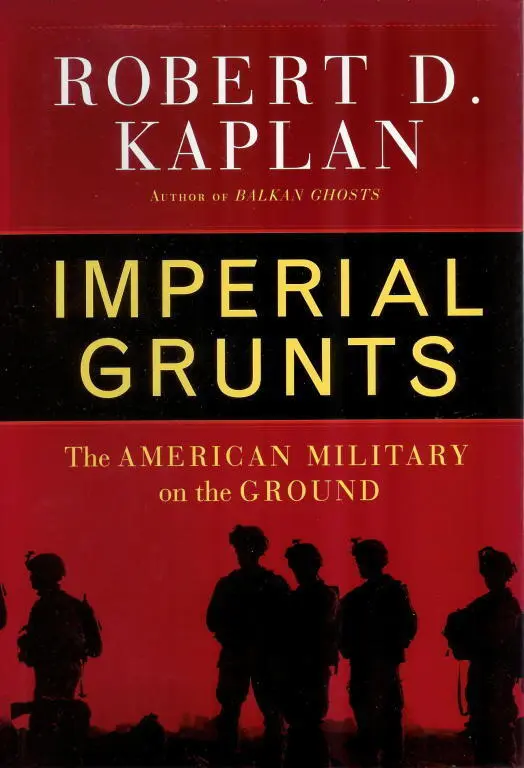
- Название:Imperial Grunts
- Автор:
- Издательство:Random House
- Жанр:
- Год:2005
- Город:New York
- ISBN:978-0-307-27850-0
- Рейтинг книги:5 / 5. Голосов: 1
-
Избранное:Добавить в избранное
- Отзывы:
-
Ваша оценка:
Imperial Grunts: краткое содержание, описание и аннотация
Предлагаем к чтению аннотацию, описание, краткое содержание или предисловие (зависит от того, что написал сам автор книги «Imperial Grunts»). Если вы не нашли необходимую информацию о книге — напишите в комментариях, мы постараемся отыскать её.
Imperial Grunts — читать онлайн бесплатно полную книгу (весь текст) целиком
Ниже представлен текст книги, разбитый по страницам. Система сохранения места последней прочитанной страницы, позволяет с удобством читать онлайн бесплатно книгу «Imperial Grunts», без необходимости каждый раз заново искать на чём Вы остановились. Поставьте закладку, и сможете в любой момент перейти на страницу, на которой закончили чтение.
Интервал:
Закладка:
• The professional ambition of Green Berets was to give battle, not merely to train others to do so. If their attitude was less aggressive than it was, they would not have volunteered for their jobs in the first place.
• They were selfless, a trait associated with a narrow field of vision. Like Master Sgt. Mike Fields, they lived for the particular technical task at hand, and were willing to die, provided there would be someone behind them to pick up the task where they had left off. Their favorite reading material was the Ranger Handbook.
• They hated routine. In Bosnia, the general staff was so timid of casualties that troops “couldn’t even take a crap at night inside the base perimeter without putting on full armor.” But as Duke explained, “If you’re never off duty, you’re never on duty,” because even heightened alert, as in Bosnia, gets dull. New and loosened ROEs for Colombia would break the routine.
• They were too young to have an active memory of Vietnam, so they were unburdened by it. They quietly disparaged older generals who were hesitant about loosening the ROEs, for fear of getting too deeply involved in a distant war. They knew that loosening the ROEs for Colombia, or adding a few more Green Berets, did not constitute sending half a million regular soldiers into harm’s way, as in Vietnam.
• Because their only experience with power had been with the American version of it in the last days of the Cold War, and in the post–Cold War and post–September 11 eras, they saw American power as incorruptible. They could not understand why American power was not applied more often and more vigorously. The motto of Special Forces was “De Oppresso Liber,” To Liberate the Oppressed.
• As captains, chief warrant officers, and sergeants, they thought tactically, not strategically. Tactically, it made sense to loosen the ROEs. Strategically, it might have caused political and legal problems with the host country, overshadowing the tactical benefits.
The best example of how military tactical thinking in Colombia differed from diplomatic and legal thinking had to do with the murderous right-wing paramilitaries. The paramilitaries were narco-terrorists, the same as the leftist FARC and ELN. Numbering some ten thousand, they controlled 40 percent of the coca-growing regions and killed people with electric saws at roadblocks. But tactically speaking, it made sense for the Colombian government to align itself with the right against the left; then, after the left had been defeated, or forced to negotiate, to roll the paramilitaries into the regular army, where they could be professionalized. The strategy had worked to a degree in El Salvador. “The paramilitaries are bad guys, but they’re good bad guys,” one Green Beret explained. “That’s why Espinal is safe. It’s why you can go to the restaurants and stay at a local hotel rather than be restricted to the base: because the town is run by the AUC [Autodefensas Unidas de Colombia],” the paramilitaries.
The war against the guerrillas was in its thirty-eighth year. Colombia’s agony went on and on. If aligning with one group of thugs to defeat another group of thugs would end the bloodshed and kidnappings sooner, how was that not virtuous? Diplomats and generals thought too often in abstractions; noncoms and middle-ranking officers saw truths on the ground.
Back in Bogotá, I learned that a single-prop Cessna 208 Caravan with four American contractors and one Colombian aboard had developed engine trouble over southern Colombia. It had been forced to crash-land in a FARC area, where at least two of the five passengers had been shot dead. The plane was on a surveillance mission for the State Department’s counter-drug program, mapping out coca fields for future spraying and eradication. It was equipped with sensitive electronic equipment. A Special Forces A-team stationed at Larandia, a Colombian army base fifteen minutes by helicopter from the crash site, had been put on alert; so had another A-team in the vicinity which specialized in search-and-rescue operations. The American major who commanded the two detachments in southern Colombia—and who, by coincidence, happened to be in Bogotá for the day—agreed to take me down there with him the next morning, February 14.
At a secluded section of the airport in Bogotá, I met quite a rogues’ gallery. There would be eight of us on the ninety-minute flight south to Larandia: FBI; ATF (Alcohol, Tobacco, and Firearms), a private defense contractor, a fellow from the intelligence community, a Special Forces medic, and my new traveling companion, Special Forces Maj. John Paul “J. P.” Roberts. All except for the medic were in civilian clothes; everyone except me and the contractor was packing either an M-4 or a 9mm pistol. The medic brought along extra body bags. The ATF guy, a long-haired Navy veteran who had fought in Desert Storm and had a Beretta strapped under his shoulder, told me that it would be his job to inspect the downed plane: to assess whether the crew had been able to destroy the equipment with thermite grenades before they were captured and killed.
As we waited to board, there was much anger regarding the FARC and the feeble policy against it. “They’re a bunch of sadistic, crazed, chickenshit motherfuckers,” one of my fellow passengers told me. “It’s what you get when you marry Colombian energy and ambition to ideology and coke profits.” “You can’t give in; the only sane policy is to kill these guys,” said another.
“That fucker Pastrana!” yet another exclaimed, referring to former Colombian president Andres Pastrana, who had compromised with the FARC and ELN, giving them safe havens that they had used to build criminal mini-states, from where they conquered more territory. For example, there was the “Ho Chi Minh Trail,” a two-lane highway laid by the FARC under the cover of a jungle canopy in the coca-growing breadbasket of Putumayo near Ecuador, lined with military bases, discos, schools, playgrounds, hospitals, and so forth for the guerrilla troops and their families.
The propellers of our CASA 212, owned by Evergreen Corporation, another U.S. government contractor, whirred up and we all inserted earplugs. I eyed the small oxygen tank next to me. We’d be flying close to sixteen thousand feet and the cabin was unpressurized. We bumped upward through gnarled and heavily bearded peaks the shimmering, spellbinding green of moss and emeralds. As we edged south, the chaos of hillsides became so unreal in their greenery that I thought of the serrated backsides of iguanas. Colombia was like the earth on the third day of Creation, primitive and untamed, bubbling and spewing smoke, with dense forests and jungle quiltworks. The bird and insect life was the most prodigious in the hemisphere, save for Brazil.
Colombia is the size of the entire southeastern quadrant of the U.S. God could not have designed a better landscape for anarchy and guerrilla outlaws, or a more malignant one for strong, central government: a “Paradise of snakes,” as Joseph Conrad puts it. 17Whereas Mexico and Chile had been mastered by central valleys surrounding their capitals, and whereas the capital cities of Venezuela, Uruguay, and Argentina had become commanding nodes of economic power in their respective countries, Colombia, since pre-Columbian times, “has had no naturally centralizing topographic feature.” 18The capital, Bogotá, was never able to dominate such cities as Medellín, Cali, and Cartagena, separated from each other by wilderness badlands and towering cordilleras, as the Andes split apart at their northern extremity.
From its inception, Colombia was always too big and too small. The Spanish conquest reified topographical divisions, with different groups of conquistadors coming north from Peru and south from Panama, and establishing themselves on different sides of the cordilleras. The urban concentrations in the cool and easily defended highlands had little need of each other; nor did the inhabitants of these cities in the mountains have the possibility or incentive to develop the seemingly impenetrable jungle lowlands split by the tributaries of the Amazon and Orinoco. As late as 1911, the Encyclopaedia Britannica could still write, “The larger part of this territory is unexplored, except along the principal rivers, and is inhabited by scattered tribes of Indians.” At the turn of the twentieth century, Bogotá was harder to reach than just about any other capital city in the world.
Читать дальшеИнтервал:
Закладка:
Похожие книги на «Imperial Grunts»
Представляем Вашему вниманию похожие книги на «Imperial Grunts» списком для выбора. Мы отобрали схожую по названию и смыслу литературу в надежде предоставить читателям больше вариантов отыскать новые, интересные, ещё непрочитанные произведения.




Обсуждение, отзывы о книге «Imperial Grunts» и просто собственные мнения читателей. Оставьте ваши комментарии, напишите, что Вы думаете о произведении, его смысле или главных героях. Укажите что конкретно понравилось, а что нет, и почему Вы так считаете.