Robert Kaplan - Imperial Grunts
Здесь есть возможность читать онлайн «Robert Kaplan - Imperial Grunts» весь текст электронной книги совершенно бесплатно (целиком полную версию без сокращений). В некоторых случаях можно слушать аудио, скачать через торрент в формате fb2 и присутствует краткое содержание. Город: New York, Год выпуска: 2005, ISBN: 2005, Издательство: Random House, Жанр: Публицистика, nonf_military, на английском языке. Описание произведения, (предисловие) а так же отзывы посетителей доступны на портале библиотеки ЛибКат.
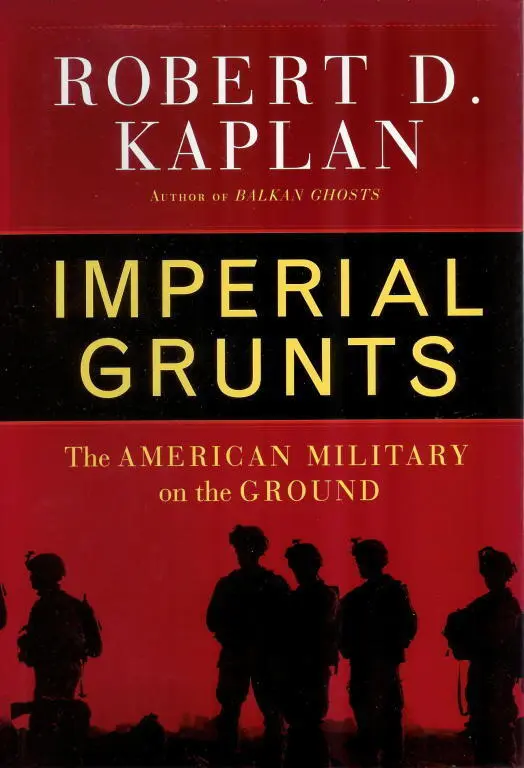
- Название:Imperial Grunts
- Автор:
- Издательство:Random House
- Жанр:
- Год:2005
- Город:New York
- ISBN:978-0-307-27850-0
- Рейтинг книги:5 / 5. Голосов: 1
-
Избранное:Добавить в избранное
- Отзывы:
-
Ваша оценка:
Imperial Grunts: краткое содержание, описание и аннотация
Предлагаем к чтению аннотацию, описание, краткое содержание или предисловие (зависит от того, что написал сам автор книги «Imperial Grunts»). Если вы не нашли необходимую информацию о книге — напишите в комментариях, мы постараемся отыскать её.
Imperial Grunts — читать онлайн бесплатно полную книгу (весь текст) целиком
Ниже представлен текст книги, разбитый по страницам. Система сохранения места последней прочитанной страницы, позволяет с удобством читать онлайн бесплатно книгу «Imperial Grunts», без необходимости каждый раз заново искать на чём Вы остановились. Поставьте закладку, и сможете в любой момент перейти на страницу, на которой закончили чтение.
Интервал:
Закладка:
Espinal, half an hour by car away from Tolemaida, is a gridwork of corrugated iron huts and modular living units resembling shipping containers. It is the home of the Carabineros, the police units of Colombia’s Defense Ministry, and of their counter-narcotics jungle fighters, known as junglas. In many developing countries the police have a full-fledged war-fighting capability. It sounds sinister, conjuring up the very image of a South American police state. But there were times in the 1990s when Colombia’s police enjoyed a more liberal reputation than its civilian government, tainted as it was by drug-financed campaign contributions.
In any case, chameleon-type units that merged army and police functions were the wave of the future in a world of unconventional, low-intensity conflict. The junglas —the police equivalent of the Lanceros—were particularly well regarded. They had better noncommissioned officers than Colombia’s army, and were able to do certain types of assaults better than the army could, such as rappelling from helicopters. Officially, the junglas were merely a counter-drug force. But because the U.S. was now fighting terrorism with drug war money, it had become the job of another Special Forces A-team, ODA-784, to train the junglas.
ODA-784 was commanded by Capt. Jim O’Brien of Portland, Maine. Jim O’Brien, a West Point graduate in his late twenties, was broad-chested with a shock of red hair and a big eager smile. He positively oozed enthusiasm. He looked like the all-American kid on a milk carton. “I’ve been waiting to command an SF team since I was eight,” he told me. “This was all I ever wanted to do. Though, I have to admit, I thought that I had reached the height of my ambition when I became the scout leader of a recon platoon in Germany.”
O’Brien’s formative experience had been in the former Yugoslavia. By his mid-twenties, he was the veritable mayor of a small Kosovo town, settling disputes over land and other matters. Yugoslavia prepared O’Brien well for Colombia. Both were places where politics and criminality were inextricable, where ideological goals provided a mask for murder and racketeering, where one or two men could strike fear into a whole town, and where the landscapes were heart-wrenchingly beautiful.
Capt. O’Brien showed me ODA-784’s hootch. Here was another salsafied 7th Group A-team, with Latin music blasting out of speakers amid guns, laptops, communications gear, and topographical maps. There were also the tattoos: of Chinese dragons, wives’ names, barbed-wire patterns. In Lima, Peru, the whole team had bonded by getting tattoos from the same parlor. The team sergeant, Timothy Norris of Longview, Texas, who had been with George Bush the Elder on the latter’s seventy-fifth birthday parachute jump, told me the first thing that A-team medics do upon arrival at a new deployment is to inspect the tattoo parlors, to make sure the equipment is sterilized.
ODA-784 trained the junglas at a nearby finca (plantation). It was an immense amphitheater of rolling fields sectioned by copses, with a glorious monotony of sawtooth mountain peaks and sandpaper hills in the foreground. You might have been in Greece or Turkey. But amid the poignant weather-stained walls of an abandoned church were African bees, boa constrictors, and caimans. I saw a group of about a hundred junglas sitting in a field taking notes, getting a human rights lecture from one of their officers. Members of O’Brien’s A-team looked on. They had trained this particular officer on the subject.
In the Special Forces community, human rights was considered an aspect of psy-ops. In the 1980s in El Salvador, Col. J. S. Roach, a member of the U.S. Army’s operational planning team, had pounded home the point that violating human rights never makes sense from a “pragmatic perspective,” because it causes you to lose civilian support, without which you cannot root out insurgents. “Human rights wasn’t a separate one hour block at the beginning of the day. You had to couch it in the training so that it wasn’t just a moralistic approach.” 16Human rights abuses didn’t come to an end in El Salvador. Still, third world military men were more likely to listen to American officers who briefed them about human rights as a tool of counterinsurgency than to civilians who talked abstractly about universal principles of justice.
“This whole scene may look inspiring to you, but don’t be fooled,” one Green Beret told me. “These soldiers know that the FARC and other groups will rape their sisters, torture their fathers, and the international community will do nothing. They see how people are kidnapped daily and held in awful conditions for years. But if any of these guys now taking notes were to accidentally shoot a guerrilla, without first trying to apprehend him peaceably, by Colombian law he would be liable for prosecution.”
Colombia was Latin America’s oldest democracy, even as its government could not protect its citizens from armed insurgents. The Colombian parliament treated the struggle against the FARC, the leftist ELN (Ejército de Liberación National), and the rightist paramilitaries not as a war but as a police action, meaning that every death had to be investigated by the civilian authorities, even if it occurred in the midst of a battle or commando raid.
Lt. Col. Duke Christie and Capt. Jim O’Brien were neither lawyers nor professors; they were Special Forces trainers. They knew what kind of motivation worked to get young men to risk their lives, and what kind didn’t. And in Colombia, human rights was a theory drawn up by a fair-skinned elite in Bogotá who had been influenced, in turn, by their cosmopolitan friends in Western capitals, with the contradictions paid for in blood by the darker-skinned, broad-faced Indian castes sitting beside me, taking notes in the hot sun. Laws in Colombia were often not a sign of the country’s democratic vibrancy, but of its impotence: of the need of Bogotá’s elite to cover its backside with legalities.
In the barracks of both American and Colombian soldiers, a book was passed around, in Spanish and in English translation: In Hell by “Johnnie.” There was no publisher’s identification. It was the anonymous memoir of a FARC assassin who had escaped the organization. The author describes the forced recruitment of teenage boys and girls into guerrilla ranks, and their executions after they tried to desert and were caught. There is an account of a young girl defecating and menstruating while crying for her mother as a noose is tied around her neck. The executions are carried out by other young recruits, who, under the watchful eyes of older commanders, are made to cut off the limbs of the dead bodies and drink the blood.
Another story, not in the book, but very similar to those in it, I heard from an official American briefer: about a policemen who fought to the last against the FARC as they assaulted a village near Espinal. The FARC tore up this man’s testicles with fishing wire, then cut off his head and played soccer with it. Afterwards they went to the man’s home, shot his children, gang-raped his wife, and tied her in a sheet that they set afire with gasoline. “Given what will happen to these policemen if they fight as we teach them to, yet still end up being caught, it’s tough lecturing them about how they should respect human rights,” said one Green Beret.
Green Berets in Colombia believed that promoting human rights meant one thing: loosening their own ROEs (rules of engagement). Current ROEs state that Special Forces teams can only train and advise Colombian troops, but cannot join them on the battlefield. Yet Green Berets talked frequently about “going beyond the base perimeters and advising from forward positions.” Some suggested that they provide cover fire from the air for Colombian ground troops, as well as fight alongside the men they trained. The roots of such bravado were several:
Читать дальшеИнтервал:
Закладка:
Похожие книги на «Imperial Grunts»
Представляем Вашему вниманию похожие книги на «Imperial Grunts» списком для выбора. Мы отобрали схожую по названию и смыслу литературу в надежде предоставить читателям больше вариантов отыскать новые, интересные, ещё непрочитанные произведения.






Обсуждение, отзывы о книге «Imperial Grunts» и просто собственные мнения читателей. Оставьте ваши комментарии, напишите, что Вы думаете о произведении, его смысле или главных героях. Укажите что конкретно понравилось, а что нет, и почему Вы так считаете.