Robert Kaplan - Imperial Grunts
Здесь есть возможность читать онлайн «Robert Kaplan - Imperial Grunts» весь текст электронной книги совершенно бесплатно (целиком полную версию без сокращений). В некоторых случаях можно слушать аудио, скачать через торрент в формате fb2 и присутствует краткое содержание. Город: New York, Год выпуска: 2005, ISBN: 2005, Издательство: Random House, Жанр: Публицистика, nonf_military, на английском языке. Описание произведения, (предисловие) а так же отзывы посетителей доступны на портале библиотеки ЛибКат.
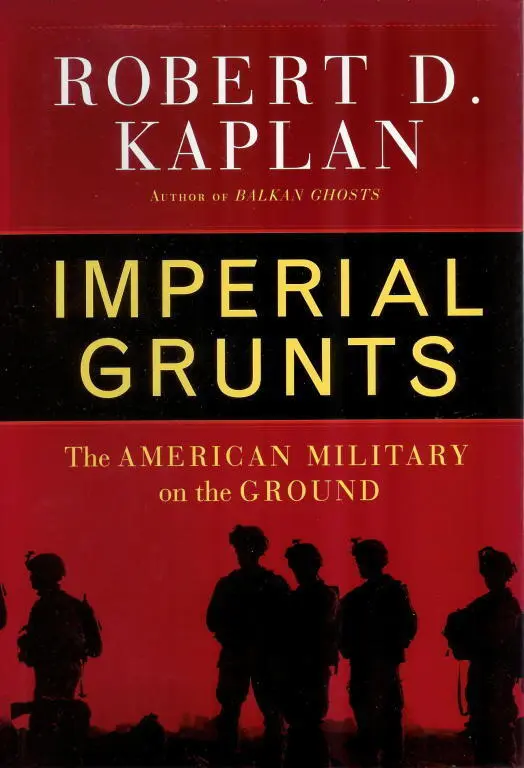
- Название:Imperial Grunts
- Автор:
- Издательство:Random House
- Жанр:
- Год:2005
- Город:New York
- ISBN:978-0-307-27850-0
- Рейтинг книги:5 / 5. Голосов: 1
-
Избранное:Добавить в избранное
- Отзывы:
-
Ваша оценка:
Imperial Grunts: краткое содержание, описание и аннотация
Предлагаем к чтению аннотацию, описание, краткое содержание или предисловие (зависит от того, что написал сам автор книги «Imperial Grunts»). Если вы не нашли необходимую информацию о книге — напишите в комментариях, мы постараемся отыскать её.
Imperial Grunts — читать онлайн бесплатно полную книгу (весь текст) целиком
Ниже представлен текст книги, разбитый по страницам. Система сохранения места последней прочитанной страницы, позволяет с удобством читать онлайн бесплатно книгу «Imperial Grunts», без необходимости каждый раз заново искать на чём Вы остановились. Поставьте закладку, и сможете в любой момент перейти на страницу, на которой закончили чтение.
Интервал:
Закладка:
Throughout the long hot afternoon and into the evening, he would teach them the Australian technique of peeling back in retreat, without allowing for a gap in fire, after making contact with the enemy. It was harder than it looked: to keep the fire up, then to keep the fire up even in the dark, then in the dark in a tangled thicket, then in the dark in a tangled thicket with smoke bombs exploding all around you. You see them. They see you. You kill them. You peel back. Because the real event would elicit such fear and confusion, your only hope was grueling repetition, so that it became instinct. Castro worked twelve hours in the heat that day, speaking in a steady, nurturing tone, working individually with each soldier until the unit performed the drill perfectly.
“All I can give is 110 percent; nothing in life is better than what I’ve been doing today,” Castro shouted at me, his hearing impaired by earplugs. Soldiers talked in clichés. It is the emotion and look in their faces—sweaty and gummed with dust—that matters more than the words. After all, a cliché is something that only the elite recognizes as such.
Laughing now, Castro gave me another acronym: “ P roper Planning, Good R econ, C ontrol, S ecurity, C ommon Sense—PUERTO RICANS SUCK COCK.”
I spent another part of the day with the team sergeant, Mike Fields. Besides being ODA-781’s effective managing director, he taught several classes. In the morning he ran a tape drill in Spanish for an AMOUT (advanced military operation in urban terrain). Since the firing range lacked buildings to practice on, Fields used tape on the ground to simulate the various structures that the Colombian anti-guerrilla team would infiltrate. He went over basics that drew on the U.S. Army’s Ranger Handbook : isolating a building and covering all of its sides before entering; entering the building from the highest point; securing one building before moving on to the next; shining a flashlight in the enemy’s face to momentarily shock him and make him easier to kill. 14
I learned that a really good sniper will take his bullets from the same box, since gunpowder grain is not always measured out evenly; that the green-tipped 5.56mm bullet that the Americans used in Somalia and Afghanistan, while it pierced Kevlar, caused less damage inside the body, so it took two or three shots to “take a bad guy down.”
Fields was full of compacted technical knowledge. He never wasted a word or body movement, and he had even nerves. The year before he had been thrown from a helicopter and bounced off a third-story building. He broke a pelvic bone, was laid up for forty-five days, then spent ninety days on crutches. He looked bored when I asked him about it, but perked up when I asked him to explain how he had machine-tooled an M-16 scope onto a Galil. Fields’s schedule was so jam-packed that the only time I could get him alone to talk was to meet him for breakfast the next day at 6 a.m. at the Colombian army canteen.
When we met for breakfast Fields seemed nervous talking to me. He said that he had his name mentioned in a newsmagazine once, and while nice words were written about him, it was something he didn’t especially appreciate. He seemed utterly without ego, channeling all his psychic energy into the technical task at hand. One shouldn’t expect soldiers to be interesting, I thought. War is work, and like all work it is for the literal minded. Fields was the opposite of the foreign correspondents who love to tell bar stories. His stories were probably much better, but he was bored by them. The only thing that interested him was the next task.
Fields also spoke in clichés that he didn’t recognize as such. Like many in this A-team, he was in his mid-thirties, married, his family back at Fort Bragg. He had attended junior college in Texas, then spent a year at Akron University in his hometown before quitting. “School wasn’t for me. I needed direction. I joined the Army.” The next sixteen years he spent in Sinai, South Korea, and then Honduras, Guatemala, “El Sal,” and other places on the cucaracha circuit.
“A twelve-hour day is, I guess, a short one,” he said flatly. “I’m away from my family six months a year. I have responsibility for all the enlisted men. I write the ratings for each guy except the chief warrant officer and the captain. I write the training schedules, control the budget. I make sure we have trucks, logistics, ranges. I answer for everything that does and does not happen. But my primary job is training COLAR [the Colombian army]. Ultimately, nothing else matters except getting a few of their special units to the point where they are capable of taking out the FARC leadership. I’m a trainer.”
“How good is the Colombian army?” I asked.
He looked at me hard, then down at his eggs and plantains. The Colombian army was the only Latin military that had fought beside the U.S. in the Korean War, and Fields and his team deeply respected that. “But their noncommissioned officer class is weak,” he said. “Their corporals and sergeants don’t take the initiative when their officers are around.” Colombian society had a rigid social hierarchy and that hurt the army. Without strong noncoms, it was hard to have well-functioning small units. And without that, it was hard to hunt down narco-terrorists.
I left Fields as he jumped into a discussion about stringing a wire for a Barker-Williams antenna. It was part of the process of relocating the commo gear. I’ll explain:
The evening before, following the long day on the firing range with Fields and Castro, the team had learned that it suddenly had to move barracks immediately: all of the equipment, everything. And they had to move into a few “crackerboxes” which offered a lot less room than the old barracks. It was no way to treat the Americans. A Colombian colonel whose unit was not being trained by ODA-781 had made the decision.
Morale could not have been good at that moment. Yet nobody complained; nor was there the slightest display of annoyance, as everyone returned from the range and methodically began the moving process. Unloading communications gear from a truck, someone said he hoped that the World Trade Center wouldn’t be replaced by “some weepy memorial. Build something bigger even, taller; that’s what America’s all about.” By midnight the bathrooms had been cleaned, the weapons, the office equipment, and other things all unpacked in their new places, and the fans installed to cut some of the equatorial heat.
All of these guys, most of whom had kids and were of the same caliber as Mike Fields, brought home no more than $4,000 a month after taxes. Unlike in civilian life, salaries were determined completely by rank, so everyone knew what everyone else was making and it was not impolite to ask. It was not rare for noncommissioned officers to be on food stamps. [17] A. J. Simons, The Company They Keep: Life Inside the U.S. Army Special Forces (New York: Free Press, 1997), pp. 189–90. The author writes that some noncom families live in trailers and turn on the heat only at night in the winter. “Others heated with wood they chopped themselves.”
If a member of ODA-781 was killed in combat or in a training accident, his family received $200,000 in servicemen’s group life insurance. That was all. “Governed by necessity, the best-disciplined army is so good that it requires neither rewards nor punishments,” writes Israeli military historian Martin van Creveld, paraphrasing ancient Chinese philosophy. The best-disciplined army behaves “as if it were a single personality.” 15That was ODA-781 all right. In a few hours they all would get up to run five miles, after which Fields would meet me for breakfast.
Интервал:
Закладка:
Похожие книги на «Imperial Grunts»
Представляем Вашему вниманию похожие книги на «Imperial Grunts» списком для выбора. Мы отобрали схожую по названию и смыслу литературу в надежде предоставить читателям больше вариантов отыскать новые, интересные, ещё непрочитанные произведения.







Обсуждение, отзывы о книге «Imperial Grunts» и просто собственные мнения читателей. Оставьте ваши комментарии, напишите, что Вы думаете о произведении, его смысле или главных героях. Укажите что конкретно понравилось, а что нет, и почему Вы так считаете.