Robert Kaplan - Imperial Grunts
Здесь есть возможность читать онлайн «Robert Kaplan - Imperial Grunts» весь текст электронной книги совершенно бесплатно (целиком полную версию без сокращений). В некоторых случаях можно слушать аудио, скачать через торрент в формате fb2 и присутствует краткое содержание. Город: New York, Год выпуска: 2005, ISBN: 2005, Издательство: Random House, Жанр: Публицистика, nonf_military, на английском языке. Описание произведения, (предисловие) а так же отзывы посетителей доступны на портале библиотеки ЛибКат.
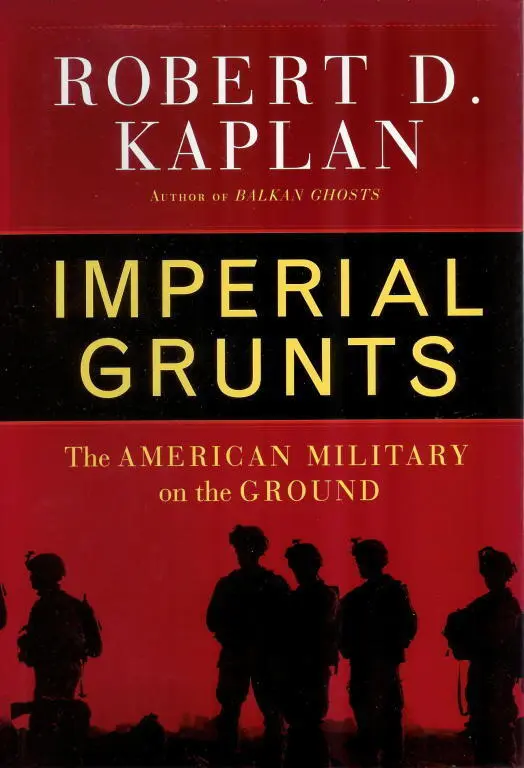
- Название:Imperial Grunts
- Автор:
- Издательство:Random House
- Жанр:
- Год:2005
- Город:New York
- ISBN:978-0-307-27850-0
- Рейтинг книги:5 / 5. Голосов: 1
-
Избранное:Добавить в избранное
- Отзывы:
-
Ваша оценка:
Imperial Grunts: краткое содержание, описание и аннотация
Предлагаем к чтению аннотацию, описание, краткое содержание или предисловие (зависит от того, что написал сам автор книги «Imperial Grunts»). Если вы не нашли необходимую информацию о книге — напишите в комментариях, мы постараемся отыскать её.
Imperial Grunts — читать онлайн бесплатно полную книгу (весь текст) целиком
Ниже представлен текст книги, разбитый по страницам. Система сохранения места последней прочитанной страницы, позволяет с удобством читать онлайн бесплатно книгу «Imperial Grunts», без необходимости каждый раз заново искать на чём Вы остановились. Поставьте закладку, и сможете в любой момент перейти на страницу, на которой закончили чтение.
Интервал:
Закладка:
In fact, Colombia was little more than a network of city-states, despite the creation by Gen. Simon Bolívar in the early nineteenth century of Gran Colombia, designed to include Colombia, Venezuela, Ecuador, and later Panama. Bolívar’s vast commonwealth was simply ungovernable, and decades were lost in a grand guignol of revolts straight out of Conrad’s novel Nostromo (which, by the way, deals with an imaginary republic, Costaguana, located somewhere near the joint of Central and South America). Colombia was a world of slaves and Indians exploited by Spanish colonizers, whose priests were as fanatical and bloodthirsty as modern-day Iranian ayatollahs. Church-state conflicts were the cause of eight civil wars, not to mention smaller rebellions.
But Colombia was also the most self-sufficient country in the hemisphere, with storied quantities of coffee, cattle, gold, emeralds, and oil. Gold and coffee created obscene concentrations of wealth, as later would drugs. The early-twentieth-century “Republic of Coffee,” as Colombia was then known, would mutate into a veritable late-twentieth-century Republic of Cocaine.
Eventually, the lowland forests were cleared and precious wood plundered, as well as rubber in the Amazon basin after the spread of automobiles had created a demand. 19The upshot was the rise of a violent frontier society that, through crime and migration, threatened the urban civilization in the highlands. Two hundred thousand people died between 1945 and 1964 in a nationwide bloodletting among peasants, set against each other by liberal and conservative hierarchs. 20The nightmarish spectacle was “so empty of meaning” that it was called simply La Violencia. 21
Coast Guard Capt. Bob Innes in Yemen had not been exaggerating when he told me that this part of Latin America was more dangerous than the Middle East. Even after the gruesome murder of journalist Daniel Pearl by al-Qaeda, you had to wonder if it might be worse, given the record of amputations and other tortures here, to be captured by the FARC. In Yemen you could travel in anarchic areas under tribal escort; in Colombia there was often no safety except in full kit, inside a Humvee with a mounted machine gun. Because Colombian guerrillas stole uniforms of government soldiers and police, it was not always clear who was manning the roadblocks. A larger percentage of Colombia than Yemen was considered by the American military to be Injun Country.
The task that the U.S. appeared to have in both Yemen and Colombia was similar. And it was similarly impossible: to make countries out of places that were never meant to be countries.
Yet the U.S. could not, at this moment in history, fail to rise to the challenge that Colombia presented. Not only was Colombia so much closer to the U.S. than the Middle East, but cocaine and other illegal drugs even in the post–September 11 era arguably constituted a greater risk to American society than Islamic extremism, barring a truly catastrophic terrorist attack. Moreover, a newly elected Colombian president was offering the U.S. a tantalizing window of opportunity for progress against the insurgents. Alvaro Uribe appeared willing to prosecute a full-scale war, and deploy large numbers of specialized police units in the most violent towns of Colombia. He was a dynamic workaholic who had filled his cabinet with people like himself. He was physically as well as politically brave, visiting remote regions of the country in spite of death threats. Uribe’s ascension, combined with the real danger of an alliance between Colombian and Middle Eastern terrorists, meant that the U.S. had to go all the way here.
Plan Colombia signified the ultimate U.S. interagency strategy for healing a troubled foreign country: hundreds of millions of American taxpayers’ dollars annually for a gamut of programs, from Special Forces to Counter Drugs, Judicial Training, Human Rights Monitoring, Child Soldier Rehabilitation, Maritime Enforcement, Alternative Crop Development, Environmental Support, and so on. The armed passengers beside me aboard the CASA 212 were evidence of the sharp, rough-and-tumble edge of several Washington bureaucracies.
The U.S. goal was not to completely pacify Colombia. That would have been too ambitious. The goal was to break up the leadership networks of the guerrilla groups through assassination and other means, thereby reducing them to an even lower level of banditry. “We aim to balkanize them and kill their centers of gravity,” one American military official said. That was the way that the Khmer Rouge had ultimately been dealt with, though here the model wasn’t Cambodia in the 1990s, but El Salvador in the 1980s.
El Salvador was the inverse of Vietnam, where, instead of applying Economy of Force through the exclusive use of Special Operations teams, President Lyndon Johnson had dispatched more than half a million troops. “El Salvador” was, too, a code phrase within Army Special Operations Command for the kind of qualified success possible in the messy world of nation-fixing—a success so slim it barely went noticed, or could be labeled as such. Richard W. Stewart, the historian for the Special Ops community, writes thus about the role of Special Forces in El Salvador from 1980 to 1992, during the country’s civil war:
How successful was the Special Forces and U.S. advisory effort in El Salvador?… Despite military setbacks and the increase of international support to the enemy (including weapons from Nicaragua and Cuba, and diplomatic recognition from France and Mexico), the El Salvadoran military fought back and beat the guerrillas to a standstill. When the “final” offensive of the FMLN [Farabundo Martí Liberación Nacional front] was launched in 1989, the El Salvadoran military faced a few minor defeats, but rallied and decimated the rebels. The FMLN was forced to seek victory with a political solution; a military victory was no longer an option for them. Special Forces had helped make that… possible. 22
The 1991 report submitted by the General Accounting Office to Senator Edward Kennedy did not differ substantially from that assessment. It said there had been “a significant decrease in political violence against civilians during the past 10 years…. U.S. military trainers… have exposed the Salvadoran military personnel to internationally recognized human rights standards and democratic principles.” 23
Despite detailed media coverage of specific human rights atrocities, the basic trend in human rights over the course of the decade was positive, especially when one considers the small number of Special Forces trainers deployed in the field. [18] <���…>
Nobody kidded himself that Colombia would be another El Salvador, where the fall of the Berlin Wall helped reduce support for a strongly ideological guerrilla movement. Moreover, the U.S. military had been in El Salvador for more than a decade, long enough to develop a learning curve. Perhaps, I thought, as I adjusted my oxygen mask in the plane, the crash of the day before would constitute a spike in the learning curve in Colombia, for it highlighted all the contradictions of America’s involvement here.
“If Washington decides to pull out of Colombia just because a bunch of us get killed, then we shouldn’t be here in the first place,” Duke Christie had told me. One of the rationalizations for the strict rules of engagement was that everyone up the command chain in the Pentagon wasn’t sure he could justify American deaths in Colombia. The politicians and higher-ups thought that this demonstrated their deep concern for American soldiers’ lives; the Green Berets thought it demonstrated political cowardice.
Meanwhile, every day American pilots crisscrossed Colombian guerrilla country in flimsy planes, conducting spraying and surveillance operations, and ferrying American troops from base to base. The inevitable had finally happened. Yet from the way people talked—and the concerns Duke and his fellow officers had about being pulled out of Colombia altogether—the policy suddenly seemed up for grabs.
Читать дальшеИнтервал:
Закладка:
Похожие книги на «Imperial Grunts»
Представляем Вашему вниманию похожие книги на «Imperial Grunts» списком для выбора. Мы отобрали схожую по названию и смыслу литературу в надежде предоставить читателям больше вариантов отыскать новые, интересные, ещё непрочитанные произведения.



Обсуждение, отзывы о книге «Imperial Grunts» и просто собственные мнения читателей. Оставьте ваши комментарии, напишите, что Вы думаете о произведении, его смысле или главных героях. Укажите что конкретно понравилось, а что нет, и почему Вы так считаете.