Robert Kaplan - Imperial Grunts
Здесь есть возможность читать онлайн «Robert Kaplan - Imperial Grunts» весь текст электронной книги совершенно бесплатно (целиком полную версию без сокращений). В некоторых случаях можно слушать аудио, скачать через торрент в формате fb2 и присутствует краткое содержание. Город: New York, Год выпуска: 2005, ISBN: 2005, Издательство: Random House, Жанр: Публицистика, nonf_military, на английском языке. Описание произведения, (предисловие) а так же отзывы посетителей доступны на портале библиотеки ЛибКат.
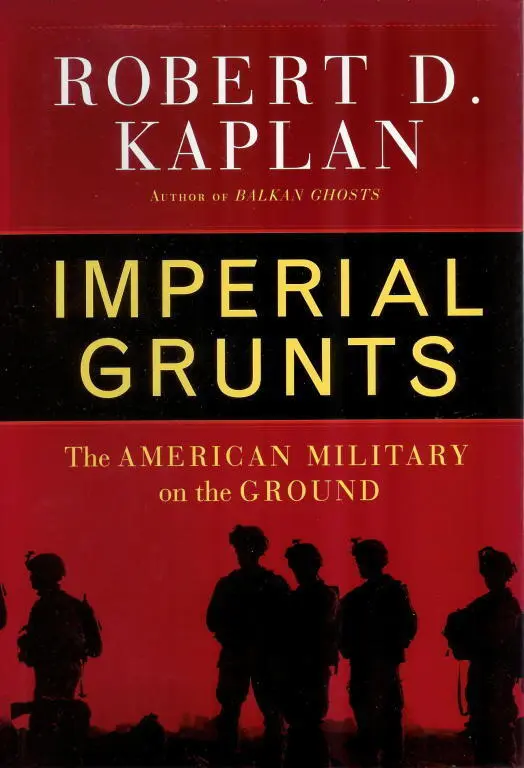
- Название:Imperial Grunts
- Автор:
- Издательство:Random House
- Жанр:
- Год:2005
- Город:New York
- ISBN:978-0-307-27850-0
- Рейтинг книги:5 / 5. Голосов: 1
-
Избранное:Добавить в избранное
- Отзывы:
-
Ваша оценка:
Imperial Grunts: краткое содержание, описание и аннотация
Предлагаем к чтению аннотацию, описание, краткое содержание или предисловие (зависит от того, что написал сам автор книги «Imperial Grunts»). Если вы не нашли необходимую информацию о книге — напишите в комментариях, мы постараемся отыскать её.
Imperial Grunts — читать онлайн бесплатно полную книгу (весь текст) целиком
Ниже представлен текст книги, разбитый по страницам. Система сохранения места последней прочитанной страницы, позволяет с удобством читать онлайн бесплатно книгу «Imperial Grunts», без необходимости каждый раз заново искать на чём Вы остановились. Поставьте закладку, и сможете в любой момент перейти на страницу, на которой закончили чтение.
Интервал:
Закладка:
The hatch door opened as we gave up altitude, revealing stagnant curvilinear rivers, oily green fields, and broadleaf foliage, with parasitic orchids in the mango canopy. As the CASA 212 set down near wire-mesh, sand-filled barriers (HESCO baskets), the sound of jungle parrots began the moment the propellers went silent. It was early morning and depressingly hot, hotter than Tolemaida and Espinal. We were 2 degrees latitude north of the equator. A UH-60 “Lima” model Black Hawk and two UH-1N Hueys hovered by us. The Hueys, the besieged nature of the base, and the landscape itself recalled the Vietnam of a third of a century earlier. I noticed that the airfield was covered in pierced steel plank, collapsible metal sheets for laying instant runway on loose tropical soil; the plank seal indicated that it had been manufactured in 1967, and had been used for the first time in Vietnam.
“Yeah, every Tuesday this base is about to be overrun,” someone half joked. Maj. J. P. Roberts barked about getting “the host nation’s commo freeks [frequencies],” and the need “to unfuck the time line” of yesterday’s crash, the capture of the crew, the recon follow-ups, and so on. Maj. Roberts was short, clean-cut, compact, and poker-faced. He seemed to have a somewhat cold and surly nature. In his late thirties from western Pennsylvania, he had a twin brother who was also an Army Special Forces major. As a major, his B-team at Larandia commanded several A-teams here.
There is a term in the U.S. military, “iron majors,” though it might really apply to all middle-level officers, from noncommissioned master sergeants and chief warrant officers to lieutenant colonels. In a sense, majors ran the military, regardless of who the chairman of the Joint Chiefs of Staff happened to be. Up through the rank of captain, an officer still hasn’t closed the door on other career options, but becoming a major means you’ve “bought into the corporation,” Maj. Roger D. Carstens had explained to me back at Fort Bragg. “We’re the ones who are up at 4 a.m. answering the general’s e-mails, making sure all the systems are go.”
But it was only when you got outside the United States that you realized the power and responsibility wielded by not only majors, but captains and master sergeants, too, to say nothing of a lieutenant colonel like Duke Christie. While policy specialists argued general principles like nation-building in Washington and New York seminars, these young middle-level officers were the true agents of the imperium.
A plane had gone down, at least one American body needed to be recovered, and several Americans on official government business were missing inside a hornet’s nest of narco-terrorists. SOUTHCOM commander Army Gen. James T. Hill was flying in from Miami; SOUTHCOM’s Special Operations commander, Army Brig. Gen. Remo Butler, was flying in from Puerto Rico; Ambassador to Colombia Anne Patterson likely rated the incident her top priority; and yet Maj. Roberts would be shaping decisions on the ground. He had slept only two hours the night before and would be making judgment calls during the course of the day that would effect his entire career. More so than civilian life, the military was about being your best under the worst of circumstances.
The barracks for ODB-780, where Maj. Roberts had his office, featured the usual clutter of drying towels and mosquito nets among piles of mortar base plates, mounted guns, bore sights, aiming sticks, and multi-band inter-team radios. Fans whined, creating pockets of relative comfort. I laid down my pack and filled my canteen with purified water. A young, enthusiastic noncom launched into an explanation about the heat ribbing on the M-60mm dropfire mortar beside me.
Maj. Roberts emerged only to disappear into a classified briefing with ODA-785 and -776: the two A-teams that, along with the FBI, ATF, a search-and-rescue unit of DynCorp (another private defense contractor), and shadowy civilian others, would be headed in two helicopters to the site of the crash and the place where the bodies had been found.
Compared to these civilians, the Green Berets looked positively innocent; the civilians were grizzled old Special Forces veterans of Vietnam, now working for private contractors and government agencies at the rough edge of the counter-drug program. Some had long hair and looked like country music stars. Another had a shaved head. Each had his weapon of choice: a Beretta, an Austrian-manufactured Glock pistol, an M-4 rifle. This was the world of the contractors.
The Pentagon, the State Department, the CIA, and others had learned that there were many intelligence-related details more efficiently handled by private firms, which did not incur quite the degree of oversight by the media and Congress. The Americans aboard the plane that had gone down were technically civilians doing contract work for the U.S. government. But their work was classified, and in a slightly earlier era their jobs might well have been handled directly by the CIA. The men were examples of the privatization of war and clandestine operations.
Maj. Roberts, in the midst of a crisis, had no time for me. I wasn’t supposed to be here. The next day, a Washington Post reporter would be turned away at the entrance to the base. Information that would be public knowledge in weeks, or days even, was still classified. I noticed a television turned to CNN in the corner of the barracks. There was an “orange” terror alert. President Bush had given a pep talk to sailors embarking for the Persian Gulf, Liberian rebels were closing in on the capital of Monrovia, rebels in the Ivory Coast were threatening to take the capital of Abidjan, twenty-nine people had died in political riots in Bolivia, and the government of Austria was blocking the transit of American troops from Germany to Italy, en route to Kuwait and Iraq. At the mention of the last news item, a noncom came over and cursed the screen, the media, and Hollywood.
Outside in the glaring sun two other noncoms were sitting with their feet propped up on ammunition cases. One had served previously in the 5th Special Forces Group, with responsibility for the Middle East.
“How was 5 Group?” I asked.
“It sucked.”
“Why?”
“Because it sucked. It just did. The Paks, the Kuwaitis, the Gypos [Egyptians] are all equally worthless. Not up to COLAR standards, Muslim armies have even worse noncoms and middle management than South American armies.”
The other noncom, Mike Davila, an 18 Delta medic, was a Mexican-American from near Brownsville, Texas. His voice was as soft and friendly as his body was huge. Chewing on a piece of shelf-stabilized bread from an MRE, he told me that the year before he had been on a small Special Forces mission in eastern Peru, near the Brazilian border. He had seen riots where people had burned down a college. It was at a time when the world media was reporting that democracy and stability had returned to Peru. “I’ve noticed that poor people naturally follow the ones with an education, and that the ones with an education are often corrupt,” Davila said. “You can’t always equate education with good character.”
Hungry myself—I still hadn’t eaten breakfast—I wandered across a dirt field to a canteen-restaurant, where under a scrap metal shed a waitress in a tank top and tight jeans brought me coffee and eggs with hot pepper sauce. There was another restaurant on the base, by a lake filled with piranha. It, too, featured waitresses who dressed and flirted almost like strippers and had the saddest stories of guerrilla atrocities to tell. I would hear one grizzled civilian contractor remark, “If my daughter ever dressed like that, I’d string her up.”
The helicopters filled with the two A-teams departed for the crash site as news arrived that a bomb had gone off in the town of Neiva, ninety miles to the north, with eighteen dead and thirty-seven wounded on the day before President Uribe was supposed to visit. It had been meant for him and was detonated by mistake.
Читать дальшеИнтервал:
Закладка:
Похожие книги на «Imperial Grunts»
Представляем Вашему вниманию похожие книги на «Imperial Grunts» списком для выбора. Мы отобрали схожую по названию и смыслу литературу в надежде предоставить читателям больше вариантов отыскать новые, интересные, ещё непрочитанные произведения.






Обсуждение, отзывы о книге «Imperial Grunts» и просто собственные мнения читателей. Оставьте ваши комментарии, напишите, что Вы думаете о произведении, его смысле или главных героях. Укажите что конкретно понравилось, а что нет, и почему Вы так считаете.