Robert Kaplan - Imperial Grunts
Здесь есть возможность читать онлайн «Robert Kaplan - Imperial Grunts» весь текст электронной книги совершенно бесплатно (целиком полную версию без сокращений). В некоторых случаях можно слушать аудио, скачать через торрент в формате fb2 и присутствует краткое содержание. Город: New York, Год выпуска: 2005, ISBN: 2005, Издательство: Random House, Жанр: Публицистика, nonf_military, на английском языке. Описание произведения, (предисловие) а так же отзывы посетителей доступны на портале библиотеки ЛибКат.
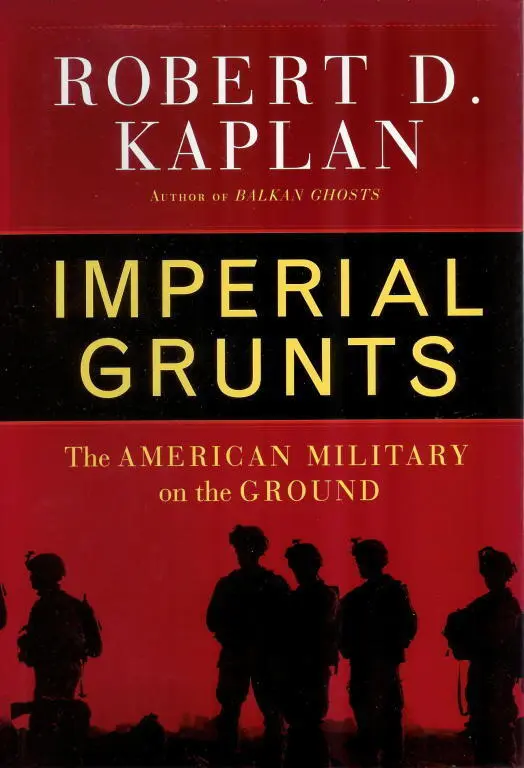
- Название:Imperial Grunts
- Автор:
- Издательство:Random House
- Жанр:
- Год:2005
- Город:New York
- ISBN:978-0-307-27850-0
- Рейтинг книги:5 / 5. Голосов: 1
-
Избранное:Добавить в избранное
- Отзывы:
-
Ваша оценка:
Imperial Grunts: краткое содержание, описание и аннотация
Предлагаем к чтению аннотацию, описание, краткое содержание или предисловие (зависит от того, что написал сам автор книги «Imperial Grunts»). Если вы не нашли необходимую информацию о книге — напишите в комментариях, мы постараемся отыскать её.
Imperial Grunts — читать онлайн бесплатно полную книгу (весь текст) целиком
Ниже представлен текст книги, разбитый по страницам. Система сохранения места последней прочитанной страницы, позволяет с удобством читать онлайн бесплатно книгу «Imperial Grunts», без необходимости каждый раз заново искать на чём Вы остановились. Поставьте закладку, и сможете в любой момент перейти на страницу, на которой закончили чтение.
Интервал:
Закладка:
Indeed, anyone who doubts that America is, or was, an imperial power should come to the Philippines, where the white baronial U.S. Embassy fronting Manila Bay occupies the most beautiful downtown real estate in the same way that British and French embassies do in their former colonies; where the Americans have their own hill station for cool weather retreats, like British hill stations in India; where leading local military officers, businessmen, and politicians are graduates of West Point just like the leading personages of former British colonies have been graduates of Sandhurst; and where the country’s romantic hero is not a Filipino but the protean figure of Douglas MacArthur, who, in the Filipino mind, rescued the country from the butchery of the Japanese occupiers.
Yet there is a deeper, less appealing truth about American colonialism in the Philippines: As far as the life of the average Filipino has been concerned, it may not have made much of a difference at all. Throughout the twentieth century, the Philippines remained among the most dysfunctional, intractable, and poverty-stricken societies in Asia, with African-like slums and Latin American–style fatalism and class divides. The journalist James Fallows bluntly observes that a damaged culture, not Ferdinand Marcos’s dictatorial rule from the mid-1960s through the mid-1980s, was the root cause of the country’s problems. 23In the early twenty-first century, almost two decades after Marcos had been overthrown, Philippine democracy had become so corrupt and inefficient that Filipinos complained constantly that “at least under Marcos you knew who to bribe.”
Karnow notes that Filipinos were easily co-opted by the Spaniards and later by the Americans because they had little sense of their own identity—something that is in stark contrast to the Vietnamese and Indonesians, who could gaze at stone temples that symbolized an indigenous historic grandeur. The only real history the Philippines had was a colonial one. 24
Before the Portuguese explorer Ferdinand Magellan fell upon the archipelago in 1521, flying the flag of Spain, the Philippines (named for the Spanish king Philip II) had merely been a jumble of Malay tribes, eight different languages, and seventy Tagalog-related dialects spread over 7,107 islands, without a central governing authority. Spain more or less invented the Philippines, providing it with a lingua franca and a common religion, Roman Catholicism, practiced by all save for the Muslim minority in the south. By giving land grants to Spanish settlers, which were passed on to rich mestizo families, Spain also created an oligarchy that has ruled the country ever since, whether it was under American auspices, dictatorial fiat, or democratic constitutionalism. Indeed, the closer one looked at how the Philippines actually functioned, and the closer one got to the Muslim areas in the south, the less important the advent of democracy in the mid-1980s seemed.
I arrived in the Philippine capital of Manila late at night, and left at noon the following day to link up with American forces at Zamboanga in southwestern Mindanao, the same Zamboanga that American soldiers had sung a song about a hundred years earlier.
It has been said that with its strip malls and faux-classical architecture reminiscent of Washington, D.C., no place—not even the cities of India with their Victorian Gothic buildings—is stamped with a colonial legacy to the degree of Manila. I had a few hours to walk around. Outside the Spanish walls of old Manila, I found teeming poverty, white pristine mansions, and fast-buck Americanization that bore eerie resemblance to cities in northern Mexico. It was a testament to just how much America had imposed itself on this capital, almost seven thousand miles across the ocean from San Francisco and Los Angeles. [33] It was also testament to the fact that under Spanish rule, administration of the Philippines was often subcontracted out to Mexicans.
Manila is vast and sterile, despite its location on a magnificent historic bay, with yawning, ruler-straight boulevards lined by faded and sharp-angled concrete towers, reflecting the alienating modernism of the 1970s. The spaces between the skyscrapers are filled by squalid hutments plastered with ratty and rusting signage. The beggars wear flip-flops and oversized ball caps. The Philippine capital conjures up the tackiness and vegetal gaudiness of Mexico and Central America grafted onto the demographic immensity of Asia.
Flying south to Mindanao, I stared through the plane window at a dazzling emerald squiggle work of islands and bays defaced by a torn mosaic of human habitation. The Philippines comprises 84.5 million people, about 40 percent of whom are under fifteen years old, with Muslims growing disproportionately to the rest of the population. There is a look to poverty from the air. Rather than the finely wrought, computer chip complexity of post-industrial Western cities, third world cities and towns seen from ten thousand feet up appear more like a ragged psoriasis. Dennis Downey, a Green Beret lieutenant colonel, would later tell me: “Below Luzon it’s the Odyssey. In the eyes of people from Manila the area to the south is ungovernable, uneducated, and unchristian, with small islands changing hands daily.”
Approaching Zamboanga, a break in the dense, ashen cloud cover of a monsoon rain revealed a shattered coast barely rising above the turquoise mirror of the Sulu Sea. Then came a glassy trapezoidal tilework of rice fields and seaweed farms, the mossy felt of well-jungled, broccoli-colored hillsides, and a seemingly unending concentration of sloping corrugated iron roofs painted in various loud colors. Unlike Colombia’s tropical badlands, the Zamboanga peninsula of Mindanao was thick with humanity.
While Manila was heavily marked by Spanish and American colonial influence, that was not the case with Mindanao and the Sulu Islands. The dozen or so Muslim sultanates that had dotted the southern Philippines were never completely subjugated by the Spanish. It took the Americans until 1913 to quell large Muslim uprisings, even as smaller ones never ceased. The problem that the U.S. had with Islamic terrorists in the Philippines and elsewhere in the early years of the twenty-first century was simply the most recent chapter of a very old story. The first so-called clash of civilizations between America and the Muslim world occurred here in the southern Philippines at the beginning of the twentieth century.
Islam, which had spread across the world from the Middle East, implanted itself in Malaya and the Indonesian islands of Java and Sumatra in the thirteenth century, with Muslim missionaries arriving in the southern Philippines from Borneo in the fifteenth century. When the Spanish arrived a hundred years later, they grouped the various tribes and ethnicities practicing Islam under the appellation “Moro,” or Moor, for with the reconquest of Muslim Spain a recent memory, the Spaniards looked down upon these southern Filipino Muslims and beheld their historic enemy. The word “Moro” remained a pejorative until the mid-twentieth century, when Moro nationalists transformed it into a symbol of collective identity. 25
Although a distinct Islamic ethnicity had arisen as a reaction to the Christianizing influence of Spanish rule, Islamization was undergirded by deep cultural ties among southern Philippine Muslims that surmounted barriers of dialect and jungle terrain. 26Islamization was further reinforced in the early twentieth century by the Americans, who, as part of an attempt to modernize the Philippines, refused to recognize traditional sultans. The undermining of the local headmen—by erasing differences between the various Moro communities—unwittingly united the Muslim Moros as never before. From 1902 to 1913, America’s attempt to impose democracy here led to a more militant Islam.
Читать дальшеИнтервал:
Закладка:
Похожие книги на «Imperial Grunts»
Представляем Вашему вниманию похожие книги на «Imperial Grunts» списком для выбора. Мы отобрали схожую по названию и смыслу литературу в надежде предоставить читателям больше вариантов отыскать новые, интересные, ещё непрочитанные произведения.






Обсуждение, отзывы о книге «Imperial Grunts» и просто собственные мнения читателей. Оставьте ваши комментарии, напишите, что Вы думаете о произведении, его смысле или главных героях. Укажите что конкретно понравилось, а что нет, и почему Вы так считаете.