Robert Kaplan - Imperial Grunts
Здесь есть возможность читать онлайн «Robert Kaplan - Imperial Grunts» весь текст электронной книги совершенно бесплатно (целиком полную версию без сокращений). В некоторых случаях можно слушать аудио, скачать через торрент в формате fb2 и присутствует краткое содержание. Город: New York, Год выпуска: 2005, ISBN: 2005, Издательство: Random House, Жанр: Публицистика, nonf_military, на английском языке. Описание произведения, (предисловие) а так же отзывы посетителей доступны на портале библиотеки ЛибКат.
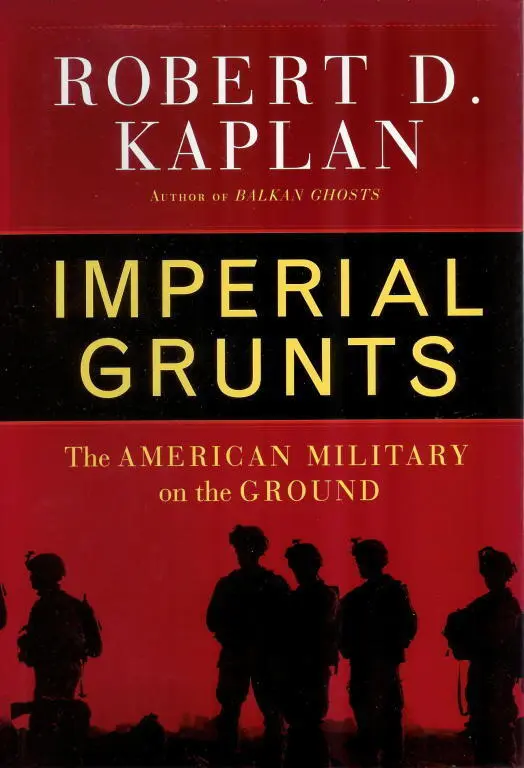
- Название:Imperial Grunts
- Автор:
- Издательство:Random House
- Жанр:
- Год:2005
- Город:New York
- ISBN:978-0-307-27850-0
- Рейтинг книги:5 / 5. Голосов: 1
-
Избранное:Добавить в избранное
- Отзывы:
-
Ваша оценка:
Imperial Grunts: краткое содержание, описание и аннотация
Предлагаем к чтению аннотацию, описание, краткое содержание или предисловие (зависит от того, что написал сам автор книги «Imperial Grunts»). Если вы не нашли необходимую информацию о книге — напишите в комментариях, мы постараемся отыскать её.
Imperial Grunts — читать онлайн бесплатно полную книгу (весь текст) целиком
Ниже представлен текст книги, разбитый по страницам. Система сохранения места последней прочитанной страницы, позволяет с удобством читать онлайн бесплатно книгу «Imperial Grunts», без необходимости каждый раз заново искать на чём Вы остановились. Поставьте закладку, и сможете в любой момент перейти на страницу, на которой закончили чтение.
Интервал:
Закладка:
Because of their fierce adherence to Islam coupled with their exotic dress, blood feuds, and love of hand-to-hand combat, the Moros became a truly romantic opponent in the eyes of America’s Pacific soldiery. The Moros were America’s own colonial equivalent to the fierce and individualistic Pushtuns whom the British fought on the Northwest Frontier of India. 27The Moros had suicidal warriors called amoks and religious fanatics called juramentados. The Americans developed the .45-caliber pistol (the Colt .45) in 1911 because the .38-caliber pistol, it was said, “would not take a Moro down.” Moros attacked at night from the high ground so they seemed invincible. They were emboldened by hallucinogens and amulets that they believed offered special powers.
The Moros’ last stand against the Americans took place in 1913 on the island of Jolo in the Sulu chain; it was not unlike that of the Indians at Wounded Knee in South Dakota twenty-three years earlier. Women and children deserted their villages to join the menfolk in battle. Capt. John Pershing conducted a series of troop withdrawals and negotiations to isolate the noncombatants, even as he planned for a decisive assault that would lead to the Moros’ defeat. 28
Yet the Moro spirit of rebellion against the Christians in Manila never died, even after elected Filipino politicians replaced American imperial overlords. Following World War II and Philippine independence in 1946, young Moros went to study in the Middle East, particularly at the al-Azhar University in Cairo. They returned home to become religious teachers, often in slum communities, channeling their economic and theological grievances into a political cause. 29The Muslim separatist movement got a further boost with President Marcos’s declaration of martial law in 1972. Between 1972 and 1977, Muslim insurgents fought the Philippine military to a stalemate. The fall of Marcos ultimately led to an autonomous region ruled by the Moro Islamic Liberation Front.
In 1991, Moros who had fought in the Afghan jihad against the Soviet Union founded a more radical Islamic group in the southern Philippines called Abu Sayyaf, or Bearer of the Sword. Thus did the Philippines emerge as a central spoke of international terrorism, with terrorists moving in small boats across a broad area from Indonesia and the Malaysian state of Sabah on Borneo, north through the Sulu Islands to Mindanao. 30Many, if not most, of the major al-Qaeda attacks on the West were planned here in Southeast Asia. 31
It was in Afghanistan that Abu Sayyaf’s founders, Abdurajak Janjalani and Abdul Murad, befriended Mohammed Jamal Khalifa—Osama bin Laden’s brother-in-law—and Ramzi Yousef, the organizer of the first World Trade Center bombing in 1993. In 1995 in Manila, Abdul Murad and Ramzi Yousef planned an attack on Pope John Paul II during the pontiff’s upcoming visit to the Philippines. As they were mixing explosive chemicals for the operation in their Manila apartment, a fire erupted that led to Murad’s capture. The Philippine security services “tortured the dog meat out of him,” an American military source told me. “But it wasn’t until they threatened to turn him over to the Israeli Mossad that he cracked.”
Murad gave Philippine investigators the password to his computer that was recovered from the burned-out apartment. On the hard disk they found the details of several terrorist plots, including one to use eleven jetliners to crash into CIA headquarters and other prominent buildings in Washington and New York. Ramzi Yousef was eventually captured in Pakistan. Both he and Murad were later extradited to the U.S. and sentenced in district court in Manhattan to 240 years in prison.
Meanwhile, back in the southern Philippines, the al-Qaeda–aligned Abu Sayyaf had launched a campaign of ritualistic beheadings, kidnapping, and rape against Filipinos and foreigners. Its victims would include two American Christian missionaries from Kansas, Martin and Gracia Burnham. Martin Burnham was killed and Gracia Burnham freed during an American-assisted Philippine rescue operation in 2002. Abu Sayyaf was given safe havens and camp facilities by the Moro Islamic Liberation Front. It got money and trainers from al-Qaeda and Jemaah Islamiyah, a transnational terrorist group that operated throughout Thailand, Malaysia, Indonesia, and the Philippines. Jemaah Islamiyah would be linked to the nightclub bombing in 2002 in Bali that killed more than two hundred people.
Besides Abu Sayyaf and Jemaah Islamiyah, the southern and central Philippines were also plagued by guerrilla outfits like the communist New People’s Army and the Misuari breakaway faction of the Moro National Liberation Front. In truth, like Yemen and Colombia, the Philippines was a country that was not really a country, with the central government unable to project its power in part because of a difficult geography. Moreover, in the 1990s the decay of security structures that came with the advent of democracy, both in Indonesia and the Philippines, provided an opening for international terrorism.
The inability of a democratic Philippine government to govern large areas of its own territory—with al-Qaeda-related terrorism the result—became a principal concern of the United States in the wake of September 11, 2001. The response was Operation Enduring Freedom, which, while predominantly focused on removing the Taliban regime in Afghanistan, also had a Philippine component.
Enduring Freedom in Afghanistan combined conventional military elements with Special Operations Forces and a militarized CIA. But the effort in the Philippines was almost exclusively a Special Operations affair. It was run by Special Operations Command, Pacific, a division of PACOM in Honolulu, which brought in assets such as the Marines and Army Special Forces from Okinawa, Japan, and Fort Lewis, Washington; Navy SEALs and Special Boat Units from Guam; and Air Force Special Operations units and regular Army helicopter crews from South Korea.
The Americans referred to the arrival of these combined assets as “Joint Task Force 510.” The democratically elected Philippine government had a different name for it: Exercise Balikatan (Shoulder to Shoulder), to give its public and local media the impression that it was all part of a normal joint maneuver. That was true to an extent: As in Colombia, the Special Forces operation was exclusively “by,” “through,” and “with” the host nation. That gave the operation political legitimacy among Filipinos. But it also imposed severe limitations on the Americans, which would result in international terrorists remaining at large.
The base of operations was Zamboanga, the center of the Spanish colonial administration in Mindanao, and of the American effort against the Moros a century earlier. September 11 had brought American troops south of the main island of Luzon, and into the Muslim south of the Philippines, for the first time since World War II.
Enduring Freedom—Philippines began in earnest in January 2002. The “force cap” negotiated by the American and Philippine governments limited the number of uniformed American personnel to six hundred (compared to four hundred in Colombia). The focus would be on expelling the Abu Sayyaf guerrillas from Basilan, the large and strategic island to the south of Zamboanga. It would be accomplished less by military actions than by an unusual kind of humanitarian assistance program. By the time I arrived in July 2003, the operation had been successfully completed, with a number of Abu Sayyaf leaders killed and the group scattered to smaller islands, reducing Abu Sayyaf to the banditry from which it had first emerged. Yet the joint task force was still in place in Zamboanga when I got there, and various Special Forces A-teams were still training Philippine units nearby and in Luzon to the north.
Читать дальшеИнтервал:
Закладка:
Похожие книги на «Imperial Grunts»
Представляем Вашему вниманию похожие книги на «Imperial Grunts» списком для выбора. Мы отобрали схожую по названию и смыслу литературу в надежде предоставить читателям больше вариантов отыскать новые, интересные, ещё непрочитанные произведения.




Обсуждение, отзывы о книге «Imperial Grunts» и просто собственные мнения читателей. Оставьте ваши комментарии, напишите, что Вы думаете о произведении, его смысле или главных героях. Укажите что конкретно понравилось, а что нет, и почему Вы так считаете.