Robert Kaplan - Imperial Grunts
Здесь есть возможность читать онлайн «Robert Kaplan - Imperial Grunts» весь текст электронной книги совершенно бесплатно (целиком полную версию без сокращений). В некоторых случаях можно слушать аудио, скачать через торрент в формате fb2 и присутствует краткое содержание. Город: New York, Год выпуска: 2005, ISBN: 2005, Издательство: Random House, Жанр: Публицистика, nonf_military, на английском языке. Описание произведения, (предисловие) а так же отзывы посетителей доступны на портале библиотеки ЛибКат.
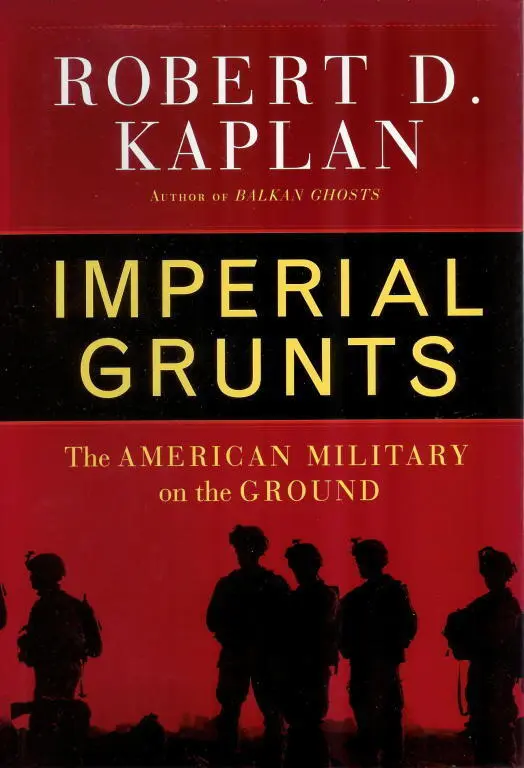
- Название:Imperial Grunts
- Автор:
- Издательство:Random House
- Жанр:
- Год:2005
- Город:New York
- ISBN:978-0-307-27850-0
- Рейтинг книги:5 / 5. Голосов: 1
-
Избранное:Добавить в избранное
- Отзывы:
-
Ваша оценка:
Imperial Grunts: краткое содержание, описание и аннотация
Предлагаем к чтению аннотацию, описание, краткое содержание или предисловие (зависит от того, что написал сам автор книги «Imperial Grunts»). Если вы не нашли необходимую информацию о книге — напишите в комментариях, мы постараемся отыскать её.
Imperial Grunts — читать онлайн бесплатно полную книгу (весь текст) целиком
Ниже представлен текст книги, разбитый по страницам. Система сохранения места последней прочитанной страницы, позволяет с удобством читать онлайн бесплатно книгу «Imperial Grunts», без необходимости каждый раз заново искать на чём Вы остановились. Поставьте закладку, и сможете в любой момент перейти на страницу, на которой закончили чтение.
Интервал:
Закладка:
The MEDCAP which I observed took place in the village of La Paz north of Zamboanga at an altitude of three thousand feet, an area where the mosquitoes brought dengue fever during the day and malaria at night. Turning inland and uphill into a low montane rain forest, I entered a glittering green world of giant ferns, bamboo and mahogany trees, rattans, tea bushes, and orchids. Pigs scampered beneath coconut leaf houses raised on stilts. Innumerable palms with their sharp fanlike leaves evoked the frightening, nightmarish infinity of nature. In too many places, palm jungles meant either touristic paradises or violent anarchy: St. Bart’s or Liberia. Higher and higher into the jungle we drove in our smoke-windowed van, to where people had never before seen a doctor, even if they dressed in cheap Western polyesters with baseball caps.
The MEDCAP had been organized at a school in a clearing. As Col. Walker and I emerged from the van, I saw that several pockets of U.S. Marines had secured a perimeter. Rain and sunlight sprayed simultaneously through a fine mother-of-pearl mist. In long lines in the rain, people waited to have their teeth pulled, their eyes checked and treated for cataracts, their children examined, and to get medicines for a variety of minor ailments. I overhead a U.S. Navy doctor sadly tell a man that he could do nothing for his daughter’s three-chambered heart. But every child was treated for worms and vitamin A deficiency. Lt. Col. Downey was standing with a microphone before an audience of children, teaching them the hokey-pokey while they waited to see the doctors. None of the posters advertising the MEDCAP mentioned the United States or the JSOTF. The front organization was a Taiwan-based, Buddhist NGO (nongovernmental organization), Tzu-Chi, whose Philippine branch had organized the event. Everyone who came went home with a “peace bag,” filled with slippers, toothpaste, shampoo, and multivitamins. The doctors were a mix of American and Philippine military medics, as well as civilian physicians mobilized by Tzu-Chi.
Downey explained: “The idea is for us to be in the background, so as to build up the credibility of the national government and the national army in outlying villages like this one. Besides, all of these people here know that without the security provided by United States Marines, none of this would be happening. The NGO and civilian doctors would have been afraid to show up, for fear of Abu Sayyaf.”
By late afternoon more than 1,800 people had been treated. I watched one man have twelve teeth pulled. “We do only what we can,” Col. Walker said. “My pets at home get better care than these kids,” he added, not wanting to overdramatize the significance of the day.
The JSOTF considered such MEDCAPS “force protection” exercises, because they built trust and relationships with surrounding communities that, in turn, provided an informal native intelligence network, like the kind U.S. troops had established a hundred years ago here in Mindanao. The MEDCAPS drove a wedge between the people and the insurgents.
The drive from Camp Navarro, headquarters of the JSOTF, to Camp Malagutay, headquarters of two U.S. Army Special Forces A-teams and one B-team, took less than fifteen minutes. But Camp Malagutay constituted a different world. For me it was like being back in Colombia, only nicer. The A- and B-teams occupied two separate hootches made of artistic coconut wood weave, raised on stilts with iron roofs. Except for the barriers of concertina wire, sandbags, and HESCO baskets, they each had the look of a small South Sea island beach house. Rather than the bland American fare at the JSOTF, the Green Berets lived on curried beef, crabs, and hot sauce. Even better was the company.
Maj. Guy Lemire of San Francisco was an articulate and policy-savvy former noncommissioned officer who had gone to Officer Candidate School. He had a few years of community college, and spoke Thai and Mandarin Chinese. His sergeant major, Brian Walsh, an Army brat from eastern Oregon, was a towering Mr. Clean of a man who barked out opinions that were as indiscreet as they were truthful. The team sergeant for one of the A-teams was a sly, wiry, and laconic Mississippian in civilian clothes, who could stare down an empty alley of Zamboanga and know whether it was Muslim or Christian. I will keep his name anonymous because of the job he did.
After about thirty seconds of polite introductions, Maj. Lemire and Sgt. Maj. Walsh got down to business. Once a Fil officer reached the rank of major, he was done, and thought of nothing but his own career, money, and corruption; 25 percent of the Philippine army’s basic weaponry was unserviceable, “because the Fils had no concept of maintenance,” even as the U.S. was providing them with state-of-the-art, frequency-hopping radio technology.
Because American military officers, unlike American diplomats, didn’t feel the need to be hopeful about the human condition, they tended to be more honest and practical in their analyses. To American diplomats, the Philippines was a democracy; to the American military, beneath the level of President Gloria Macapagal Arroyo, a few of her cabinet ministers, and her military chief of staff, the Philippines was a klepto-oligarchy. But the candor became even clearer and more refreshing as you descended lower through the ranks. In Maj. Lemire’s command and intel room, filled with marked terrain maps and soft porn pinups, the candor was like pure oxygen.
Here was Maj. Lemire: “Because the Abu Sayyaf Group has RPGs [rocket-propelled grenades], the Armed Forces of the Philippines says it needs RPGs, too. Bullshit. No it doesn’t. RPGs are useless at close range. The response to RPGs is to lay down suppressive fire, and maneuver closer to the enemy. But moving closer to grenade fire is counterintuitive, which means troops have to trust their officers, which here they don’t. The truth is that the Filipino army is terrified of Abu Sayyaf. The Fil army does little reconnaissance. It will only initiate battle with a tremendous numerical advantage, and won’t do so below the company level. There is no understanding of logistics and maintenance in the Philippine military, of planning for the next day.”
In other words, the Philippine military was like the Colombian military, only a bit worse. Meanwhile, there were stories of Abu Sayyaf guerrillas sharing one rifle among four men in the battlefield, making every shot count. The Abu Sayyaf terrorists wore amulets like the Moros a hundred years before. They believed that the blood of hostages whom they beheaded made them stronger. Their irrationality gave them the battlefield discipline that the regular Philippine military lacked.
Sgt. Maj. Walsh and the other noncoms I met at Camp Malagutay were irate that the Filipinos were so bad at maintenance, yet were getting high-frequency radios and night optical devices (NODs) from the U.S. “First, let’s see if they can clean and zero in their rifles, and take care to do so, before we give them the gee-whiz stuff,” one noncom told me. Another remarked: “Because it’s such a lovely, agreeable culture, there are no internal standards, that’s why you need growling American sergeants to advise them, or else nothing happens.”
At the rifle range one day, I was in the midst of talking with a Filipino lieutenant when a broad-shouldered American sergeant with a commanding glare under a ball cap walked over and stuck his face in the eyes of the Filipino officer and snapped: “Sir, tell your machine gunner that if he wants to break his gun he should keep it on full automatic, just the way he’s doing.” A moment later the sergeant was back in the Filipino officer’s face: “Sir, your man over there is sitting in the kill zone too long, get him out, faster.” I liked this Special Forces sergeant from California’s San Joaquin Valley. He missed no detail. He had served all over Asia, and had taken time off from military service to work as a bounty hunter back in the U.S. I asked him his assessment of the Philippine military.
Читать дальшеИнтервал:
Закладка:
Похожие книги на «Imperial Grunts»
Представляем Вашему вниманию похожие книги на «Imperial Grunts» списком для выбора. Мы отобрали схожую по названию и смыслу литературу в надежде предоставить читателям больше вариантов отыскать новые, интересные, ещё непрочитанные произведения.








Обсуждение, отзывы о книге «Imperial Grunts» и просто собственные мнения читателей. Оставьте ваши комментарии, напишите, что Вы думаете о произведении, его смысле или главных героях. Укажите что конкретно понравилось, а что нет, и почему Вы так считаете.