Robert Kaplan - Imperial Grunts
Здесь есть возможность читать онлайн «Robert Kaplan - Imperial Grunts» весь текст электронной книги совершенно бесплатно (целиком полную версию без сокращений). В некоторых случаях можно слушать аудио, скачать через торрент в формате fb2 и присутствует краткое содержание. Город: New York, Год выпуска: 2005, ISBN: 2005, Издательство: Random House, Жанр: Публицистика, nonf_military, на английском языке. Описание произведения, (предисловие) а так же отзывы посетителей доступны на портале библиотеки ЛибКат.
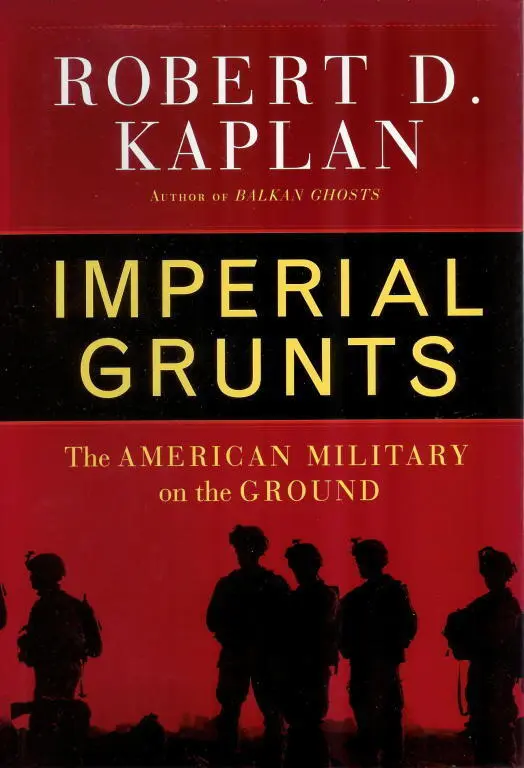
- Название:Imperial Grunts
- Автор:
- Издательство:Random House
- Жанр:
- Год:2005
- Город:New York
- ISBN:978-0-307-27850-0
- Рейтинг книги:5 / 5. Голосов: 1
-
Избранное:Добавить в избранное
- Отзывы:
-
Ваша оценка:
Imperial Grunts: краткое содержание, описание и аннотация
Предлагаем к чтению аннотацию, описание, краткое содержание или предисловие (зависит от того, что написал сам автор книги «Imperial Grunts»). Если вы не нашли необходимую информацию о книге — напишите в комментариях, мы постараемся отыскать её.
Imperial Grunts — читать онлайн бесплатно полную книгу (весь текст) целиком
Ниже представлен текст книги, разбитый по страницам. Система сохранения места последней прочитанной страницы, позволяет с удобством читать онлайн бесплатно книгу «Imperial Grunts», без необходимости каждый раз заново искать на чём Вы остановились. Поставьте закладку, и сможете в любой момент перейти на страницу, на которой закончили чтение.
Интервал:
Закладка:
From 1979 to 1989, Bagram air base had been the nerve center of the Soviet occupation force. The Soviets surrounded Bagram with trenches and minefields, and packed the runways with Hind helicopter gunships that incinerated Afghan villages harboring mujahedin guerrillas. That was until the mid-1980s, when the Americans supplied the mujahedin with Stinger anti-aircraft missiles. Thus did the tide of battle turn, triggering the endgame of the Cold War.
Minefields still littered Bagram’s perimeter, along with vast junkyards
of wrecked and rusted Soviet helicopters, MiG fighters, fixed-wing Antonovs, air-to-ground missiles, and anti-aircraft guns—the detritus of Russian imperialism.
The van passed through an obstacle course of concrete barriers, sand-filled HESCO baskets, and security checks. It takes so little to reproduce a material culture, I thought. HESCO barriers, a bit of cheap carpentry, rows of portable toilets, Armed Forces Radio, two weight rooms with Sheryl Crow CDs playing in the background, and half a dozen chow halls serving fried chicken, collard greens, and Snapple and Gatorade—and boom! You’ve got the United States. Or at least a particular country-slash-southern-slash-working-class version of it.
It was in Bosnia where Kellogg, Brown & Root had perfected the instant American military base, a signature item of the nation’s late-industrial know-how. It featured aluminum-coated balsa-wood pallets for shower floors, guard towers made of stacked shipping containers, twenty-thousand-gallon synthetic bladders for holding oil and drinking water, and acres of plywood B-huts strangely reminiscent of the tented pavilions of the Ottoman army. Bagram even had its own time zone, Zulu time, equivalent to Greenwich Mean Time. Zulu time was used by the American military at major air bases worldwide, so that they all operated within the same time zone, helpful for the coordination of air assets.
The 250-bed American hospital at Bagram had taken just seventy-two hours to erect. It was a warren of wards, blood and urine analysis labs, and portable hard-walled facilities for X-rays, CAT scans, ultrasound, and microbiology augmentation, all of which lay encased in layers of tenting and giant plenum tubing, which produces a dust-proof environment in the middle of the desert. Manned by Wisconsin reservists, the hospital offered the finest medical care in Central Asia, as well as in much of the Middle East. While it had been set up for wounded coalition soldiers, the Milwaukee-area doctors and nurses spent most of their time treating local victims of the hundreds of thousands of Soviet mines that still littered the countryside.
Except for some of the road crews and the pervasive dust, I would not have known that I was in Afghanistan. Occasionally, I heard the faint echo of the Muslim prayer call from an adjacent village. And that was the real, unspoken, subtle cultural influence working upon the Americans: an Islamic puritanism that activated the puritanical strain within America’s own cultural experience. While at Zamboanga in the Philippines troops were allowed a few beers a week and all sorts of stuff happened outside the gates, at American bases in the Muslim Near East there was “no alcohol, no fraternization, period.”
But there was another factor behind Bagram’s puritanical climate. In the world of the military, the bigger the base, the stricter the rules, and consequently the more uptight and dreary the atmosphere. It reflected the fear of the top brass that large numbers of troops would get out of control without iron discipline. I don’t remember how many times I heard it said that being in Bagram was like being in prison. Everyone had to wear rank and salute each other, something I had never seen at Special Forces outposts—or even at the Joint Special Operations Task Force in the Philippines—where rank was nothing and function was everything.
Except for a few quaint, tin-roofed concrete piles and a shrapnel-scarred control tower, you never would have known that the Soviets had ever been here. Construction was ubiquitous: the gravel pit at the base’s edge was as large as Ground Zero in lower Manhattan, and getting larger. The Americans were planning for a long stay. Now it was the Global War on Terrorism, but the border with China was close by.
The old Soviet control tower, whose basement had been used by the Taliban for interrogation and torture, constituted the true nerve center of Bagram. From this tower, a team of American Air Force personnel and private contractors directed complex nighttime symphonies of steeply ascending and descending aircraft. The C-130 cargo planes brought troops and almost all of the heavy equipment in from Germany. The CH-47 Chinooks and UH-60 Black Hawks, protected by AH-64 Apaches, helicoptered troops within Afghanistan, though most noticeable on the tarmac were the A-10 Thunderbolts, or Warthogs, which provided CAS (close air support) for ground troops in the thick of battle.
Like the B-52 bomber that has also been around forever, the A-10 is a true hall-of-fame airplane, an ancient ugly duckling with its Gatling guns and twin vertical stabilizers, that since the latter days of Vietnam often turned out to be more useful than the sexiest fighter jets. As dumpy as it looks, once in the air the A-10 is as graceful as any F-15. Because the A-10’s self-sealing fuel tank allows it to absorb ground fire without exploding, its pilots can risk flying low within a contained space and thus be instantly available to troops directly underneath. It also helps that the A-10 is slow, so it doesn’t disappear over the horizon just when ground troops need it. The A-10s at Bagram were further defined by the graffiti carved on their camera-guided bombs: “To Osama, kiss my ass.” Or: “Bought on E-Bay for $7.99.”
Without close air support and a few dozen Green Berets this entire American base complex at Bagram might not have existed. [44] Close air support, during Operation Enduring Freedom in the fall of 2001, involved the much more high-tech AC-130 Spectre gunships, which were converted cargo planes.
It was the capture of Bagram, orchestrated by one Green Beret A-team, ODA-555 (“the triple nickel”), that, more than any other single event, led to the collapse of the Taliban regime in November 2001. When ODA-555 had arrived here in late October of that year, Bagram constituted the front line of the war between the Northern Alliance and the Taliban, with the former holding the northern part of the base and the latter the southern part. It was from this control tower that ODA-555’s close air support unit called in strikes that decimated thousands of Taliban troops massed to Bagram’s south.
As ODA-555’s success at Bagram indicated, Afghanistan had been the stage for the most dramatic use of Army Special Forces since the Vietnam War.
The American invasion of Afghanistan in October 2001, a month after the 9/11 attacks, had been greeted with a chorus of dire, historically based predictions from the media and academia about a looming catastrophe. American soldiers, it was said, would fail to defeat the rugged, unruly Afghans just as the Soviets and the nineteenth-century British had. The Afghans had never been defeated by an outsider, nor would they ever be. By mid-November, however, after only a few weeks of American bombing, the Taliban fled the Afghan capital of Kabul in disarray. To say that the Americans succeeded because of their incomparable technology would have been a narrow version of the truth. America’s initial success rested on deftly combining high technology with low-tech unconventional warfare.
Afghanistan represented the first time that Army Special Forces were the centerpiece of a major American military effort since El Salvador two decades earlier. But unlike in El Salvador, where, as in Colombia and the
Читать дальшеИнтервал:
Закладка:
Похожие книги на «Imperial Grunts»
Представляем Вашему вниманию похожие книги на «Imperial Grunts» списком для выбора. Мы отобрали схожую по названию и смыслу литературу в надежде предоставить читателям больше вариантов отыскать новые, интересные, ещё непрочитанные произведения.







Обсуждение, отзывы о книге «Imperial Grunts» и просто собственные мнения читателей. Оставьте ваши комментарии, напишите, что Вы думаете о произведении, его смысле или главных героях. Укажите что конкретно понравилось, а что нет, и почему Вы так считаете.