Robert Kaplan - Imperial Grunts
Здесь есть возможность читать онлайн «Robert Kaplan - Imperial Grunts» весь текст электронной книги совершенно бесплатно (целиком полную версию без сокращений). В некоторых случаях можно слушать аудио, скачать через торрент в формате fb2 и присутствует краткое содержание. Город: New York, Год выпуска: 2005, ISBN: 2005, Издательство: Random House, Жанр: Публицистика, nonf_military, на английском языке. Описание произведения, (предисловие) а так же отзывы посетителей доступны на портале библиотеки ЛибКат.
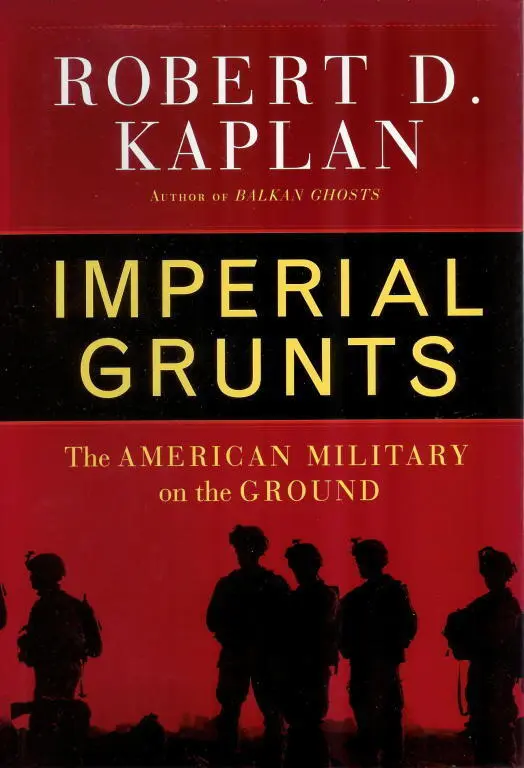
- Название:Imperial Grunts
- Автор:
- Издательство:Random House
- Жанр:
- Год:2005
- Город:New York
- ISBN:978-0-307-27850-0
- Рейтинг книги:5 / 5. Голосов: 1
-
Избранное:Добавить в избранное
- Отзывы:
-
Ваша оценка:
Imperial Grunts: краткое содержание, описание и аннотация
Предлагаем к чтению аннотацию, описание, краткое содержание или предисловие (зависит от того, что написал сам автор книги «Imperial Grunts»). Если вы не нашли необходимую информацию о книге — напишите в комментариях, мы постараемся отыскать её.
Imperial Grunts — читать онлайн бесплатно полную книгу (весь текст) целиком
Ниже представлен текст книги, разбитый по страницам. Система сохранения места последней прочитанной страницы, позволяет с удобством читать онлайн бесплатно книгу «Imperial Grunts», без необходимости каждый раз заново искать на чём Вы остановились. Поставьте закладку, и сможете в любой момент перейти на страницу, на которой закончили чтение.
Интервал:
Закладка:
Philippines, Special Forces did not fight so much as train those who did, in Afghanistan Green Berets were unleashed to both train and assist in combat operations. Afghanistan constituted a throwback to the early days in Vietnam.
CIA operatives had been the first to arrive: in late September 2001 they were airdropped into northern Afghanistan to prepare for the insertion of Green Beret A-teams from the 5th Special Forces Group, which covers the Greater Middle East and is based out of Fort Campbell, Kentucky. The CIA operatives made contact with the Afghan Northern Alliance. Dominated by ethnic Tajiks and Uzbeks, the Northern Alliance represented the principal opposition to the Pushtun Taliban.
The Northern Alliance had recently suffered a major blow when al-Qaeda assassinated its leader, Ahmad Shah Massoud, two days before 9/11. Massoud, an ethnic Tajik and moderate Islamist, had been Afghanistan’s greatest guerrilla asset against the Soviets. The Northern Alliance was essentially an outgrowth of his own military genius. With Massoud dead, it would be the job of 5th Group’s A-teams to help fill the organizational gap within the Northern Alliance, as well as to give its Tajik and Uzbek commanders the tactical edge they required against the Taliban, an edge to be provided by high technology.
At the same time, 5th Group teams were preparing to infiltrate the Kandahar region of southern Afghanistan, to help the forces of moderate Pushtuns such as Hamid Karzai.
Upon their arrival in Afghanistan in mid-October 2001, the Special Forces A-teams traveled primarily on horseback, about fifteen miles a day, meeting local commanders and coordinating attacks. In coming weeks each of these small teams would be responsible for the destruction of hundreds of Taliban vehicles and thousands of enemy troops. They were true force multipliers.
The heart of this force multiplication was the three-man close air support units within each A-team, often composed of two Special Forces soldiers and an embedded specialist from the U.S. Air Force. The three operators would usually crouch behind a mound of dirt and set up their equipment: a rubberized spotting scope and a laser designator that resembled a pair of giant binoculars mounted on a tripod. The laser designator shot out a beam to pinpoint the target, so that a laser-guided bomb fired by an aircraft overhead could strike it. 10
A typical Green Beret/Air Force team would often be surrounded by scores of Taliban troops as close as a hundred yards away in all directions. Amidst the clutter of radios, terrain maps, and mortars, in addition to the scopes and laser designators, the three men would calmly vector American pilots overhead onto the targets. 11It was such sound-and-light performances that won the A-teams the crucial edge of respect they required from the Northern Alliance as well as from Karzai’s troops.
Among the more gifted of such sound-and-light experts was ODA-574’s 18 Echo, or communications specialist, Sgt. First Class Dan Petithory of Cheshire, Massachusetts. Sgt. Petithory’s adroitness at close air support in southern Afghanistan helped save Hamid Karzai’s life. Sgt. Petithory was killed forty-eight hours before the fall of Kandahar, in a blue-on-blue friendly-fire incident when a satellite-guided bomb was incorrectly programmed. [45] Also killed in the incident were Sgt. Brian Cody Prosser of California and the team sergeant, Master Sgt. Jefferson Davis of Tennessee. Robin Moore’s book The Hunt for Bin Laden: Task Force Dagger (New York: Random House, 2003) fills a significant gap in war coverage by detailing this and much else.
It is a small world that we inhabit sometimes, for Petithory was from the same area of western Massachusetts as I. His father delivered my local newspaper.
A-team members grew beards and longish hair, and wore flat woolen caps from the Hindu Kush known as pakols. They went as native as they needed to, in order to be credible in the local landscape. From my own experience living with Afghan mujahedin in the 1980s, it made perfect sense. Inside Afghanistan, no male was taken seriously if he had not grown a beard. Though many conventional thinkers inside the Pentagon were aghast at the news photos of American troops on horseback in native garb, unconventional warriors like Gen. Brown and retired Maj. Gen. Shachnow smiled and understood.
The push into Kabul by the Northern Alliance, assisted by 5th Group Green Berets, began November 11, 2001, and ended victoriously two days later. The territorial gains would be consolidated by the Marines and the Army’s 10th Mountain Division. By giving the Green Berets an active combat role, Operation Enduring Freedom in Afghanistan had closed a circle with Vietnam.
If history could stop at that point, it would have been an American success story. But history, like the intertwining of war and politics as defined by the Prussian general Clausewitz, does not stop. By the autumn of 2003 when I arrived in Afghanistan, the Taliban had regrouped to fight a guerrilla struggle against the American-led international coalition—similar to the struggle that the mujahedin had waged against the Soviets. With hit-and-run attacks across a dispersed and mountainous battlefield, and a new national army that needed to be trained and equipped, Afghanistan still constituted a challenge better suited to Special Operations forces than to the conventional military.
The Joint Special Operations Task Force that functioned within the CJTF-180 was about the same size as the JSOTF at Zamboanga in the Philippines. But after I spent the first two nights at Bagram in one of the hundreds of tents housing CJTF-180’s support personnel, the comparatively smaller JSOTF—which lay bureaucratically within, yet physically isolated from, the CJTF-180—felt intimate almost, especially after I had spotted familiar faces from Fort Bragg. [46] The sector of Bagram where the JSOTF was located was called “Camp Vance,” after Sgt. First Class Gene Arden Vance, a West Virginia National Guardsman killed in the Afghanistan-Pakistan border area in May 2002.
The food was better, as the fruit and vegetables were bought locally. “Yeah, compared to the rest of Bagram, we’re living large here,” one of the majors from Fort Bragg told me.
Technically, it was a C-JSOTF, a Combined Joint Special Operations Task Force, because of the presence of special operators from not only the U.S. but the United Arab Emirates and Lithuania, too. The Lithuanians distinguished themselves by their handy decision to bring a pregnant cat along on the deployment, which produced kittens that in turn killed the field mice in their barracks.
Though the Special Operations community constituted only about 10 percent of the CJTF-180’s forces, it was responsible for half of the intelligence gathered, half the prisoners captured, and half the “bad guys” killed. This was not surprising. The bigger the military force, often the smaller the percentage of troops engaged in substantive activities. Washington, in particular, had a way of “piling on,” creating an unnecessarily large footprint with high numbers of support personnel. As I would learn upon venturing deeper into Afghanistan, Bagram had just too many upper-level officers micro-managing field operations.
The Special Operations commander at Bagram was Col. Walter Herd, a stiff-mannered Kentuckian with a short crop of iron gray hair and a hardscrabble border state accent. If the U.S. Army was stereotypical enough to have had an official accent, Col. Herd’s might have been it. In his tent, late one night, Col. Herd took less than five minutes to tersely summarize the situation in Afghanistan. As he began, I noticed that on his desk, waiting to be hung, was a black-and-white photo of Col. Cornelius Gardner, a hero of the Philippine War, who, as a commander in southern Luzon, put particular emphasis on civil affairs and indigenous self-government as a tool of pacification, and also blew the whistle on human rights abuses committed by U.S. troops.
Читать дальшеИнтервал:
Закладка:
Похожие книги на «Imperial Grunts»
Представляем Вашему вниманию похожие книги на «Imperial Grunts» списком для выбора. Мы отобрали схожую по названию и смыслу литературу в надежде предоставить читателям больше вариантов отыскать новые, интересные, ещё непрочитанные произведения.





Обсуждение, отзывы о книге «Imperial Grunts» и просто собственные мнения читателей. Оставьте ваши комментарии, напишите, что Вы думаете о произведении, его смысле или главных героях. Укажите что конкретно понравилось, а что нет, и почему Вы так считаете.