Robert Kaplan - Imperial Grunts
Здесь есть возможность читать онлайн «Robert Kaplan - Imperial Grunts» весь текст электронной книги совершенно бесплатно (целиком полную версию без сокращений). В некоторых случаях можно слушать аудио, скачать через торрент в формате fb2 и присутствует краткое содержание. Город: New York, Год выпуска: 2005, ISBN: 2005, Издательство: Random House, Жанр: Публицистика, nonf_military, на английском языке. Описание произведения, (предисловие) а так же отзывы посетителей доступны на портале библиотеки ЛибКат.
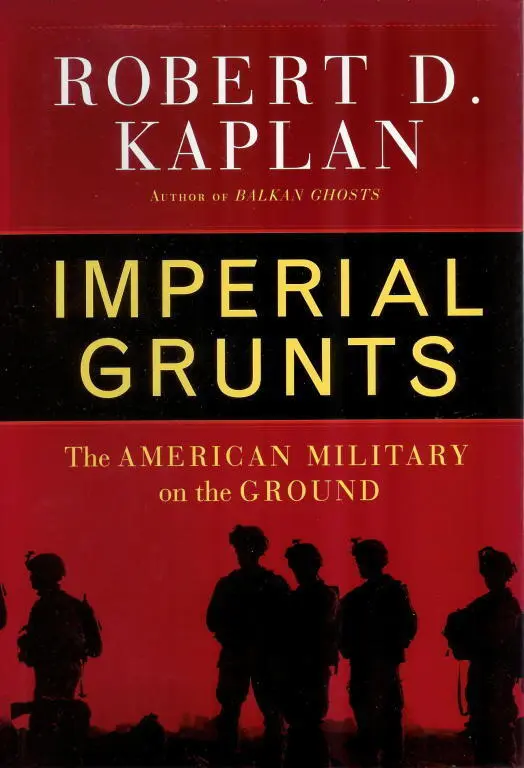
- Название:Imperial Grunts
- Автор:
- Издательство:Random House
- Жанр:
- Год:2005
- Город:New York
- ISBN:978-0-307-27850-0
- Рейтинг книги:5 / 5. Голосов: 1
-
Избранное:Добавить в избранное
- Отзывы:
-
Ваша оценка:
Imperial Grunts: краткое содержание, описание и аннотация
Предлагаем к чтению аннотацию, описание, краткое содержание или предисловие (зависит от того, что написал сам автор книги «Imperial Grunts»). Если вы не нашли необходимую информацию о книге — напишите в комментариях, мы постараемся отыскать её.
Imperial Grunts — читать онлайн бесплатно полную книгу (весь текст) целиком
Ниже представлен текст книги, разбитый по страницам. Система сохранения места последней прочитанной страницы, позволяет с удобством читать онлайн бесплатно книгу «Imperial Grunts», без необходимости каждый раз заново искать на чём Вы остановились. Поставьте закладку, и сможете в любой момент перейти на страницу, на которой закончили чтение.
Интервал:
Закладка:
Holiday had served with the Army’s 82nd Airborne Division before returning to civilian life and joining Special Forces as a Florida National Guardsman. His long months of National Guard duty had not pleased his private employer, so he left his job and went to work as a civil engineer for the state of Florida, where he could wear his Army uniform to work. “You see all this around you,” he said, eyeing the dust, the engine grease, and mudbrick walls; “well, it’s the high point of my life and of everyone else here.”
Truly, looking at the American and Texas flags, the Alamo-style fort, the high-desert landscape with its limitless scale, and the Afghan-cum–Wild West regalia of the troops, they seemed to be living an American myth.
“What about the beards?” I asked.
Maj. Holiday smiled, deliberately rubbing his chin. “The other day I had a meeting at the provincial governor’s office,” he replied. “All these notables came in and rubbed their beards against mine, a sign of endearment and respect. I simply could not get my message across in these meetings unless I made some accommodations with the local culture and values. Afghanistan is not like other countries. It’s a throwback. You’ve got to compromise and go a little native. Another thing,” he went on, “ever since 5th Group was here in ‘01, Afghans have learned not to tangle with the bearded Americans. Afghanistan needs more SF, less conventional troops, but it’s not that easy because SF is already overstretched in its deployments.”
Holiday had a tough, lonely job. He was the middleman between the firebase and Bagram. Bagram wanted no beards, no alcohol, no porn, no pets, and very safe, well-thought-out missions. The guys here wanted to go wild and crazy, breaking all the rules just as 5th Group had done in the early days of the War on Terrorism, before the CJTF-180 was stood up; before the Big Army entered the picture, with its love of regulations and hatred of dynamic risk. A monastic existence of sorts had evolved here, with its own code of conduct.
Holiday had to sell the missions and plead understanding for the beards and ball caps with the C-JSOTF, which, in turn, was under similar pressures from the CJTF-180. On one occasion, when the guys were watching a particularly raunchy Italian porn movie during chow, Holiday came in and turned it off, saying, “That’s enough of that; keep that stuff hidden, please.” An angered silence ensued, but the iron major got his way. Holiday, though an evangelical Christian, was no prude. He was only being sensible. If we are going to flout the rules, he seemed to be saying, we have to at least be subtle about it.
I found a cot inside one of the tents and unraveled my sleeping bag on it, then walked around, climbed the ramparts, talked to people, and in general let myself be amazed by the sawdust landscape and the dust devils constantly kicking up in the direction of the “two tits.” Chief Warrant Officer III Neville Shorter helped me get settled, finding me some extra blankets to put over the sleeping bag during the subfreezing nights. Chief Shorter, an African-American man with a gray beard who had been a real Special Forces stud in his younger years at the dive school in Key West, had aged into a good-natured, fine-mannered gentleman. His mastering, almost mothering type of personality, which quietly directed everything from inventories to vehicle maintenance, was the essence of what James Jones meant when he idealized those who really knew how “to soldier.”
I can’t remember whether it was Chief Shorter or someone else who warned me that I would have to pass “the sniff test.” As I had suspected, not everyone here was Special Forces. There was a sprinkling of OGAs, representatives from other governmental agencies, which usually meant the CIA, Defense Intelligence Agency, and the like. They were in a similar situation as I. To see the front line in the War on Terrorism it was necessary to stay at a Special Forces firebase. And no matter who you were, if the “boys” didn’t like you, they made sure you didn’t see much. Maj. Gen. Lambert at Fort Bragg, Gen. Brown at SOCOM, and a few others might have gotten me here, but ultimately it would be the team sergeants who decided what I could actually do. And that’s the way it should be, I thought.
I had started growing a beard a week before my arrival here. Still, the first days were a bit rough. No, I couldn’t go out on this patrol mission, it was too dangerous. No, I couldn’t go out on that mission either. While waiting to see if I passed the sniff test, I met “Big Country.” Big Country had a big reddish beard, and was from Louisiana. He sported an LSU ball cap. He lived next door in another mud-walled fort, which belonged to the local PRT (provincial reconstruction team), a civil affairs element stood up by the CJTF-180. Big Country was a “terp,” an interpreter. He spoke passable Pushtu and gave me a tour of the nearby town of Gardez.
A scraggly dust-bleached growth of eucalyptus and poplar trees in the otherwise milk-coffee color of death heralded Gardez. Then came a massive and venerable glacis, topped by a yawning line of ramparts, where the provincial governor was headquartered, and the Taliban and Soviets before him. The ancient citadel had been, for a short time in the first centuries of the Common Era, the seat of the Kushanids, a dynasty that spread Buddhism throughout the Indus Valley into China. Later, in the early Islamic period, Gardez became a base for the Kharijites, a tribal movement opposed to the centralizing tendencies of the Umayyad caliphs in Damascus. More recently, Gardez was known as a center of the Ghilzai Pushtuns, a major branch of the Pushtuns that was well represented in the Soviet-sponsored regimes of the late 1970s and the 1980s, as well as in the resistance against them. [50] Pro-Soviet Afghan rulers Nur Mohammed Taraki, Hafizullah Amin, and Najibullah, and anti-Soviet radical mujahedin leaders Gulbuddin Hekmatyar and Rasul Sayyaf were all Ghilzais, prompting one expert to note that in the latter part of the twentieth century power in Afghanistan had passed from the Durrani Pushtuns to the Ghilzai Pushtuns. See Ludwig W. Adamec’s Historical Dictionary of Afghanistan (London: Scarecrow, 1997), pp. 123–24.
By the standards of Afghanistan in 2003, Gardez was a success story:
no massive violence, not even an atmosphere of tension. By any other standard Gardez was a wreck: crumbling storefronts lined by water channels where water had not run in decades, and which were now filled with garbage. (Besides a quarter-century of war, Afghanistan was in the seventh year of a drought.) The pungent smells of spices and rotting fruit, the wooden-poled pavilions, the turbans, the felt and topi caps with inlaid mirrors, the garishly painted Bedford “jingle” trucks, and the deep chocolate complexions of the inhabitants all indicated the closeness of India.
Run down by war though it was, Gardez still felt a lot safer than Arauca on the Colombian-Venezuelan border. Roman Catholicism provided Colombia with much less social cohesion than Islam provided Afghanistan.
Beautiful little dark-haired girls in flamboyant-colored fabrics waved at our vehicle. “They’re burka -ed when they’re thirteen, have breast-fed five kids by the time they’re thirty. By then, they look like sixty,” Big Country remarked. After the Taliban fell, the burka, which conceals a woman’s face and the rest of her body, had been really removed only in certain areas of Kabul. The fact was that the Taliban, being tribal Pushtuns, were closer to the indigenous culture than many of the Westernized Afghans favored by the Americans. In the Philippines, T & A meant “tits and ass”; in Afghanistan, as U.S. soldiers quipped, it meant “toes and ankles,” because that’s all you could see.
Читать дальшеИнтервал:
Закладка:
Похожие книги на «Imperial Grunts»
Представляем Вашему вниманию похожие книги на «Imperial Grunts» списком для выбора. Мы отобрали схожую по названию и смыслу литературу в надежде предоставить читателям больше вариантов отыскать новые, интересные, ещё непрочитанные произведения.




Обсуждение, отзывы о книге «Imperial Grunts» и просто собственные мнения читателей. Оставьте ваши комментарии, напишите, что Вы думаете о произведении, его смысле или главных героях. Укажите что конкретно понравилось, а что нет, и почему Вы так считаете.