Robert Kaplan - Imperial Grunts
Здесь есть возможность читать онлайн «Robert Kaplan - Imperial Grunts» весь текст электронной книги совершенно бесплатно (целиком полную версию без сокращений). В некоторых случаях можно слушать аудио, скачать через торрент в формате fb2 и присутствует краткое содержание. Город: New York, Год выпуска: 2005, ISBN: 2005, Издательство: Random House, Жанр: Публицистика, nonf_military, на английском языке. Описание произведения, (предисловие) а так же отзывы посетителей доступны на портале библиотеки ЛибКат.
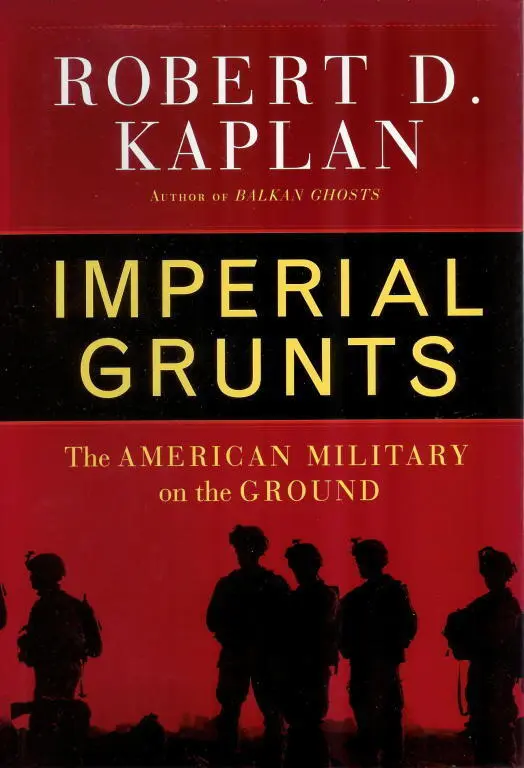
- Название:Imperial Grunts
- Автор:
- Издательство:Random House
- Жанр:
- Год:2005
- Город:New York
- ISBN:978-0-307-27850-0
- Рейтинг книги:5 / 5. Голосов: 1
-
Избранное:Добавить в избранное
- Отзывы:
-
Ваша оценка:
Imperial Grunts: краткое содержание, описание и аннотация
Предлагаем к чтению аннотацию, описание, краткое содержание или предисловие (зависит от того, что написал сам автор книги «Imperial Grunts»). Если вы не нашли необходимую информацию о книге — напишите в комментариях, мы постараемся отыскать её.
Imperial Grunts — читать онлайн бесплатно полную книгу (весь текст) целиком
Ниже представлен текст книги, разбитый по страницам. Система сохранения места последней прочитанной страницы, позволяет с удобством читать онлайн бесплатно книгу «Imperial Grunts», без необходимости каждый раз заново искать на чём Вы остановились. Поставьте закладку, и сможете в любой момент перейти на страницу, на которой закончили чтение.
Интервал:
Закладка:
ODA-2027 offered the perfect introduction for what I would encounter at the firebases in southeastern and southern Afghanistan.
With troops jammed elbow-to-elbow along the sides, divided by a high wall of mailbags and rucksacks, the CH-47 Chinook, followed by its Apache escort, lifted up off the pierced steel planking that the Soviets had left behind at Bagram. The rear hatch was left open for the M-60 7.62mm mounted gun, manned by a soldier strapped over the edge. Behind the gun, the medieval landscape of Afghanistan fell away: mud-walled castles and green terraced fields of rice, alfalfa, and cannabis on an otherwise gnarled, sandpaper vastness, pockmarked by steep canyons and volcanic slag heaps. The rusty, dried-blood hue of some of the hills indicated iron ore deposits; the drab green colors copper and brass. Because of the drone of the engine, everyone wore earplugs. Nobody talked. Soon, like everyone else, I fell asleep.
An hour later the Chinook descended steeply amid twisted cindery peaks. After it hit the ground, those of us headed for the Gardez firebase grabbed our rucksacks and ran off amid the wind and dust generated by the propellers. At the same time, another group of soldiers, waiting on the ground, ran inside. The crew threw off the mailbags. Then two men placed a hooded figure with a number scrawled on his back and his hands tied in flex cuffs onto the helicopter. In less than five minutes, the Chinook, its engine still beating loudly, roared back up into the sky.
The handcuffed man concealed under a burlap sack was a PUC, person under control, the U.S. military term for its temporary detainees in the War on Terrorism. It had become a verb: to take someone into custody was “to PUC him.” The men who had firmly placed the PUC onto the Chinook, en route to Bagram where he would be interrogated, were members of an Army Special Forces A-team at the Gardez firebase. But they didn’t look like any of the Green Berets I had so far encountered in my travels. These Green Berets had thick beards and wore traditional Afghan kerchiefs ( deshmals ) around their necks and over their mouths. Covering their heads were either Afghan pakols or ball caps with some gas station or firearms insignia. Except for their camouflage pants, M-4s, and Berettas, there was nothing to specifically identify them with the U.S. military. They looked like the photos of the Special Forces troops on horseback inside Afghanistan two years earlier that had mesmerized the American public and horrified the old guard at the Pentagon. They were all gummed with dust like sugarcoated cookies.
I threw my rucksack in the back of one of their Toyota pickups and we drove to the firebase, a few minutes away. There was a science fiction quality to the landscape, which seemed dead of all life-forms. Near the fort were two distinctive hills that the driver referred to as “the two tits.”
The Gardez firebase was a traditional yellow, mud-walled fort with the flags of the United States, the state of Texas, and the Florida Gators football team flying from the top of its ramparts. The flags were not necessarily inappropriate. Guardsmen technically are deployed by their state governors. Surrounded by barren hills on a tableland 7,600 feet above sea level, the fort looked like a cross between the Alamo and a French foreign legion outpost. Outside the walls were the familiar HESCO barriers and mountains of “tuna cans,” filled with Chinese and Russian ammunition that Special Forces had captured from “the bad guys.”
An armed Afghan militiaman opened the creaky gate. Inside, caked and matted with “moondust,” as everyone called it, stood double rows of up-armored Humvees, armed ground mobility vehicles, and Toyota Land Cruisers: the essential elements of a new kind of “convoy” warfare, in which Special Operations was adapting more from the Mad Max tactics of the Eritrean and Chadian guerrillas of recent decades than from the cow and oxen tank armies of the passing industrial age. [49] In the history of modern imperialism this was not unusual. At the turn of the twentieth century in the Sahara Desert, the French military found it necessary to shift from “sedentary infantry to mobile, camel-mounted troops.” Douglas Porch, The Conquest of the Sahara (New York: Knopf, 1984), p. 251.
Hidden behind the vehicles and veils of swirling dust were canvas tents, a few pissers, a crude shower facility, and the perennial Special Forces standby—a weight room. Like my escorts, everyone here was either a muscular Latino or a white guy dressed like an Afghan-cum-convict-cum-soldier. Half of them smoked. Like Col. Tom Wilhelm in Mongolia, they put Tabasco sauce on everything. Back at home most owned firearms. They bore an uncanny resemblance to the freelance journalists who had covered the mujahedin war against the Soviets two decades earlier here.
“Welcome to the Hotel Gardez,” said a smiling and bearded Maj. Kevin Holiday of Tampa, Florida. Maj. Holiday was the commander of this firebase and of another farther south in Zurmat. “Within these walls we have ODB-2070 and two A-teams, 2091 and 2093,” he told me in rapid-fire fashion. “Next door, living with an Afghan National Army unit, is 2076. Down at Zurmat is 2074. Most of us are 20th Group guardsmen from Florida and Texas, here for nine months.” There was also a tent full of active duty 7th Group guys on a ninety-day deployment—the Latinos. “We’re the damn Spartans,” Maj. Holiday said, smiling again, “physical warriors with college degrees.”
From Firebase Gardez, Maj. Holiday’s “Spartans” launched sweeps across Paktia Province, trying to snatch infiltrators from Pakistan. “All the bad guys are coming from Waziristan,” said Holiday, referring to a Pakistani tribal agency. “Because of the threat from Pakistan, there is not much civil affairs stuff going on here. It’s too dangerous.” Officially, the Pakistani government of President Pervez Musharraf was an ally of the U.S. But Musharraf, like his predecessors, and like the British before them, had insufficient control over the unruly tribal areas. Pakistan is the real enemy was a phrase that I quickly got used to hearing.
“Who was the PUC they put on the Chinook when I arrived?” I asked Maj. Holiday.
“We hit a compound. It had zero-time grenades, seven RPGs, Saudi passports, and books on jihad. The PUC lived there. We’ve got more people to round up from that hit.
“Everything we do,” he went on, repeating a phrase I had heard often already, “is ‘by,’ ‘through,’ ‘with’ the indigs. The ANA [Afghan National Army] comes along on our hits. Though the AMF [tribally based Afghan Militia Forces] are the real stand-up guys. They see themselves as our personal security element. Yeah, every time we go out on a mission we try to pick up a few hitchhikers—any Afghan who wants to be associated with what we do. Give the ANA and AMF the credit, put them forward in the eyes of the locals. We have to build up the ANA, it’s the only way a real Afghan state will emerge. But it’s naive to think you can simply disband the militias.”
The mud-walled fort was a “battle lab” for Special Forces, explained Maj. Holiday. The model was El Salvador in the 1980s: build up a national army while at the same time employing the paramilitaries, then help the paramilitaries to merge with the new army. The process would take years, a prospect Holiday relished. Another Special Forces officer, Lt. Col. David Maxwell, who had helped design the Basilan operation in the southern Philippines, had told me: counterinsurgency always requires the three p ’s—“presence, patience, and persistence.”
Holiday, who had just turned forty, seemed the most clean-cut of the fort’s inhabitants. A civil engineer with a master’s degree from the University of South Florida and three small children back at home, he was chatty, grammatical, and intense. “God has put me here,” he told me matter-of-factly. “I’m a Christian,” meaning an evangelical. “The best kind of moral leader is one who is invisible. I believe character is more important than education. I have noticed that people who are highly educated and sophisticated do not like to take risks. But God can help someone who is highly educated to take big risks.”
Читать дальшеИнтервал:
Закладка:
Похожие книги на «Imperial Grunts»
Представляем Вашему вниманию похожие книги на «Imperial Grunts» списком для выбора. Мы отобрали схожую по названию и смыслу литературу в надежде предоставить читателям больше вариантов отыскать новые, интересные, ещё непрочитанные произведения.



Обсуждение, отзывы о книге «Imperial Grunts» и просто собственные мнения читателей. Оставьте ваши комментарии, напишите, что Вы думаете о произведении, его смысле или главных героях. Укажите что конкретно понравилось, а что нет, и почему Вы так считаете.