Robert Kaplan - Imperial Grunts
Здесь есть возможность читать онлайн «Robert Kaplan - Imperial Grunts» весь текст электронной книги совершенно бесплатно (целиком полную версию без сокращений). В некоторых случаях можно слушать аудио, скачать через торрент в формате fb2 и присутствует краткое содержание. Город: New York, Год выпуска: 2005, ISBN: 2005, Издательство: Random House, Жанр: Публицистика, nonf_military, на английском языке. Описание произведения, (предисловие) а так же отзывы посетителей доступны на портале библиотеки ЛибКат.
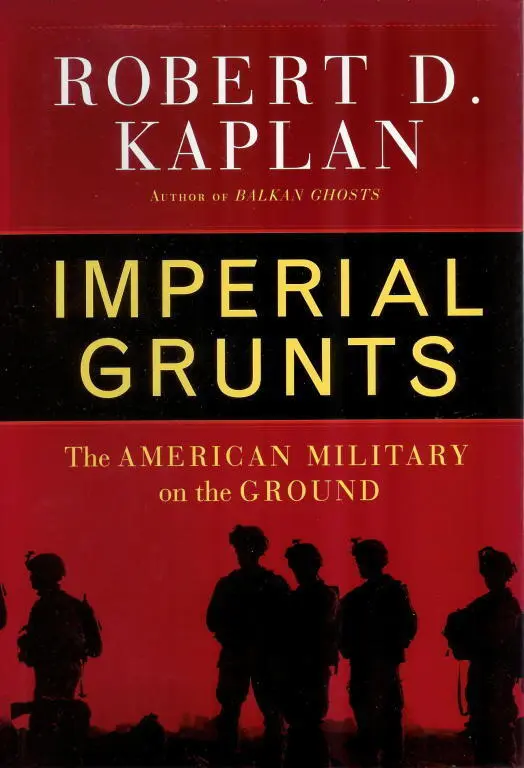
- Название:Imperial Grunts
- Автор:
- Издательство:Random House
- Жанр:
- Год:2005
- Город:New York
- ISBN:978-0-307-27850-0
- Рейтинг книги:5 / 5. Голосов: 1
-
Избранное:Добавить в избранное
- Отзывы:
-
Ваша оценка:
Imperial Grunts: краткое содержание, описание и аннотация
Предлагаем к чтению аннотацию, описание, краткое содержание или предисловие (зависит от того, что написал сам автор книги «Imperial Grunts»). Если вы не нашли необходимую информацию о книге — напишите в комментариях, мы постараемся отыскать её.
Imperial Grunts — читать онлайн бесплатно полную книгу (весь текст) целиком
Ниже представлен текст книги, разбитый по страницам. Система сохранения места последней прочитанной страницы, позволяет с удобством читать онлайн бесплатно книгу «Imperial Grunts», без необходимости каждый раз заново искать на чём Вы остановились. Поставьте закладку, и сможете в любой момент перейти на страницу, на которой закончили чтение.
Интервал:
Закладка:
The creation of SOCOM marked the most dramatic elevation of Special Operations since President Kennedy had awarded Army Special Forces the green beret. SOCOM comprised not only the various Army Special Forces groups, but the 75th Ranger Regiment, Navy SEALs, Air Force Special Operations squadrons, a provisional Marine detachment, and other commando-style units. The Nunn-Cohen Amendment, at least officially, made SOCOM a war-fighting command as well as a force provider—though in practice SOCOM rarely had operational control of missions in the manner that CENTCOM, PACOM, and the other area commands did.
It was the Global War on Terrorism—and particularly Secretary of Defense Donald Rumsfeld’s implementation of it—that made SOCOM a war-fighting command in more than name only. SOCOM was now supposed to be an area command just like the others, but with its area the entire earth, for if al-Qaeda constituted a seamless worldwide apparatus without bureaucratic impediments, so, too, it was thought, should SOCOM.
SOCOM, in theory, was to be the executive arm for the War on Terrorism. Yet, there was an inherent conflict between area commands that had operational control over specific geographic sectors and SOCOM, which could launch operations anywhere, on anybody’s turf. Therefore, SOCOM was still a work in progress. Nevertheless, it managed to run operations of some sort in 150 countries in 2003.
SOCOM’s was the only command whose budget came directly from Congress, not from the Pentagon. [42] In 2003 it was $5 billion out of a total defense budget of $364.7 billion, or 1.8 percent. About one third of that $5 billion was for salaries.
It dealt with a plethora of government agencies in addition to all the uniformed services and area commands. SOCOM’s bureaucratic flowchart was numbing in its complexity. Because post–Cold War challenges like nation-building were dependent on interagency cooperation, SOCOM’s success or failure as an interagency tool would provide a litmus test of sorts for how well America was able to fulfill its international obligations.
SOCOM’s activities were secret to a far greater degree than the other commands. Its “black SOF [Special Operations Forces]” missions against al-Qaeda in the Afghanistan-Pakistan border area were the dagger point of the War on Terrorism. The public affairs officer at SOCOM, Chet Justice, told me that journalists were rare there, and that was just fine with his bosses. Even the meeting rooms at SOCOM had coded locks on them. There was no buzz of activity inside SOCOM as there was at CENTCOM, just secretaries and brawny men in uniforms silently passing each other in the hallways. The command briefing I received began with these words from George Orwell:
People sleep peaceably in their beds at night only because rough men stand ready to do violence on their behalf.
The SOCOM commander at the time, Army Gen. Doug Brown, a four-star, had been an enlisted man, like his friend Sid Shachnow, the latter whom I had met at the horse farm in North Carolina. Both had gone to Officer Candidate School and risen through the ranks. Gen. Brown’s second in command, naval Vice Adm. Eric Olson, was a former SEAL. My conversations with them were off the record, yet the most interesting insight I obtained, oddly enough, was very much on the record. It was SOCOM’s four “enduring truths”:
• Humans are more important than hardware.
• Quality is better than quantity.
• Special Operations Forces cannot be mass-produced.
• Competent SOF cannot be created after emergencies occur.
Though they seem like clichés, they go against the grain of much of American military thinking in the twentieth century. And they go against what military historian Max Boot critically labels “the army way, the American way, the World War II way: find the enemy, fix him in place, and annihilate him with withering fire power.” 4Contrarily, SOCOM believed that small guerrilla-like groups of men, armed with linguistic and cultural expertise, were more effective than industrial-age tank and infantry divisions manned by citizen conscripts—the heroes of World War II. And because al-Qaeda was a worldwide insurgency, America had to fight a classic worldwide counterinsurgency. Thus, SOCOM commanders thought more about the Philippines of a hundred years ago, about the OSS units in Nazi-occupied France and Japanese-occupied Burma, and the Green Berets in Vietnam and El Salvador than they did about the two Gulf wars, Korea, and World War II.
While the area commands were still wedded to the conventional use of large armies, navies, and air forces, SOCOM was the Pentagon’s principal bureaucratic machine of unconventional war (UW). UW entailed not only commando-style raids but softer techniques like the humanitarian work on Basilan Island in the Philippines that had helped root out Islamic insurgents. Violence was not being discarded, but in the future it would be, to quote Sid Shachnow, “complementary rather than controlling.”
Success required a long-term continuous presence on the ground in scores of countries—quiet and unobtrusive—with operations harmonized through a central strategy, but with decentralized execution in the manner of the most successful global corporations, be it General Electric or al-Qaeda. 5
The Afghanistan-Pakistan borderlands were where the jurisdictions of SOCOM and the more conventionally oriented CENTCOM overlapped. How was it working?
This would be my first visit to Afghanistan and the Afghanistan-Pakistani borderlands since the spring of 2000, when I had traveled along the Northwest Frontier and did a profile of Hamid Karzai, then an obscure Afghan tribal leader. 6Before that, I had reported from Pakistan in the 1990s and covered the mujahedin war against the Soviet Union inside Afghanistan in the 1980s.
Whatever the maps might say, I had learned to view Afghanistan and Pakistan as a single political unit. This was not just the result of Pakistan’s intense involvement in the mujahedin war against the Soviet occupation and in the rise of Taliban extremists the following decade, but of simple geography and British colonial history. 7
Because the transition from the steamy lowlands of the Indian subcontinent to the arid moonscapes of Central Asia is gradual, the border between Afghanistan and Pakistan could never be precise. The border region—a thousand miles long and a hundred miles wide—is a deathly volcanic landscape of crags and winding canyons where the Indian subcontinent’s tropical floor pushes upward into Inner Asia’s high, shaved wastes. From Baluchistan north through the Pakistani “tribal agencies” of Waziristan, Kurram, Orakzai, Khyber, Mohmand, and Bajaur, near Peshawar—the destitute capital of Pakistan’s Northwest Frontier Province—there is an anarchic realm of highwaymen, tribal and religious violence, heroin laboratories, and arms smuggling.
The tribal Pushtuns (also known as Pathans), who controlled the frontier zone of eastern and southern Afghanistan, never accepted the arbitrary boundary between Afghanistan and colonial India (from which Pakistan later emerged): a boundary drawn in 1893 by the British envoy Sir Mortimer Durand. Moreover, the British bequeathed to the Pakistanis the belt of anarchic territories they called “tribal agencies,” which lay just east of the Durand Line. This had the effect of further confusing the boundary between settled land in Pakistan and the chaos of Afghanistan. Consequently, Pakistani governments always felt besieged—not only by India to the east but by Afghan tribesmen to the west. To fight India, in the Pakistani view, it was necessary to dominate Afghanistan.
Afghanistan did not truly exist until the middle of the eighteenth century. In 1747, Ahmad Khan, leader of the Abdali contingent of Nadir Shah the Great—the Persian king and conqueror of Moghul India—fled Persia with four thousand horsemen, following Nadir Shah’s assassination and the collapse of his regime. Ahmad Khan and his troops fled southeast out of Persia, to Kandahar.
Читать дальшеИнтервал:
Закладка:
Похожие книги на «Imperial Grunts»
Представляем Вашему вниманию похожие книги на «Imperial Grunts» списком для выбора. Мы отобрали схожую по названию и смыслу литературу в надежде предоставить читателям больше вариантов отыскать новые, интересные, ещё непрочитанные произведения.




Обсуждение, отзывы о книге «Imperial Grunts» и просто собственные мнения читателей. Оставьте ваши комментарии, напишите, что Вы думаете о произведении, его смысле или главных героях. Укажите что конкретно понравилось, а что нет, и почему Вы так считаете.