Robert Kaplan - Imperial Grunts
Здесь есть возможность читать онлайн «Robert Kaplan - Imperial Grunts» весь текст электронной книги совершенно бесплатно (целиком полную версию без сокращений). В некоторых случаях можно слушать аудио, скачать через торрент в формате fb2 и присутствует краткое содержание. Город: New York, Год выпуска: 2005, ISBN: 2005, Издательство: Random House, Жанр: Публицистика, nonf_military, на английском языке. Описание произведения, (предисловие) а так же отзывы посетителей доступны на портале библиотеки ЛибКат.
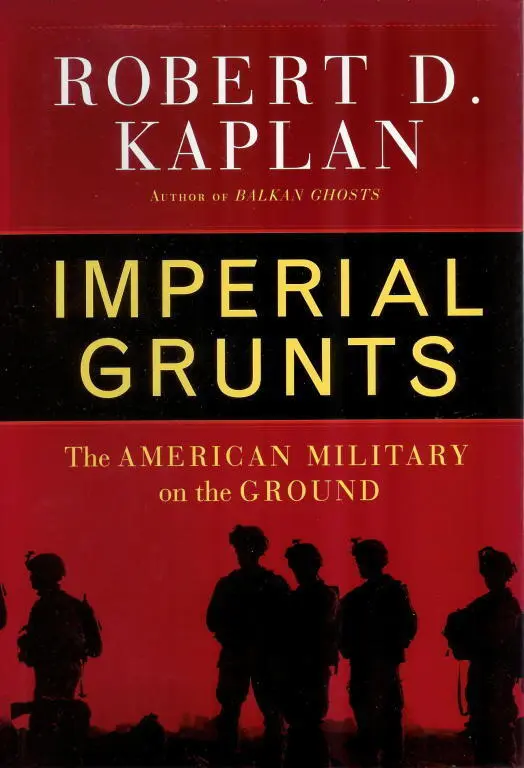
- Название:Imperial Grunts
- Автор:
- Издательство:Random House
- Жанр:
- Год:2005
- Город:New York
- ISBN:978-0-307-27850-0
- Рейтинг книги:5 / 5. Голосов: 1
-
Избранное:Добавить в избранное
- Отзывы:
-
Ваша оценка:
Imperial Grunts: краткое содержание, описание и аннотация
Предлагаем к чтению аннотацию, описание, краткое содержание или предисловие (зависит от того, что написал сам автор книги «Imperial Grunts»). Если вы не нашли необходимую информацию о книге — напишите в комментариях, мы постараемся отыскать её.
Imperial Grunts — читать онлайн бесплатно полную книгу (весь текст) целиком
Ниже представлен текст книги, разбитый по страницам. Система сохранения места последней прочитанной страницы, позволяет с удобством читать онлайн бесплатно книгу «Imperial Grunts», без необходимости каждый раз заново искать на чём Вы остановились. Поставьте закладку, и сможете в любой момент перейти на страницу, на которой закончили чтение.
Интервал:
Закладка:
I will put what he and others told me in my own words: The essence of military “transformation”—the Washington buzzword of recent years—is not new tactics or new weapons systems, but bureaucratic reorganization. In fact, such bureaucratic reorganization was achieved in the weeks following 9/11 by the 5th Special Forces Group based out of Fort Campbell, Kentucky, whose handful of A-teams, with help from the CIA and the Air Force, conquered Afghanistan by themselves.
The relationship between 5th Group and the highest levels of Pentagon officialdom had, in those precious, historic weeks of autumn 2001, evinced the flat bureaucratic hierarchy which distinguished not only al-Qaeda but also the most innovative global corporations. It was an arrangement that the finest business schools and management consultants would have been impressed with. The captains and team sergeants of 5th Group’s A-teams did not communicate to the top brass through a yawning, vertical chain of command. No, they weren’t even given specific instructions. They were just told to link up with the indigs (in this case the Northern Alliance) and help them defeat the Taliban. And to figure the details out as they went along.
The result was the empowerment of master sergeants to call in B-52 strikes. The 5th Special Forces Group was no longer a small part of a massive defense bureaucracy. It had become a veritable corporate spin-off, commissioned to do a specific job its very own way, in the manner of a top consultant.
The upshot was that con-ops (concepts of operation) were approved orally within minutes, whereas now in Afghanistan, two years later, it took three days of paperwork, with bureaucratic layers of lieutenant colonels and other senior officers delaying operations and diluting them of risk, so when attacks on suspect compounds finally took place, they often turned up dry holes.
There was no scandal here, no one specifically to blame. It was just the way that the Big Army—that is, Big Government, that is, Washington—always did things. It was the same reason a Joint Special Operations Task Force had been stood up in Zamboanga, in the southern Philippines, when a much smaller and leaner forward operating base would have done just as well. It was standard Washington “pile on.” Every part of the military wanted a piece of Afghanistan.
(Indeed, the further removed I got from Colombia, the more brilliant the Colombia model looked. In Colombia, the Green Berets were frustrated only because the rules of engagement were too restrictive. But that was a matter of high politics, not of military organization. Organizationally, the forward operating base located in the prefab cheesebox on the grounds of the U.S. Embassy in Bogotá and staffed by Lt. Col. Duke Christie’s A-team represented the perfect lean and mean structure for managing an unconventional war. Of course, such a bureaucratic structure threatened the Big Army.)
Soon after 5th Group had helped the Northern Alliance take Kabul, the U.S. occupation of Afghanistan was consolidated by the 10th Mountain Division, among other branches of the conventional military. By 2002, a Combined Joint Task Force (CJTF-180) was stood up, with a Combined Joint Special Operations Task Force (C-JSOTF) built inside that. Bagram became a base of thousands of troops, many of them REMFs. The days of the innovative flat hierarchy were over. It was back to the dinosauric, vertical bureaucracy of the industrial age, the greatest single impediment to America’s ability to wage a successful worldwide counterinsurgency.
As Lt. Col. Custer explained patiently to me: “It’s simply tragic. We don’t need Bagram. We have many more people there than we need, and they’re clogging up operations. Half of Bagram should be at K2 [Karsi-Khanabad] in Uzbekistan, where people like me wouldn’t be draining aviation resources needed by the firebases. CJTF-180 is located just too far forward. Bagram should be a lean FOB with a few shower units; that’s it. And these firebases should be AOBs [advanced operating bases] for even smaller garrisons of special operators located even further out. That’s UW [unconventional war].”
People referred to Bagram as “the self-licking ice cream cone,” which existed for the sake of PT (physical training) in the morning and a PX. If you visited only Bagram, nobody in Special Forces considered that you had even been to Afghanistan.
Custer continued, articulating better what so many others told me: “Big Army just doesn’t get it.” He smiled, like a persevering parent dealing with the antics of a child. “It doesn’t get the beards, the ball caps, the windows rolled down so that we can shake hands with the hajis and hand out Power Bars to the kids, as we do our patrols. Big Army has regulations against all of that. Big Army doesn’t understand that before you can subvert a people you’ve got to love them, and love their culture.
“The National Guard units of SF are more like the original SF and OSS than the active duty units,” he went on, “because the guard tolerates personal peculiarities. You can’t be effective in the War on Terrorism unless you break the rules of the Big Army. Army people are systems people. They think the system is going to protect them. Green Berets don’t trust the system. That’s really why you see us with all these guns. We know the Kevlar helmets may not stop a 7.62mm round. As they’ll tell you in 1st Group, you might as well wear a Thai Buddha around your neck. So we wear ball caps, they’re more comfortable. When you see a gunner atop an up-armor, bouncing up and down in the dust, breaking his vertebrae almost, let him wear a ball cap and he’s happy. His morale is high, because simply by wearing that ball cap he’s convinced himself that he’s fucking the system.
“Maybe in the future we’ll be incorporated into a new and reformed CIA rather than into the Big Army. Any bureaucracy that is interested in results more than in regulations will be an improvement. You see, I can say these things—I’m a guardsman.”
Custer explained the upcoming proposed mission, for which he was helping Maj. Holiday with the con-op. In northern Paktia, a certain Maulvi Jalani was making a lot of trouble for the Karzai government. [52] Maulvi is a Pushtun honorific to denote a respected imam or religious personage.
Jalani was an ally of Jalaluddin Haqqani, a former mujahedin leader associated with Saudi Wahabi extremists such as Osama bin Laden. Maj. Holiday wanted to hit Jalani’s compound near Sayed Kurram, where I had gone on the presence patrol a few days earlier.
But Bagram was risk-averse. It wanted helicopters employed in the mission, to reduce the risk of casualties. However, due to bureaucratic changes a generation earlier, Special Forces no longer had its own dedicated air support at the battalion level. It now had to fight for “air” with other Special Operations elements. Since the 10th Mountain Division “owned” helicopters, a piece of the mission could, according to Custer, be farmed out to 10th Mountain in order to get them. This was how different parts of the Big Army did business with each other these days. As the saying went, Amateurs discussed tactics, and rank amateurs discussed grand strategy, while the professionals discussed logistics.
Another freezing night sleeping in all my clothes. In the morning I got word of a mission that ODA-2076 next door was executing with its Afghan National Army contingent. I grabbed my body armor and fell in with a crew in a ground mobility vehicle. I rode in the back with two ANA soldiers: an ethnic Tajik and an ethnic Hazara manning a PKM, a Russian general purpose machine gun. [53] The Hazaras are a people of Mongolian origin who live in the mountains of central Afghanistan, and were converted to Shiism several hundred years ago by the Safavid rulers of Iran.
This really was a national army taking shape, I thought. It was not as if the government had merely recruited local Pushtuns and called it a national army.
Интервал:
Закладка:
Похожие книги на «Imperial Grunts»
Представляем Вашему вниманию похожие книги на «Imperial Grunts» списком для выбора. Мы отобрали схожую по названию и смыслу литературу в надежде предоставить читателям больше вариантов отыскать новые, интересные, ещё непрочитанные произведения.








Обсуждение, отзывы о книге «Imperial Grunts» и просто собственные мнения читателей. Оставьте ваши комментарии, напишите, что Вы думаете о произведении, его смысле или главных героях. Укажите что конкретно понравилось, а что нет, и почему Вы так считаете.