Robert Kaplan - Imperial Grunts
Здесь есть возможность читать онлайн «Robert Kaplan - Imperial Grunts» весь текст электронной книги совершенно бесплатно (целиком полную версию без сокращений). В некоторых случаях можно слушать аудио, скачать через торрент в формате fb2 и присутствует краткое содержание. Город: New York, Год выпуска: 2005, ISBN: 2005, Издательство: Random House, Жанр: Публицистика, nonf_military, на английском языке. Описание произведения, (предисловие) а так же отзывы посетителей доступны на портале библиотеки ЛибКат.
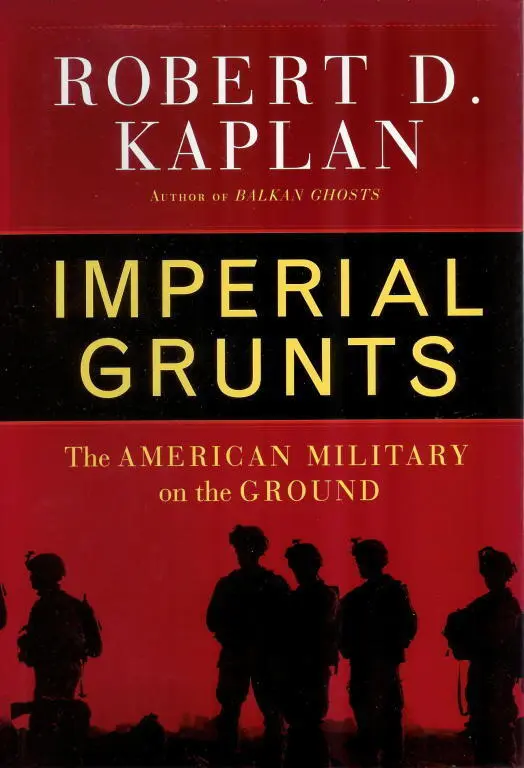
- Название:Imperial Grunts
- Автор:
- Издательство:Random House
- Жанр:
- Год:2005
- Город:New York
- ISBN:978-0-307-27850-0
- Рейтинг книги:5 / 5. Голосов: 1
-
Избранное:Добавить в избранное
- Отзывы:
-
Ваша оценка:
Imperial Grunts: краткое содержание, описание и аннотация
Предлагаем к чтению аннотацию, описание, краткое содержание или предисловие (зависит от того, что написал сам автор книги «Imperial Grunts»). Если вы не нашли необходимую информацию о книге — напишите в комментариях, мы постараемся отыскать её.
Imperial Grunts — читать онлайн бесплатно полную книгу (весь текст) целиком
Ниже представлен текст книги, разбитый по страницам. Система сохранения места последней прочитанной страницы, позволяет с удобством читать онлайн бесплатно книгу «Imperial Grunts», без необходимости каждый раз заново искать на чём Вы остановились. Поставьте закладку, и сможете в любой момент перейти на страницу, на которой закончили чтение.
Интервал:
Закладка:
Each question elicited a long conversation between the man and the terp. It was clear that the intelligence officer was missing a lot. He didn’t speak Pushtu beyond a few phrases. Finally, all he could say to the man was “If you ever have a problem, come and see me at the firebase,” as if the man would feel comfortable forsaking his kinsmen and trusting this most recent band of invaders passing through his land, invaders who couldn’t even communicate with him.
Here was where the American Empire, such as it was, was weakest. With all of its technology and willingness to send the most enterprising of its soldiers to the most distant parts of the world, it was woefully incompetent in linguistic skills, especially in places and in situations where it counted the most. This was another neglected part of defense “transformation” that had nothing to do with the latest weapons systems.
Early the next morning an eleven-year-old boy who had just stepped on an old Soviet land mine was brought to the front gate of the firebase in the back of a pickup. Suddenly the profanities stopped in the shower unit and in the chow hall, and everything went quiet and efficient, as several of the 18 Delta medics quickly brought the boy into the field clinic, injected him with morphine and a regimen of antibiotics, and went to work on his leg and shoulder. One of the medics did nothing but talk to the boy, telling him through a terp that he would be playing soccer the following week. Within a few minutes, about a third of the boy’s body was bandaged, a space blanket was wrapped around him, and internal e-mails to Bagram had spun up a chopper to medivac him there for an operation.
The boy was lucky. His accident had happened close to an American firebase. His limbs were saved in the operation, which took place later that day. He recovered fully. “That’s the gold standard,” said Maj. Holiday, “what that boy tells people back in his village about how the Americans helped him.”
The overwhelming reality of Afghanistan in 2003 was still the Soviet occupation, which had destroyed the tribal infrastructure, deforested the landscape, and sown it with as many as thirty million mines, all in places that the Soviets had not bothered to map. 15
That day I heard bad news. An internal e-mail had arrived from the firebase at Khost, which lay closer to the border with Pakistan. It was where I wanted to go next. The e-mail, from one of the team sergeants at Khost, informed Lt. Col. Custer that the firebase there was not owned by Special Forces, but by OGAs (people from other government agencies), and that they would have a shit fit if I showed up. In plain English, it meant that the CIA might be using the Khost firebase as a platform for cross-border infiltration into the Pakistani tribal agency of North Waziristan, possibly the “most evil place on earth,” as one U.S. military official had put it to me.
North Waziristan was where many of the HVTs (high-value targets) were thought to be hiding. It was where, by all logical standards, the Special Forces firebases really needed to be but weren’t, because of the fear of offending Musharraf’s regime. From the vantage point of the Gardez firebase, it seemed that the Bush administration policy toward a radical and nuclearizing Pakistan had become as feckless as the Clinton administration’s policy toward Taliban-ruled Afghanistan.
The CIA platform at Khost probably, I surmised, was part of an Afghanistan-Pakistan border operation that included the “black,” or secret, side of Special Forces, as well as the Army’s Delta Force and the SEALs. These elite units, dedicated to the hunt for high-value targets, of whom Osama bin Laden was the foremost, were not subject to the bureaucratic dysfunction that Custer and many others complained about. They functioned much like the 5th Group A-teams in the weeks following 9/11, before the CJTF-180 was stood up. They had their own dedicated air support, and were relatively unfettered by the Pentagon’s vertical, at times Soviet-style, bureaucracy.
But this did not solve the larger problem for these reasons:
• Catching high-value targets (HVTs) was dependent on catching middle-value targets (MVTs), and even low-value targets (LVTs), since the MVTs and LVTs provided intelligence on the HVTs. It was like the subway turnstile phenomenon. When New York City mayor Rudolph Giuliani was first elected, he arrested significant numbers of young men for low-level crimes such as jumping turnstiles. In many cases, they turned out to be wanted for more serious crimes, or at least could provide information on those who were. So as long as the Big Army impeded the hunt for MVTs and LVTs, the chances of catching HVTs were reduced.
• If more MVTs and LVTs were not apprehended, HVTs who were killed or captured would quickly be replaced by persons who were currently MVTs and LVTs. Indeed, it was the hunt for MVTs that was the real bread and butter of the War on Terrorism and the effort to stabilize the Afghan regime.
In any case, I was not welcome at Khost. Despondent, I hitched a ride on the back of a truck that was part of a convoy headed for Bagram. It was a bone-breaking, freezing journey in the dust, through a dizzying, almost vertical landscape of sheer rock, a crazed tangle of soft-shouldered hills that heaved upward into winglike formations of gray granite. Then we entered a wide valley of villages that might have been mistaken for archaeological ruins. The road was crowded with jingle trucks carrying vast quantities of timber off to Pakistan. We got into two accidents. In the second, a jingle truck smashed into us sideways, tearing off the iron rail on which I was leaning and sending me flying from one end of the truck to the other. Because of the body armor and helmet I was wearing, not only wasn’t I hurt, I barely felt a thing.
In Bagram, it was back to Zulu time, in which noon was 7:30 a.m. and sunset was 1:30 p.m. I began casting about for another trip, which meant hanging around, listening to conversations at the C-JSOTF, until fate intervened.
I had conversations with several civil affairs officers who had just returned from Herat in western Afghanistan and Mazar-e Sharif in the north. In both places, they told me, under the tutelage of the warlords Ismael Khan of Herat and Abdul Rashid Dostum of Mazar-e Sharif, there was relative order and a lot of rebuilding going on.
“Mazar is booming. There really isn’t much for the American military to do in those places,” one civil affairs officer told me. I was not surprised. It was common knowledge at Bagram that the least stable parts of the country were those ruled by the democratic, internationally recognized government.
In the chow hall, I ran into Col. Herd, and told him my problem with getting to Khost. He had a better idea. He would get me hooked up with the “Third of the Third”—the 3rd Battalion of the 3rd Special Forces Group—currently manning firebases in southern Afghanistan.
The next day, I hiked over to the airfield with my backpack, body armor, and helmet, in order to catch “Flash 43,” the next C-130 cargo plane flight to Kandahar.
At the C-JSOTF I had been warned about the departure procedures for the C-130 flights. “When they call your name, if you don’t answer immediately, or if you’ve gone to the head for a minute, they’ll scratch you from the flight. The Air Force NCOs [noncommissioned officers] there are bastards,” an Army guy had told me. I had to appear four and a half hours before departure; sometimes the planes left early, sometimes late, so you waited six or seven hours. I was shouted at and given contradictory instructions. But so was everyone else. There was nothing to eat. It was like the departure lounge of a dysfunctional third world country. Getting on the aircraft was like being released from forced confinement. REMFs, I thought.
Читать дальшеИнтервал:
Закладка:
Похожие книги на «Imperial Grunts»
Представляем Вашему вниманию похожие книги на «Imperial Grunts» списком для выбора. Мы отобрали схожую по названию и смыслу литературу в надежде предоставить читателям больше вариантов отыскать новые, интересные, ещё непрочитанные произведения.








Обсуждение, отзывы о книге «Imperial Grunts» и просто собственные мнения читателей. Оставьте ваши комментарии, напишите, что Вы думаете о произведении, его смысле или главных героях. Укажите что конкретно понравилось, а что нет, и почему Вы так считаете.