Robert Kaplan - Imperial Grunts
Здесь есть возможность читать онлайн «Robert Kaplan - Imperial Grunts» весь текст электронной книги совершенно бесплатно (целиком полную версию без сокращений). В некоторых случаях можно слушать аудио, скачать через торрент в формате fb2 и присутствует краткое содержание. Город: New York, Год выпуска: 2005, ISBN: 2005, Издательство: Random House, Жанр: Публицистика, nonf_military, на английском языке. Описание произведения, (предисловие) а так же отзывы посетителей доступны на портале библиотеки ЛибКат.
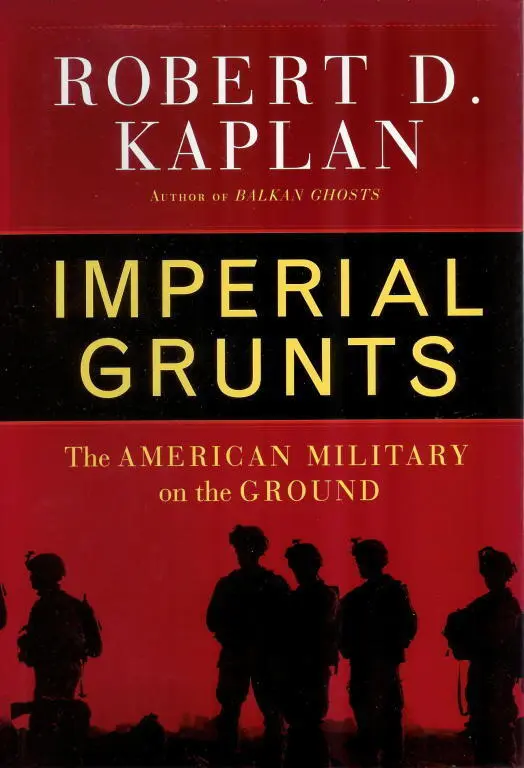
- Название:Imperial Grunts
- Автор:
- Издательство:Random House
- Жанр:
- Год:2005
- Город:New York
- ISBN:978-0-307-27850-0
- Рейтинг книги:5 / 5. Голосов: 1
-
Избранное:Добавить в избранное
- Отзывы:
-
Ваша оценка:
Imperial Grunts: краткое содержание, описание и аннотация
Предлагаем к чтению аннотацию, описание, краткое содержание или предисловие (зависит от того, что написал сам автор книги «Imperial Grunts»). Если вы не нашли необходимую информацию о книге — напишите в комментариях, мы постараемся отыскать её.
Imperial Grunts — читать онлайн бесплатно полную книгу (весь текст) целиком
Ниже представлен текст книги, разбитый по страницам. Система сохранения места последней прочитанной страницы, позволяет с удобством читать онлайн бесплатно книгу «Imperial Grunts», без необходимости каждый раз заново искать на чём Вы остановились. Поставьте закладку, и сможете в любой момент перейти на страницу, на которой закончили чтение.
Интервал:
Закладка:
The C-130 is one of the most venerable, dependable aircraft in the history of military aviation. But flying in one is not comfortable. Without windows, the enormous fuselage looks and feels like the darkened hull of a bobbing ship, or the backstage area of a run-down theater, or a creepy basement. It got even darker when the palettes were slid in and the hatch door closed. The plane steeply lumbered into the air, heavily vibrating. The descent after an hour of flying was steeper still, in order to avoid possible ground fire.
The hatch opened at KAF (Kandahar Air Field). In the smoky, glazy heat lay mountains that appeared like crouching dinosaurs on an immense pie-crust plateau. From previous trips to Kandahar fifteen and thirty years ago, I recalled this awesome flatness, periodically interrupted by singular rock sculptures, rising up hundreds and thousands of feet, which defined southern Afghanistan.
Outside the plane, I was grabbed by someone from the 3rd Special Forces Group and driven to the part of the airfield that served as the 3rd Battalion’s forward operating base, commanded by Lt. Col. Rand Binford of Houston.
Unlike the original 10th Special Forces Group, which grew out of the legacy of the OSS in Europe, and the 1st, 5th, and 7th groups, all of which were associated with particular parts of the world, 3rd Special Forces Group for a long time had been consigned to Africa, a nonstrategic second-rate theater for a long time in the eyes of the American military. But in recent years, 3rd Group had gotten its area of responsibility extended to the Middle East, and was lately on a roll. It was deployed to northern Iraq during Operation Iraqi Freedom, where it had linked up with the Kurds to attack elements of the Iraqi army’s 5th Corps, and it had been deployed twice to Afghanistan following the departure of 5th Group in early 2002. Third Group’s profile was now hard-bitten and aggressive.
Lt. Col. Binford’s FOB (forward operating base) was the former airport hotel for transit passengers during the bad old Taliban days, a ratty line of arched chambers and grim rooms with fluorescent lights, and cracked and cobwebbed toilets, that seemed perfect backdrops for interrogation and worse. Nearby was a junkyard of destroyed Soviet vehicles and aircraft.
Binford, with short gray hair and an in-your-face expression, told me, in a very deliberate manner: “I’m a blessed commander. I have bust-your-ass, hard-working soldiers, and our job is to kill these fuckers: to kill, capture, destroy, and disrupt the activities of the ACM [anti-coalition militias]. You’ll be with a DA [direct action] weapons company. It does smashmouth combat, often unilaterally, without ANA or other indigs. You may find these guys terse, standoffish, and hard on each other. Remember that their job is combat only, and they are professionals at it. Then they come back to their loved ones, retool, retrain, and go back on deployment. I look each wife in the eye before we deploy and say, ‘We’ve done everything we can to train your husband, in order to bring him back safely.’”
On September 11, 2001, Binford had been in the wing of the Pentagon that was destroyed by one of the hijacked jetliners. He had been all over Africa and the Middle East. We talked about the exploits of the Eritrean guerrillas, whom we both knew well. That got us on to the fighting qualities of the Taliban.
“Guns, drugs, and thugs come out of the opium trade,” Binford told me. “Between the drugs and the availability of weapons, the Taliban does not really need outside donors. The drug network sends couriers in and out through a ratline that leads right back to the Central Highlands,” he said, pointing on a map to a cluster of mountains in the center of Afghanistan, just north of Kandahar, near where the firebases under his command were located.
“What’s with the short hair and clean shave?” I asked, looking at him, feeling out of place because I was heavily bearded at this point in my trip.
He frowned. “You know Bagram,” he replied. “They made us shave.” He went on: “We’re launching a mission in a few days that you’ll be on. Yeah, we’re going to let you go out and play. The train-ups begin after midnight. The site is called Newark. It’s on the southeastern tip of the Central Highlands. A recon element has just gone out there—they were able to wear beards and indigenous garb. You’ll hear the details in the briefs and train-ups. Meanwhile, Commander Sherzai of the AMF has invited us to an iftar reception tonight. [Ramadan had recently begun with the new moon.] Go along. Look at who’s there. Don’t ask questions. Just observe. You’ll find it interesting.”
The reception was just outside the air base at Commander Abdul Raziq Sherzai’s fancy new headquarters, distinguished by a full-sized plastic palm tree decorated with Christmas lights: it looked like a prop from Disney World. Sherzai’s brother had been engaged in a power struggle of sorts with President Karzai; nevertheless, the Americans had found a need for his brother’s militia. The evening was a typical Middle Eastern attempt to seem Western, with awkward, uncomfortable chairs and couches, and tissues in place of napkins at the table. I noticed that beside Afghans and 3rd Group soldiers in uniform, there was a group of Americans, including a woman, all of whom were armed with rifles and guns. They dressed like Pushtuns, with beards and shalwars; the lady wore a traditional local dress. Some of them spoke Pushtun. They were referred to somewhat jokingly as Peace Corps workers. I asked no questions.
I had a few hours’ sleep before the mission train-up.
The brief was delivered by the mission commander, Maj. Paul Helms of Bossier City, Louisiana, a graduate of Louisiana State University at Shreveport. A tall and dark-haired Air Force brat who had lived around the world, Maj. Helms had a deep, gravelly voice reminiscent of George Clooney rather than a southern accent. He would be in charge as per standard operating procedure; Lt. Col. Binford would remain at the forward operating base.
The mission, Newark, Helms explained, would be serviced by Task Force Hawk, consisting of two CH-47 Chinooks to transport us to the strike zone, and a UH-60 Black Hawk and two AH-64 Apaches to serve as “aerial blocks,” and also for close air support if it was needed.
“We’re looking for a phone,” Maj. Helms said casually, describing the purpose of the mission: “a Thuraya cell phone that we’ll dub ‘moonbeam.’” Signals Intelligence had picked up a number of interesting calls on the Thuraya regarding Taliban finances and supplies. The user of the phone was a male whom Helms code-named “Nawab.” Nawab, apparently, was a legitimate businessman by day and a Taliban moneyman by night.
“We do not know what he looks like. We only know what he reveals in traffic,” Helms said. “He walks out into the fields to the north and south of his compound to make his calls, obviously searching for a strong signal. There is a long line of karezes issuing from the compound, which may contain contraband and which could take us hours to search,” he added, referring to a system of wells and tunnels, originally built for water storage, that are found in Afghanistan, Iran, and western Pakistan. [55] The more familiar, Arabic term is qanat.
“Nawab is a facilitator rather than an operator. He’s not from the muscle end of the ACM [anti-Coalition militias], so he’s not likely to resist. Thus, Newark is considered a CSS [combat service support] site, approved for SSE,” sensitive site exploration, which meant a slow and deliberate site search as opposed to a “kinetic strike.”
Because women and children had been seen in the compound, any shooting would have to be extremely discriminatory—another reason for a unilateral mission, without Afghan National Army or Afghan militia help.
Читать дальшеИнтервал:
Закладка:
Похожие книги на «Imperial Grunts»
Представляем Вашему вниманию похожие книги на «Imperial Grunts» списком для выбора. Мы отобрали схожую по названию и смыслу литературу в надежде предоставить читателям больше вариантов отыскать новые, интересные, ещё непрочитанные произведения.








Обсуждение, отзывы о книге «Imperial Grunts» и просто собственные мнения читателей. Оставьте ваши комментарии, напишите, что Вы думаете о произведении, его смысле или главных героях. Укажите что конкретно понравилось, а что нет, и почему Вы так считаете.