Robert Kaplan - Imperial Grunts
Здесь есть возможность читать онлайн «Robert Kaplan - Imperial Grunts» весь текст электронной книги совершенно бесплатно (целиком полную версию без сокращений). В некоторых случаях можно слушать аудио, скачать через торрент в формате fb2 и присутствует краткое содержание. Город: New York, Год выпуска: 2005, ISBN: 2005, Издательство: Random House, Жанр: Публицистика, nonf_military, на английском языке. Описание произведения, (предисловие) а так же отзывы посетителей доступны на портале библиотеки ЛибКат.
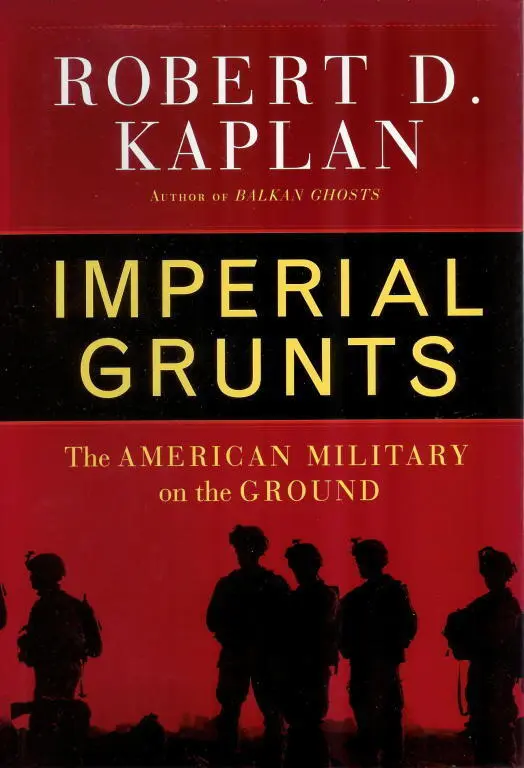
- Название:Imperial Grunts
- Автор:
- Издательство:Random House
- Жанр:
- Год:2005
- Город:New York
- ISBN:978-0-307-27850-0
- Рейтинг книги:5 / 5. Голосов: 1
-
Избранное:Добавить в избранное
- Отзывы:
-
Ваша оценка:
Imperial Grunts: краткое содержание, описание и аннотация
Предлагаем к чтению аннотацию, описание, краткое содержание или предисловие (зависит от того, что написал сам автор книги «Imperial Grunts»). Если вы не нашли необходимую информацию о книге — напишите в комментариях, мы постараемся отыскать её.
Imperial Grunts — читать онлайн бесплатно полную книгу (весь текст) целиком
Ниже представлен текст книги, разбитый по страницам. Система сохранения места последней прочитанной страницы, позволяет с удобством читать онлайн бесплатно книгу «Imperial Grunts», без необходимости каждый раз заново искать на чём Вы остановились. Поставьте закладку, и сможете в любой момент перейти на страницу, на которой закончили чтение.
Интервал:
Закладка:
Mattis had the reputation of a “warrior-monk,” a spartan fighter with deep moral convictions who was prodigiously well read in history and philosophy, even as he could communicate succinctly with lance corporals. He was a confirmed bachelor; his living quarters at Camp Pendleton were filled with maps and books. On his official résumé he chose to list only his commands, not other career paraphernalia. There was something minimalistic and vaguely Eastern about him—a gene almost, something which I had first detected in lesser degrees in Brig. Gen. Robeson and Capt. Cassidy in Djibouti. With Maj. Gen. Mattis it became sufficiently noticeable for me to identify.
The Prussian-style high-and-tight crew cuts and the cult of German Field Marshal Erwin Rommel that existed within the corps fooled a lot of people. In fact, the U.S. Marines came from the East, from the Orient. That was their spiritual tradition. It was the legacy of their naval landings throughout the Pacific, of the Marine legation guards during the Boxer Rebellion in China, of the “China Marines” in the 1920s, and, most of all, of the very didacticism of the Navy itself, the Marines’ sister service, which fit well with Eastern philosophy.
The Army had Clausewitz; the Marines Sun-Tzu. It was a Marine brigadier general, Samuel Blair Griffith II—who had served in China before and after World War II—who translated Sun-Tzu’s The Art of War in 1963 and Mao Zedong’s On Guerrilla War in 1978. [74] Lt. Gen. Griffith also earned the Navy Cross on Guadalcanal in September 1942 for “extreme heroism.”
Marines picked up on the local philosophy the same as they did the local food—not all marines obviously, not even most or many, but enough influential officers here and there so it filtered into the Marine character.
Embracing the local culture seemed to be particularly necessary in western Iraq, “where American military units,” as one journalist had written, “had come and gone so often that they had little time to understand their surroundings,” or to form meaningful relationships. [75] Michael Gordon, New York Times, Dec. 12, 2003. Gordon adds: In the Al-Fallujah area, the Army’s 82nd Airborne Division had been replaced by the 3rd Armored Cavalry Regiment, which was replaced in turn by the 2nd Brigade of the 3rd Infantry, which handed it back to the 3rd Armored Cavalry and then back to the 82nd Airborne again.
The Marines even had an acronym for the dual tasks that lay ahead—“winning hearts and minds” and “nation-building.” It was SASO (stability and security operations). SASO was the buzzword at Camp Pendleton in late January 2004. It represented a hope that the conventional application of military force in “OIF-I”—what the Marines called their deployment in Iraq the year before—would be followed up in “OIF-II” by a more subtle, unconventional use of military force, resulting in the stabilization of Iraq as a democratic society.
As I would see, these hopes died hard.
Kuwait was the jumping-off point for my journey into Iraq. An oil-rich Persian Gulf city-state like Dubai, from where I had flown to and from Afghanistan a few months back, Kuwait was different. Dubai had been a veritable luxury shopping mall, punctuated by designer restaurants, nightclubs offering Russian prostitutes, and service up to the highest Asian standards, with international staffs. At times in Dubai, I didn’t quite know where I was. Kuwait, however, was more traditional, with no alcohol and little flagrant prostitution, though Filipino cathouses were said to exist on Kuwait City’s outskirts. Many of Kuwait’s malls catered to a new Arab middle class rather than to a wealthy global elite. Unlike Dubai, whose Arabs and subcontinental Asians seemed like the smiling employees of one vast airport duty-free shop, Kuwait seemed an authentic mixture of Arabia and the Indian subcontinent. In the crumbly, crowded streets near my modest-priced hotel, Kuwait City brought back memories of my first visit to Baghdad twenty years earlier, during the Iran-Iraq War, prior to Saddam Hussein’s invasion of Kuwait that had set in motion the destruction of Iraq’s nascent prosperity.
My choice of a relatively cheap hotel was deliberate. The hardest, loneliest times on such trips were the days and hours before embedding, when you were particularly sensitive to the creature comforts you were about to give up. Nothing is worse for morale in these moments than lux-urious surroundings.
One morning, following a typical Middle Eastern breakfast of ful beans, green olives, goat cheese, fresh pita bread, and tea in the dowdy dining room of my hotel, where I seemed to be the only westerner, a Marine lieutenant colonel in civilian clothes drove up to the entrance, threw my backpack and duffel bag into the rear of a sport utility vehicle, and transported me northwest into the desert, the site of Camp Udari, the staging point for the Marine deployment to Iraq. An hour later I was back in the Kellogg, Brown & Root world of tents, palettes, shipping containers, chow halls, and acronyms. Vast lines of seven-ton trucks and Humvees stretched across the horizon, all headed north. The epic scale of America’s involvement in Iraq, so much larger than the other deployments I had been covering around the world, became quickly apparent.
The lieutenant colonel quickly passed me and my bags on to another officer, who drove me farther into the desert, to link up with the 1st Battalion of the 5th Marine Regiment, now part of Maj. Gen. Mattis’s First Marine Division. The 1st of the 5th as it was called, or simply “1/5,” had begun its field isolation the day before. In two days it would be crossing the border into Iraq.
Soon I was amidst two quarter-mile-long lines of Humvees and seven-ton trucks. A sandstorm had started. There was an icy wind. Rain threatened. Several officers and noncoms came up to me, introducing themselves. I was bewildered. It wasn’t just their desert cammies, ballistic sunglasses, and high-and-tights that made them look the same; that I was used to. It was also that they all had mustaches. The decision to grow mustaches had been made by 1/5’s commander, Lt. Col. Brennan Byrne, who believed that if his men looked a bit like Iraqis, winning hearts and minds might be easier. It would be days before I could distinguish many of his marines individually.
The two lines of humvees and seven-tons constituted Charlie Company, a subdivision of the 1st of the 5th. When I arrived, 1st Lt. David Denial of South Gate, California, was in the middle of a brief. He had an easel against the side of a Humvee, jerry-rigged with armored plates, making the Humvee into what the Marines called a hardback.
First Lt. Denial screamed above the wind and the Humvee’s idling engine: “If you’re forward of an explosion, haul ass a hundred meters in urban terrain, two hundred in rural; if you’re behind an explosion, un-ass a hundred meters in urban, two hundred in rural. If you make contact with the enemy, let me know. I’ll do the translation. I speak Army; not much, but I speak it. And explain the ROEs to your subordinate NCOs. This battalion killed civilians last year in OIF-I because in some cases it didn’t know the ROEs.”
The 1st of the 5th, which comprised just under a thousand marines, was a small part of the 1st Marine Division that would be replacing the Army’s 82nd Airborne Division in western Iraq. This formed a major piece of one of the largest troop movements in half a century, with roughly 250,000 soldiers and marines leaving and entering Iraq through the narrow umbilical cord of several bases in Kuwait, over a six-week period. Here was where the mass organizational know-how, borne of several major wars in the twentieth century, paid off for the U.S. military.
Читать дальшеИнтервал:
Закладка:
Похожие книги на «Imperial Grunts»
Представляем Вашему вниманию похожие книги на «Imperial Grunts» списком для выбора. Мы отобрали схожую по названию и смыслу литературу в надежде предоставить читателям больше вариантов отыскать новые, интересные, ещё непрочитанные произведения.








Обсуждение, отзывы о книге «Imperial Grunts» и просто собственные мнения читателей. Оставьте ваши комментарии, напишите, что Вы думаете о произведении, его смысле или главных героях. Укажите что конкретно понравилось, а что нет, и почему Вы так считаете.