Robert Kaplan - Imperial Grunts
Здесь есть возможность читать онлайн «Robert Kaplan - Imperial Grunts» весь текст электронной книги совершенно бесплатно (целиком полную версию без сокращений). В некоторых случаях можно слушать аудио, скачать через торрент в формате fb2 и присутствует краткое содержание. Город: New York, Год выпуска: 2005, ISBN: 2005, Издательство: Random House, Жанр: Публицистика, nonf_military, на английском языке. Описание произведения, (предисловие) а так же отзывы посетителей доступны на портале библиотеки ЛибКат.
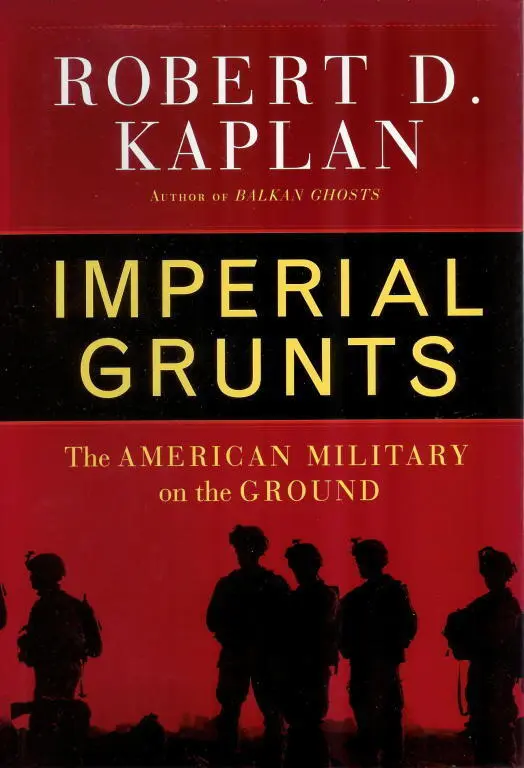
- Название:Imperial Grunts
- Автор:
- Издательство:Random House
- Жанр:
- Год:2005
- Город:New York
- ISBN:978-0-307-27850-0
- Рейтинг книги:5 / 5. Голосов: 1
-
Избранное:Добавить в избранное
- Отзывы:
-
Ваша оценка:
Imperial Grunts: краткое содержание, описание и аннотация
Предлагаем к чтению аннотацию, описание, краткое содержание или предисловие (зависит от того, что написал сам автор книги «Imperial Grunts»). Если вы не нашли необходимую информацию о книге — напишите в комментариях, мы постараемся отыскать её.
Imperial Grunts — читать онлайн бесплатно полную книгу (весь текст) целиком
Ниже представлен текст книги, разбитый по страницам. Система сохранения места последней прочитанной страницы, позволяет с удобством читать онлайн бесплатно книгу «Imperial Grunts», без необходимости каждый раз заново искать на чём Вы остановились. Поставьте закладку, и сможете в любой момент перейти на страницу, на которой закончили чтение.
Интервал:
Закладка:
About 60 percent of the battalion were veterans of OIF-I. They had fought pitched battles in the oil fields of southern Iraq, slogged through muddy, dusty hellholes like Ad-Diwaniyah, and in a nine-hour battle on April 10, 2003, secured Saddam’s palace at the bend of the Tigris in central Baghdad, in the course of which 1/5 sustained dozens of casualties and collected several Bronze Stars for valor. Yet the most significant thing about OIF-I, according to 1st Lt. Richard Wilkerson of Knoxville, Tennessee, was that except for fourteen total hours of hard fighting over a twenty-day period, it was also a small war. “Most of the time we were doing SASO: convoy ops, presence patrols, community policing, that is,” Lt. Wilkerson said.
The sun sunk so fast over the desert that it was like a searchlight being switched off. Because of the northeast wind I immediately began to freeze. I have never been so cold as in semi-tropical deserts at night. Lt. Col. Byrne held his command brief in the “lee” of a Humvee in the pitch blackness. (A naval force, marines used any opportunity they could find to employ seafaring terminology.) The one-hour meeting dealt with the logistics of a forty-mile-long convoy split into four serials, leaving at thirty-minute intervals, with 250 vehicles spaced a hundred meters apart. Everything from guard duty to battery charging to radio frequency hopping to ammunition draws was gone over. “If the comms shit in bed as comms have a tendency to do, it means we’ll have a break in radio contact, so use your fucking hand signals,” advised one officer. Thus the meeting went.
The meeting broke up with everyone going off to sleep under their respective cammie nets. Field isolation meant no running water, no coffee or tea, and no chow except for MREs. “Come on,” Lt. Col. Byrne told me, “I’ll show you your hootch.” He pointed out a cammie net and then disappeared. I couldn’t see a thing. A voice asked, “What’s your name?”
“Bob,” I answered. “I’m a writer.”
“Me too. I write haikus and science fiction. But my real passion is harvesting venom from pygmy rattlesnakes and reading about feudal Japan. I started my own computer company in high school but didn’t have enough money to go to college. I love guns, so I joined the Marines. Do you need anything?”
“I didn’t expect it to be this cold in Kuwait. My gear is insufficient.”
There was a rustling sound and then I felt a thick sleeping bag in my hand, and a liner given to me by someone else moving around in the dark. A minute later I was handed a balaclava.
The haiku writer was Lance Cpl. Mike Neal of the South Side of Chicago. He handled the M240G medium machine gun mounted atop the Humvee in which I would travel all the way to Al-Fallujah. The driver of the Humvee was Cpl. Daniel Pena of Waukegan, Illinois. The commander of the Humvee and five others, comprising Lt. Col. Byrne’s headquarters and personal security element, was Chief Warrant Officer II David Bednarcik of Allentown, Pennsylvania. All were veterans of OIF-I. They had fought their way from southern Iraq into Saddam’s palace. They called themselves the “Renegades.”
Lance Cpl. Neal and Cpl. Pena were twenty and twenty-one, respectively. Chief Warrant Officer Bednarcik was in his mid-thirties. Because he was an infantry weapons specialist, he was more properly addressed as Gunner Bednarcik rather than Chief Bednarcik, the way chief warrant officers are addressed in the Army. All three introduced themselves to me in the dark; only in the morning would I see their faces.
Stars winked through the cammie net. I got a few hours of sleep. Reveille was at 5:30 a.m. Immediately thereafter, rifle and other drills commenced. Then ammunition was handed out for the long journey, and radio call signs were issued: “Red Cloud,” “Apache,” “Crazy Horse,” “Geronimo,” and other Indian names. Because of the feverish activity and excitement of departure, the distinctions between the various categories of Marine sergeants and corporals that I had noticed in Djibouti seemed less sharp here.
Before we rolled out, Protestant and Catholic prayer services were held. At the Protestant ceremony, about several hundred marines huddled together on the dun flatness of the Kuwaiti desert, as bagpipes sounded “Amazing Grace.” Chaplain Steve Pike of Whittier, California, read from Deuteronomy (26:4–10), about the Hebrews’ “affliction” in Egypt, and how the Lord had brought them out of bondage. Then he thanked God “for such a dry, hard place” where the Marines could do the “difficult spiritual work necessary to experience the glory of Easter,” a few weeks away. He prayed for “the marines, their families, and the Iraqi people.” At the end of the service, rumbling lightly over the desert, was the sound of hundreds of voices:
Our Father which art in heaven, Hallowed be thy name. Thy kingdom come. Thy will be done on earth, as it is in heaven. Give us this day our daily bread. And forgive us our debts, as we forgive our debtors. And lead us not into temptation, but deliver us from evil: For thine is the kingdom, and the power, and the glory, forever. Amen. 4
The congregation dispersed quietly. Lance Cpl. Mike Neal gave me a refresher course on feeding ammunition to a machine gunner in the event we made contact with the enemy. At 1300 hours, a “police call” was announced, when the entire battalion formed a quarter-mile-long line that moved in unison over the camp area, in order to pick up our trash off the desert. The cammie nets were taken down. Marines put on their “flaks” (what Army Special Forces had called “individual body armor”). “Hard cover” (Kevlar helmets) replaced “soft cover” (bush hats; what Special Forces called “boonies”).
Ours would be the last of 1/5’s four “serials” to break camp. The complex preparations, including the counting of vehicles and “packages” (personnel), reminded me of the organizational procedures that had accompanied one of the last of the great camel caravans to cross Inner Mongolia in the late 1920s, as experienced by Owen Lattimore in The Desert Road to Turkestan. If one considered that the age of mass infantry warfare might be drawing to a close, this journey of more than 350 miles through open desert into central Iraq could constitute one of history’s last great military convoys.
Finally we were on the road. “Why did you join the Marines?” I asked the driver of our Humvee, Cpl. Pena, a short, soft-spoken, fair-complexioned Mexican-American with a bulky physique and sweet disposition. He provided a typical story.
“To get away from lots of shit at home. I had bad habits. I would have been in jail by now had I not joined the corps. Just graduating from Waukegan, Illinois, High School was a real struggle for me. I won’t reenlist, though. I’m going to college to study business management. I want to go into real estate and be a good citizen. The state of Illinois will pay for my education through the GI Bill.”
We traveled north only two hours on Main Supply Route Tampa, or Highway 80—the famed “Highway of Death” for Iraqi soldiers fleeing Kuwait during Desert Storm. Then we stopped for the night at NAVISTAR: navigation starting point, the term that the U.S. military used for the Iraqi-Kuwaiti border. NAVISTAR was a massive fuel and maintenance facility—the mother of all truck stops. A sign at the entrance warned: “Kevlars and flak jackets are mandatory gear for all travel beyond this point.”
Lance Cpl. Neal came down from his machine gun position on the Humvee’s roof and immediately began talking to me, as he had the night before when we met. He was a big kid with stores of energy, dark hair, and a warm, friendly face that was constantly on the verge of a broad smile. On his shoulder was a big tattoo of a ghoulish monster. “That’s Parintachin,” he explained, “the crazy little clown that lives inside my head.”
Читать дальшеИнтервал:
Закладка:
Похожие книги на «Imperial Grunts»
Представляем Вашему вниманию похожие книги на «Imperial Grunts» списком для выбора. Мы отобрали схожую по названию и смыслу литературу в надежде предоставить читателям больше вариантов отыскать новые, интересные, ещё непрочитанные произведения.





Обсуждение, отзывы о книге «Imperial Grunts» и просто собственные мнения читателей. Оставьте ваши комментарии, напишите, что Вы думаете о произведении, его смысле или главных героях. Укажите что конкретно понравилось, а что нет, и почему Вы так считаете.