Robert Kaplan - Imperial Grunts
Здесь есть возможность читать онлайн «Robert Kaplan - Imperial Grunts» весь текст электронной книги совершенно бесплатно (целиком полную версию без сокращений). В некоторых случаях можно слушать аудио, скачать через торрент в формате fb2 и присутствует краткое содержание. Город: New York, Год выпуска: 2005, ISBN: 2005, Издательство: Random House, Жанр: Публицистика, nonf_military, на английском языке. Описание произведения, (предисловие) а так же отзывы посетителей доступны на портале библиотеки ЛибКат.
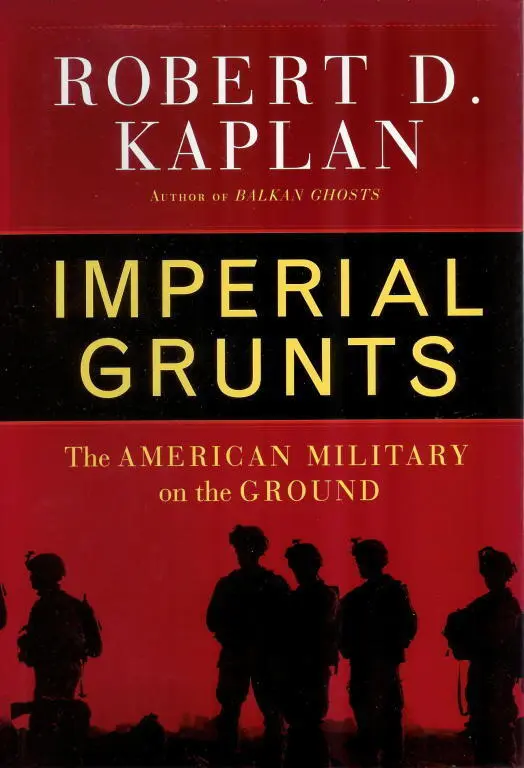
- Название:Imperial Grunts
- Автор:
- Издательство:Random House
- Жанр:
- Год:2005
- Город:New York
- ISBN:978-0-307-27850-0
- Рейтинг книги:5 / 5. Голосов: 1
-
Избранное:Добавить в избранное
- Отзывы:
-
Ваша оценка:
Imperial Grunts: краткое содержание, описание и аннотация
Предлагаем к чтению аннотацию, описание, краткое содержание или предисловие (зависит от того, что написал сам автор книги «Imperial Grunts»). Если вы не нашли необходимую информацию о книге — напишите в комментариях, мы постараемся отыскать её.
Imperial Grunts — читать онлайн бесплатно полную книгу (весь текст) целиком
Ниже представлен текст книги, разбитый по страницам. Система сохранения места последней прочитанной страницы, позволяет с удобством читать онлайн бесплатно книгу «Imperial Grunts», без необходимости каждый раз заново искать на чём Вы остановились. Поставьте закладку, и сможете в любой момент перейти на страницу, на которой закончили чтение.
Интервал:
Закладка:
Before we pushed off, the chaplain asked the holy angels to protect us.
We would drive north until the outskirts of Baghdad, then veer west into the heart of the Sunni Triangle near Al-Fallujah. There, at Forward Operating Base (FOB) Mercury, 1/5 would replace the 1st Battalion of the 504th Regiment of the Army’s 82nd Airborne Division.
As soon as our serial pulled out onto the main highway, the convoy halted because of a suspected improvised explosive device. Two Army helicopters flew overhead to survey the area and to escort the serial onward. It was a false alarm, though. “Fucking paranoia,” Gunner Bednarcik complained. I saw immediately how one person, planting a primitive explosive device, might tie an entire infantry company in knots, even if it had air support. Asymmetry was a basic fact of life in Iraq. And it usually favored the insurgents.
“I want action,” Cpl. Pena blurted out.
“No thanks. I’ve had my fill of shooting civilians,” answered Lance Cpl. Neal. “During OIF-I,” he explained, “we had strong indications that a vehicle was hostile and I was ordered to fire. It turned out to be an old man who died in seconds. I felt miserable, but under the same circumstances I would have no choice but to do it again.”
We were on the outskirts of Baghdad. Pena, Neal, and the Gunner were amazed at the new cars and satellite dishes that clogged the road and rooftops, which they told me had not been here the year before, on the eve of the invasion. The only ugly thing we noticed was the graffiti on the highway overpasses scrawled by the Army’s 3rd Infantry Division. The mosques, both Sunni and Shiite, with their glittering faience domes bore the mark of Persian architectural influence: the product of history and geography, as Iran was next door. The golden age of Baghdad at the turn of the ninth century, under the Abbasid caliph Harun al-Rashid, had been, to a significant degree, the upshot of Persian ideas and artisanship.
In early afternoon the low dun walls of Al-Fallujah came into view over the desert. The convoy turned away from the city, though, and headed eastward a few miles: until the apricot-colored desert, partially lost in a haze of choking dust squalls, gave way to a maze of Jersey, Texas, and Alaska barriers, followed by concertina wire, HESCO baskets, and tank treads functioning as speed bumps. [77] The size of the state indicated the size of the various cement barricades, Jersey being the smallest and Alaska the largest.
Here and there I saw light scrub and lines of eucalyptus trees. For the marines, this would be their home for months to come.
It was a complex of two bases, really: FOB (forward operating base) St. Mere, and the smaller FOB Mercury. Both had been named by the 82nd Airborne. St. Mere commemorated the village in Normandy, Sainte-Mère-Eglise, that the 82nd had fought for on D-Day. The entire area had been a training facility for the Iranian Mujahidin Khalq (Holy Warriors of the Masses), a guerrilla group supported by Saddam Hussein that sought to overthrow the regime in Teheran. Because Saddam’s Iraq was such a highly militarized state, Iraq was cluttered with palaces and military encampments in which American troops ensconced themselves.
The 1st Marine Division was divided into three regimental combat teams, or RCTs. FOB St. Mere was the headquarters of RCT-1, of which 1/5 formed a part. St. Mere was also the headquarters of I MEF. High-ranking officers were everywhere, therefore. Pena and Neal took one look at the place and muttered disdainfully, “POGs” (pronounced “poges”—persons other than grunts, that is, office types at the regimental, division, and MEF level). “They live high on the hog,” Pena said, “not like us grunts who do the real fighting. But we like it that way.” The chow hall at St. Mere was the fanciest I had seen thus far in my travels, with separate salad and dessert bars and a big-screen television set permanently to the ESPN sports channel. St. Mere also had a nice PX, laundry facilities, and Kellogg, Brown & Root shower units.
We left FOB St. Mere after a brief stop and journeyed two miles farther into the desert: to FOB Mercury, 1/5’s new home.
Forward Operating Base Mercury was a bleak gravel and dirt expanse with low reinforced-concrete buildings and rows of tents. It was noisy with the groan of generators. There were no amenities. Instead of nice shower and toilet units there were plastic Porta-Johns. The chow hall made you think of a penitentiary. I shared a barracks room with five captains and two warrant officers, along a hallway with busted doors, smashed fluorescent lights, and choking dust. Kit bags were splattered everywhere. “This room looks like a yard sale,” one of my rack mates complained in jest after we had moved in. After days of traveling, our “feet funk” was overpowering. Of course, all the deprivations up to this point counted for little compared to those suffered by both the troops and the journalists who had experienced OIF-I.
It didn’t help matters that there was often no water in the showers. Living conditions at FOB Mercury would never really improve much over the weeks I was there. Something was always running out—the water, the electricity, the chow even. But FOB Mercury would turn out to be the ultimate stripped-down forward base. It was a place where everyone contributed directly to the fighting effort. It harbored a monastic purity that I had found almost nowhere else in the world among the American military.
The first night there we were attacked by mortars and rockets. It would be a regular occurrence. Problems tumbled down upon the marines before they had even washed and unpacked. The Iraqi barber who serviced the base had just been murdered; the local water contractor had been threatened. The day we arrived there was a shoot-out at a meeting of the provincial council in Al-Fallujah, which couldn’t even decide on getting a road built. A number of American soldiers and marines in the city, who had arrived in-country some days before us, were wounded in the process.
One of the captains in my hootch, Jaime McCall of Wilmington, Delaware, had just learned that come the end of June, following the transfer of political power back to the Iraqis, U.S. troops might require search warrants whenever they entered Iraqi houses in pursuit of terrorists. As the battalion judge advocate general, he was sure a compromise could be worked out. Nevertheless, the early consensus in the hootch was that the Bush administration was thrusting too much responsibility upon the Iraqis too soon.
Within hours the details and rigors of the convoy had been forgotten and everyone immersed himself in his new tasks. Because 1/5 would be replacing the 1st of the 504th of the 82nd Airborne in the region between Al-Fallujah and Baghdad, the commander of 1/504, Army Lt. Col. Marshall Hagen of Fosston, Minnesota, spent the next few days showing Lt. Col. Byrne around the AOR (area of responsibility), introducing him to members of the various Iraqi town councils.
It was a unique AOR. Partly because of its proximity to Baghdad, it had more Shiites than perhaps any other place in the Sunni Triangle. The Shiites were generally easier for the U.S. military to deal with. Not only had they been on board for regime change, but their more formalized clerical bureaucracy facilitated the identification of local leaders, and thereby the establishment of communal relationships with the Army and Marines. (It had also facilitated the Iranian revolution in 1978–79, allowing the ayatollahs to form a state within a state even before the Shah fell.)
Army Lt. Col. Hagen’s knowledge of the local tribes, clans, and subclans, and the power struggles therein, plus his ability to separate good guys from bad guys on each local council, was considerable—testimony to the fact that even such a conventional force as the 82nd Airborne was capable of adaptation to the most unconventional of circumstances. “I’m no expert,” he told me; “there are at least seven different Iraqs, and many layers to each of them. Anyone who calls himself an expert on Iraq is full of shit. The more I learn, the more unfathomable it all becomes.”
Читать дальшеИнтервал:
Закладка:
Похожие книги на «Imperial Grunts»
Представляем Вашему вниманию похожие книги на «Imperial Grunts» списком для выбора. Мы отобрали схожую по названию и смыслу литературу в надежде предоставить читателям больше вариантов отыскать новые, интересные, ещё непрочитанные произведения.







Обсуждение, отзывы о книге «Imperial Grunts» и просто собственные мнения читателей. Оставьте ваши комментарии, напишите, что Вы думаете о произведении, его смысле или главных героях. Укажите что конкретно понравилось, а что нет, и почему Вы так считаете.