Robert Kaplan - Imperial Grunts
Здесь есть возможность читать онлайн «Robert Kaplan - Imperial Grunts» весь текст электронной книги совершенно бесплатно (целиком полную версию без сокращений). В некоторых случаях можно слушать аудио, скачать через торрент в формате fb2 и присутствует краткое содержание. Город: New York, Год выпуска: 2005, ISBN: 2005, Издательство: Random House, Жанр: Публицистика, nonf_military, на английском языке. Описание произведения, (предисловие) а так же отзывы посетителей доступны на портале библиотеки ЛибКат.
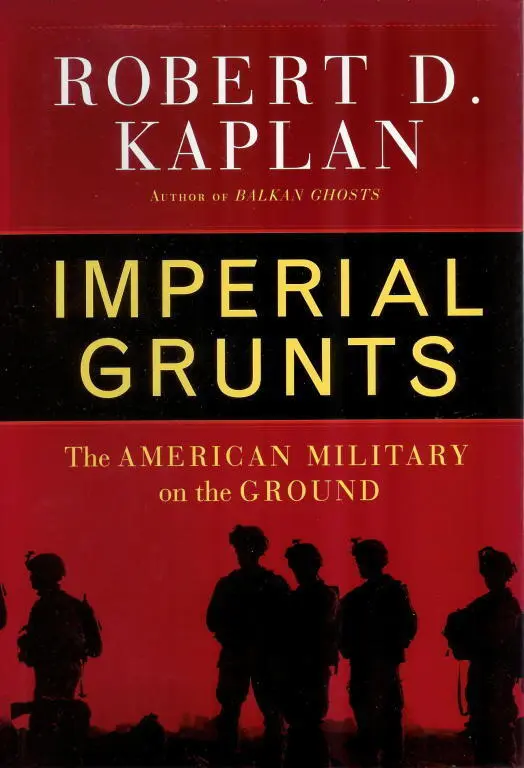
- Название:Imperial Grunts
- Автор:
- Издательство:Random House
- Жанр:
- Год:2005
- Город:New York
- ISBN:978-0-307-27850-0
- Рейтинг книги:5 / 5. Голосов: 1
-
Избранное:Добавить в избранное
- Отзывы:
-
Ваша оценка:
Imperial Grunts: краткое содержание, описание и аннотация
Предлагаем к чтению аннотацию, описание, краткое содержание или предисловие (зависит от того, что написал сам автор книги «Imperial Grunts»). Если вы не нашли необходимую информацию о книге — напишите в комментариях, мы постараемся отыскать её.
Imperial Grunts — читать онлайн бесплатно полную книгу (весь текст) целиком
Ниже представлен текст книги, разбитый по страницам. Система сохранения места последней прочитанной страницы, позволяет с удобством читать онлайн бесплатно книгу «Imperial Grunts», без необходимости каждый раз заново искать на чём Вы остановились. Поставьте закладку, и сможете в любой момент перейти на страницу, на которой закончили чтение.
Интервал:
Закладка:
Thus, the sheikhs and others, driven by narrow self-interest—as if that should have surprised anyone—made it known that they were open to deals with Syrians and assorted other jihadists, who knew the ingress routes and safe houses along the Euphrates River ratline into Iraq. It didn’t help matters that the very militarization of the state facilitated by Saddam had turned Iraq into one huge ammunition storehouse for the supply of rockets and mortars to the jihadists, and the making of IEDs (improvised explosive devices). And with the Iraqi army disbanded, there was now a pool of people with knowledge of ordnance and explosives, and the incentive to use it against the Americans.
I noted the derision with which the council members and other Iraqis present at the meeting looked at us, with our Kevlar helmets and flak jackets further fortified by rifle plates. Simply by being seen with us, they were taking greater risks than we were, and yet they had no such protection, and rarely demanded any. The fact that, a year after the invasion, American marines and soldiers still had to travel around Iraq wearing such protective gear was itself an indication of how little had been achieved.
Because the Bush administration, trapped in an election cycle, could not tolerate more American casualties, unusual security precautions had to be taken which only increased the distance between the American military and the average Iraqi. The willingness to accept a greater number of casualties might have meant faster progress, but the home front in America probably lacked the appetite for that.
Lt. Col. Byrne, a marine brat who had grown up near Quantico, told me: “OIF-I may have been our greatest military victory since World War II. The Iraqi regime was a bunch of animals. How can any civilized person be against what we did? Our defense budget relative to our GDP is now lower than it’s been for decades. Objectively, we can stay here at little cost for years helping the new Iraqi government, in order to get the job done. And with sufficient time, we simply can’t lose. But will the home front, and the media that influences it so much, allow that? That’s the issue.”
Keep in mind that this was the early spring of 2004. The Abu Ghraib prison scandal and many other bad things were still in the future, and the marines with whom I was embedded were still more hopeful than hard-bitten. It was a time when Iraqis were still waving at them. Also remember that as a lead fighting unit in the successful 2003 conquest of Baghdad, they had returned here with an idealistic sense of mission. Byrne’s comment, and those of other marines with whom I was traveling, reflected how the war was being viewed at a certain moment in time. After I left Iraq, and as the summer arrived, and then the autumn, the military situation would worsen, and embedded correspondents would accurately report a corresponding change in attitudes among marines, registered in growing doubts about the efficacy of the war.
Leaving the council meeting, I noticed the towering, half-completed mosque which dominated the entire Mansour district of Baghdad. Saddam had ordered it built as a monument to himself. On the eve of OIF-I, the mosque was on its way to being one of the largest buildings in the world, hideous beyond all imagining, like the Houston Astrodome surrounded by rocket launchers. I was reminded of Romanian dictator Nicolae Ceau¸sescu’s half-completed House of the Republic in Bucharest at the time that he was toppled.
The architecture of parts of Baghdad told you everything you needed to know about the deposed regime. The presidential palace and the remnants of the nearby Defense and Interior ministries that had withstood American bombing made Baghdad’s so-called Green Zone appear like a Babylonian temple precinct built to monstrous Stalinist proportions. Here in wafer-thin yellow brick and blue faience, all forms of megalomania from antiquity to the late twentieth century were united. The eight-pointed star, symbol of the Baath party, was, like the Nazi swastika, everywhere: on bridges, highway girders, overpasses, windows, gates, and other grillwork, evidence of the regime’s egotistical desire for dominance over every facet of life. Even in the countryside I would find a world of opulent little palaces surrounded by primitive mudhut settlements: a veritable landscape of antiquity.
The palaces of Saddam and his sons Uday and Qusai, some adorned by immense man-made lakes, had two motifs: Las Vegas hotel-casinos or love shacks for their menagerie of mistresses and rape victims. Indeed, Saddam’s son Uday bore a marked resemblance to Ceau¸sescu’s spoilt and depraved son, Nicu, who also violently abused women.
The social and cultural refuse created by the regime was everywhere, overwhelming the American authorities. While clichés abounded about the talent of the Iraqi people and their ability to quickly build a vibrant capitalist society, officers of the 82nd Airborne who had been here for months told another, more familiar story: of how Iraqis, like their Syrian neighbors, had in recent decades not experienced Western capitalism so much as a diseased variant of it, in which you couldn’t even open a restaurant or a shop without having connections to the regime. Above the level of the street vendor, in other words, capitalism here would have to be learned from scratch.
After we returned to FOB Mercury from the council meeting, the 82nd Airborne intel shop delivered another three-hour brief and data dump to the marines, this one dealing, in part, with tribal and clan politics. A bewildered Gunner Bednarcik came out of the meeting muttering, “There seems to be no end to this thing. But now I suppose we’ll have to see it through, for the sake of our honor.” He stayed up half the night, downloading photos of every intersection we had crossed, in order to learn the route better and prepare for ambushes. It would be a ritual of his for several weeks, as we visited all the towns in the area of responsibility for the first time.
Truly, Iraq’s tribal reality hit you square in the face the moment you peered into local politics. Because Iraq was among the most backward parts of the Ottoman Empire, with little tradition of central government, tribalism had always been strong here. The Iraqi nationalism that followed World War I was in reality a vague ideological construction, dependent on an intertribal consensus. Tribalism was particularly prevalent near the Bedouin-influenced western desert, part of 1/5’s area. The strength of the tribes intensified during the Iran-Iraq War of the 1980s, when the state lost much of its potency amid economic pressures. Because the tribes in the western desert near Al-Fallujah were too strong to destroy, Saddam had no choice but to co-opt them and make them part of his power structure. [79] The situation was more complicated than that, however. Saddam, by drafting significant numbers of people into the military and hiring many on public works projects, weakened the traditional sheikhs even as he co-opted them. See Patrick Graham’s “Beyond Fallujah: A Year with the Iraqi Resistance,” Harpers, June 2004.
It was such traditional loyalties existing below the level of the state that both Marxist and liberal intellectuals, in their pursuit of remaking societies along Soviet and Western democratic models, tragically underestimated. 12Indeed, a year after the invasion of Iraq, with the country teetering on chaos, among the few groups in Washington without egg on their faces was a subculture of Middle Eastern area experts known as “tribalists.”
Unable to sleep the first few nights at FOB Mercury, I walked around the camp under the stars, watching marines wash their BDUs in plastic buckets with their rifles beside them, often the only chance they had to do such chores. Every few hours the ground would shake from a rocket or mortar attack on the base, which everyone quickly got used to, even as there were periodic casualties.
Читать дальшеИнтервал:
Закладка:
Похожие книги на «Imperial Grunts»
Представляем Вашему вниманию похожие книги на «Imperial Grunts» списком для выбора. Мы отобрали схожую по названию и смыслу литературу в надежде предоставить читателям больше вариантов отыскать новые, интересные, ещё непрочитанные произведения.




Обсуждение, отзывы о книге «Imperial Grunts» и просто собственные мнения читателей. Оставьте ваши комментарии, напишите, что Вы думаете о произведении, его смысле или главных героях. Укажите что конкретно понравилось, а что нет, и почему Вы так считаете.