Robert Kaplan - Imperial Grunts
Здесь есть возможность читать онлайн «Robert Kaplan - Imperial Grunts» весь текст электронной книги совершенно бесплатно (целиком полную версию без сокращений). В некоторых случаях можно слушать аудио, скачать через торрент в формате fb2 и присутствует краткое содержание. Город: New York, Год выпуска: 2005, ISBN: 2005, Издательство: Random House, Жанр: Публицистика, nonf_military, на английском языке. Описание произведения, (предисловие) а так же отзывы посетителей доступны на портале библиотеки ЛибКат.
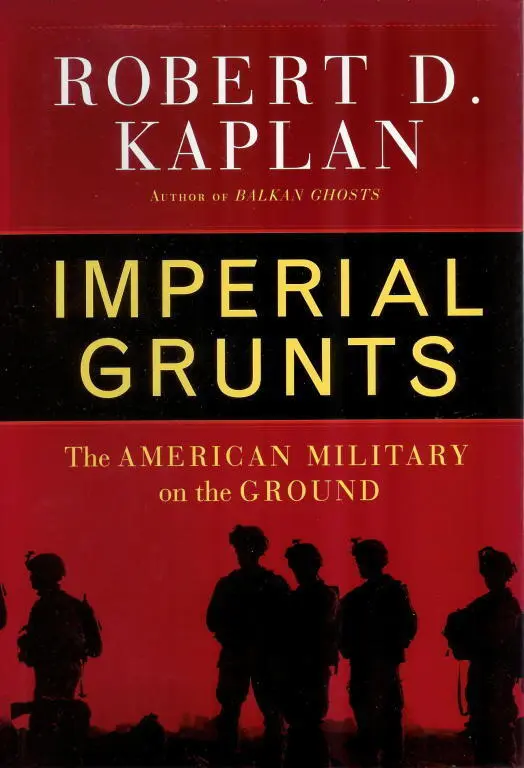
- Название:Imperial Grunts
- Автор:
- Издательство:Random House
- Жанр:
- Год:2005
- Город:New York
- ISBN:978-0-307-27850-0
- Рейтинг книги:5 / 5. Голосов: 1
-
Избранное:Добавить в избранное
- Отзывы:
-
Ваша оценка:
Imperial Grunts: краткое содержание, описание и аннотация
Предлагаем к чтению аннотацию, описание, краткое содержание или предисловие (зависит от того, что написал сам автор книги «Imperial Grunts»). Если вы не нашли необходимую информацию о книге — напишите в комментариях, мы постараемся отыскать её.
Imperial Grunts — читать онлайн бесплатно полную книгу (весь текст) целиком
Ниже представлен текст книги, разбитый по страницам. Система сохранения места последней прочитанной страницы, позволяет с удобством читать онлайн бесплатно книгу «Imperial Grunts», без необходимости каждый раз заново искать на чём Вы остановились. Поставьте закладку, и сможете в любой момент перейти на страницу, на которой закончили чтение.
Интервал:
Закладка:
Lt. Col. Byrne’s next excursion was to Al-Karmah, nicknamed “Bad Karma” by the 82nd. Located between FOB Mercury and western Baghdad, it was a mini-Fallujah, a town where the soldiers of the 82nd were always getting shot at. Like Al-Fallujah, Karmah was a lawless town on the smuggling ratline to Jordan and Syria, where tribal rule was supreme and no one went to the police for anything. As with Al-Fallujah, Saddam had kept control by turning it into a Baath party stronghold. Both of these towns had a strong sense of local identity. The state of Iraq had usually counted for little in such places, except when it employed high levels of oppression.
Before departing for Al-Karmah, Chief Warrant Officer Todd Mathisen of Reno, Nevada, a surrogate chaplain, read us Psalm 91, the so-called warrior psalm: because “ He is my refuge and my fortress…. A thousand shall fall at thy side, and ten thousand at thy right hand; but it shall not come nigh thee.” Mathisen told us that in Hebrew the words “trust” and “refuge” can mean the same thing. “So if you trust in the Lord of the Israelites, gents, you will be protected. Remember, you’re on the enemy’s
playground, the terrain of evil. To trust in the Lord is the best way to hunt down the devil.”
After more than a year of travel with the U.S. military, I had become accustomed to such sermons. They revealed a similar emphasis on a Christian God evinced by American troops in their letters home during the Revolutionary War, in the songs the soldiers sang during the Civil War that, as Edmund Wilson noted, “were like psalms,” and in the stirring photos of Marines bowing down in prayer prior to the Pacific landings of World War II. 13Though today’s society may be more multicultural than those of the past, that is much less the case regarding the religious makeup of our all-volunteer military. Moreover, for young men living in austere conditions who were not rear-echelon types counting the days to go home but combat troops going out daily to risk their lives, morale could not be based on polite subtleties or secular philosophical constructions, but only on the stark belief in your own righteousness, and in the iniquity of your enemy.
Al-Karmah was heralded by a lovely mosque with a dazzling blue faience dome. Otherwise, it was a shithole. As soon as we pulled into the police station, Gunner Bednarcik had his marines mount the rooftop and fan out in a 360-degree protective fire formation. Lt. Col. Hagen then took Lt. Col. Byrne into the station to introduce the incoming Marine commander to the police chief, Ahmed Abdul Kareen. Kareen was the third police chief in Al-Karmah since the American conquest. The first had proved incompetent. The second had been assassinated. Kareen immediately began asking for more pistols and flak jackets, and complained about car thefts and other crimes that he was unable to stop. The police here had no power to bring in criminals; only the sheikhs could do that.
We moved to another room in the police station where the new town council had been assembled. The talk was about providing seed to the farmers, repairing a cement factory to create several hundred more jobs, landscaping a soccer field for local youth, and ripping out the guardrails on the highway which terrorists were using to plant IEDs. The civil affairs officers whom Lt. Col. Byrne had brought along took notes and asked follow-up questions. The area was too dangerous to interest civilian relief charities.
Outside the police station, I saw that the Gunner was not altogether happy with how the Renegades had manned and maintained their fire positions. “We’re new,” he told me. “That’s what makes us vulnerable. The 82nd knows this place like their front yard. It’s only a matter of time before we’re tested.”
That happened on the next visit to Al-Karmah. Toward the end of the next council meeting, the police fled and the kids on the streets beside the station scattered. Shops shut, bad signs all. A few minutes later, rocket-propelled grenades hit the compound, followed by mortar rounds from the east, and small arms fire from a girls’ school to the west. The small arms fire then came at the Renegades from the north, as the beginning of an encircling movement: a classic ambush. The firefight lasted more than an hour. A QRF (quick reaction force) was called in over the radio, including helicopters. Sgt. D was all over the place, zigzagging, carefully firing off rounds, encouraging his men. Cpl. Pena and the others were on the rooftops, shooting. When he returned to FOB Mercury and finally cleared his rifle in the clearing barrel, Sgt. D’s smile was so wide it seemed that his whole face would split apart. It was the platoon’s first firefight since OIF-I. For the two platoon members who had not fought in Iraq the previous year, Al-Karmah was the place where they had their “cherries popped.”
That night Gunner Bednarcik’s and Sgt. D’s marines were in high spirits, sitting around in camp chairs under the stars, reliving every moment of the firefight. Lance Cpl. Neal told me, “It never fails. You never feel so alive as after you’ve just been in a close firefight, then had a hot shower, and had your laundry done.” He himself had not gotten off a shot that day. “I stayed dry,” he explained matter-of-factly. “I had no viable target to shoot at. I’m the machine gunner. I have to be extra careful.” In fact, a few days later, one of the town council members would compliment Lt. Col. Byrne on the disciplined shooting of his men. Not one civilian had been hit. It made it easier for the council members to justify to their constituents the American counterattack. Marines were tough young kids from troubled backgrounds, but when the shooting started, I was impressed at how they instantly became mature and calculating thirty-year-olds.
My next visit to Al-Karmah was two days later with Bravo Company, commanded by Capt. Jason Eugene Smith of Baton Rouge, Louisiana, a graduate of Louisiana State University. Capt. Smith, with his determined, rawboned visage, was one of the battalion linchpins.
Organizationally, the Marine Corps was shaped like a triangle; it kept subdividing into threes. Thus, the 1st of the 5th had three infantry companies, or “line” companies: Alpha, Bravo, and Charlie. That wasn’t the whole story, though. There was also a weapons company, and a “command element” for Lt. Col. Byrne, managed by Gunner Bednarcik. But the company captains—of Alpha, Bravo, Charlie, and Weapons—were the universal joints for the battalion. Because the Marine Corps had a more powered-down hierarchy than the Army, the company captains were the equivalent of the Army’s iron majors.
The infantry captains for 1/5 were variations of the same mold: intense, terse, driven, and generally humorless, like Capt. Cassidy in Djibouti, only more so because of the combat-active environment in Iraq. Because majors and up in the Marine Corps are prisoners of staff work, for the captains this would be their last chance to be in the field with the grunts. Thus, they were all out to prove themselves. Capt. Jason Smith was no exception.
He told his marines, “We’re going into Al-Karmah as the first group after the gun battle. We’re going to get off the trucks, walk the streets, look people in the eye—to let ’em see the good things about the United States. The kids here refer to the terrorists as ‘Ali Babas.’ [80] Apparently, the term “Ali Baba” was coined by American soldiers who preceded the Marines here, and was picked up on by local kids. See Graham’s “Beyond Fallujah.”
So be aware when you hear those words. Look for the presence of the abnormal: horns honking, kids fleeing, stores closing. The police chief and many of the townspeople are on the fence. We’ve got to show ’em the way to go.”
Интервал:
Закладка:
Похожие книги на «Imperial Grunts»
Представляем Вашему вниманию похожие книги на «Imperial Grunts» списком для выбора. Мы отобрали схожую по названию и смыслу литературу в надежде предоставить читателям больше вариантов отыскать новые, интересные, ещё непрочитанные произведения.






Обсуждение, отзывы о книге «Imperial Grunts» и просто собственные мнения читателей. Оставьте ваши комментарии, напишите, что Вы думаете о произведении, его смысле или главных героях. Укажите что конкретно понравилось, а что нет, и почему Вы так считаете.