Robert Kaplan - Imperial Grunts
Здесь есть возможность читать онлайн «Robert Kaplan - Imperial Grunts» весь текст электронной книги совершенно бесплатно (целиком полную версию без сокращений). В некоторых случаях можно слушать аудио, скачать через торрент в формате fb2 и присутствует краткое содержание. Город: New York, Год выпуска: 2005, ISBN: 2005, Издательство: Random House, Жанр: Публицистика, nonf_military, на английском языке. Описание произведения, (предисловие) а так же отзывы посетителей доступны на портале библиотеки ЛибКат.
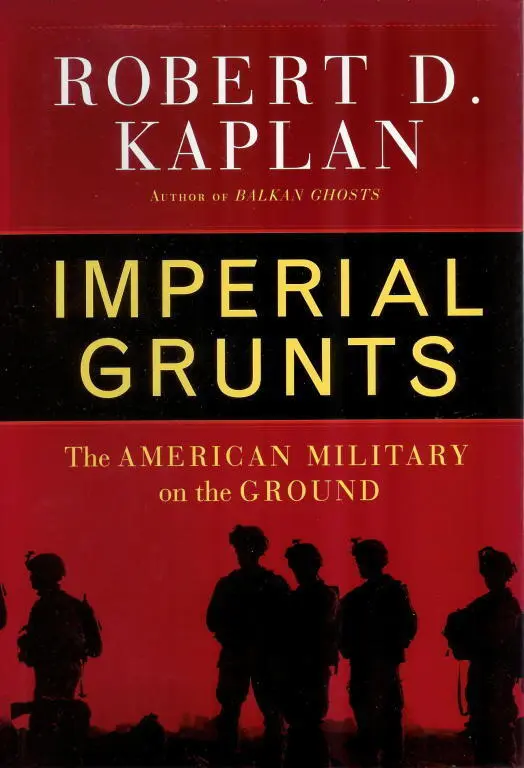
- Название:Imperial Grunts
- Автор:
- Издательство:Random House
- Жанр:
- Год:2005
- Город:New York
- ISBN:978-0-307-27850-0
- Рейтинг книги:5 / 5. Голосов: 1
-
Избранное:Добавить в избранное
- Отзывы:
-
Ваша оценка:
Imperial Grunts: краткое содержание, описание и аннотация
Предлагаем к чтению аннотацию, описание, краткое содержание или предисловие (зависит от того, что написал сам автор книги «Imperial Grunts»). Если вы не нашли необходимую информацию о книге — напишите в комментариях, мы постараемся отыскать её.
Imperial Grunts — читать онлайн бесплатно полную книгу (весь текст) целиком
Ниже представлен текст книги, разбитый по страницам. Система сохранения места последней прочитанной страницы, позволяет с удобством читать онлайн бесплатно книгу «Imperial Grunts», без необходимости каждый раз заново искать на чём Вы остановились. Поставьте закладку, и сможете в любой момент перейти на страницу, на которой закончили чтение.
Интервал:
Закладка:
As soon as we arrived at the police station, the police fled, running past us in the opposite direction. Stores closed, kids ran, and traffic disappeared off the streets. As I entered the station with Capt. Smith, I braced for a barrage of rocket-propelled grenades. Meanwhile, other elements of Bravo Company were flooding adjacent areas of the town with foot patrols.
Capt. Smith, his translator, and I entered the police chief’s office. Another Marine officer followed us inside, but Capt. Smith told him to leave, saying, “I want to talk frankly to the police chief.” Tension seemed to suffocate the room.
“I’m here to make sure you fulfill your obligations,” Capt. Smith told Chief Kareen. “Why did your men just desert the station?”
“Only civilians fled,” the chief replied nervously.
“I didn’t see civilians. I saw men in uniform run away,” Capt. Smith replied icily in a mild southern drawl. “If I were concerned with my own safety, I’d have stayed home in the United States. I expect a similar attitude from you and your men. You’re going to see a lot of the Marines from now on. We know 95 percent of the town are good people, intimidated by the other 5 percent. I am aware of the risk you take by working with us. We are prepared to take the same risk.” [81] Several weeks later, after assaulting parts of Al-Fallujah, Bravo Company and other elements of 1/5 returned to Al-Karmah. They lived in the community, patrolled regularly, talked to people, collected information, and made some progress toward reclaiming the town.
Whereas Capt. Smith’s bearing was erect, immobile, and unblinking as he stared laser-like at the police chief, the police chief was bobbing and weaving all over the room, lighting a cigarette, moving from chair to chair, his back curled like a wet noodle, delivering evasive answers. The police chief made demands for more flak jackets and other equipment, which Capt. Smith promised to facilitate. Upon leaving the room, Capt. Smith told me that the police chief was a bellwether challenge: if the Marines were serious about proving that they were the superior tribe in town, the police chief might show more courage. On the other hand, it might just be a matter of getting a new chief. “This guy was appointed,” Smith observed. “We might have to find somebody crazy enough to volunteer.”
Outside we noticed new Arabic graffiti: “Death to Traitors.” “Long live Saddam Hussein.” “Kill the Members of the City Council.” The information officer with us made a note to return and paint over the graffiti, and replace it with new slogans. The Marines were about to initiate a graffiti war.
No one attacked us, though. Some local kids told us that they saw more than thirty Ali Babas with RPGs and AK-47s run away as soon as the Marines dismounted from their vehicles to commence foot patrols. One officer remarked that a simple change in the TTPs (tactics, techniques, and procedures), such as sending in foot patrols at the same time we entered the police station, is “more effective than all the high-tech shit.”
Later at FOB Mercury, 1/5’s civil affairs officers were briefed by their outgoing 82nd counterparts about two road-widening projects for Al-Karmah, originally slated to cost $32,000 and $75,000, respectively, for which the local contractor was now demanding more money.
“What about bringing in another contractor from Baghdad?” someone asked.
“If you bring in an outside contractor, he’ll end up dead,” the officer from the 82nd said. It was assumed that the cost overruns were because the contractor and some city council members wanted a slice of the American largesse. “It’s like Kosovo,” remarked Gunnery Sgt. Mark Kline, an
African-American from Kansas City, Missouri, with experience in the Balkans. “The whole system here has been built on graft. All we can do is get these folks out of the ditch they’re in, to a slightly higher level of development. What we call corruption is their way of doing things.”
I went on a number of Humvee patrols deep into the countryside of central Iraq. It was an extraordinary landscape. My first impression was of a flat, ashen monotony pulverized by the sun. Within that monotony, though, was a pageant of micro-terrains created by ruler-straight, fungal-green irrigation ditches cut into the earth like cuneiform marks; and sluggish rivers, including the Euphrates, whose slate-blue surfaces would harden into a chain of goose bumps in the breeze. Masses of reeds, fatalistic and yielding, twice the height of a man, whispered like time itself in the wind.
“You know what it all reminds me of?” remarked Gunner Bednarcik. “South Carolina. Yeah, real tranquil. Nothing like shrimping in South Carolina. The tide comes in and the shrimp feed in the marshes.” A look of ecstasy crossed his face.
The ditches and dams, as well as the wide and navigable cement-lined canals—like the one that stretched from Baghdad all the way to the Syrian border—were impressive feats of engineering, as were the highways, cloverleaf overpasses, and architectural immensities of the Green Zone. Saddam, like the tyrants of Mesopotamia, Egypt, India, and China, was a classic “hydraulic” dictator. According to the early-twentieth-century German political scientist Karl Wittfogel, who borrowed from Karl Marx and Friedrich Engels’s theory of “oriental despotism,” civilizations of the Near and Far East have manifested an absolutism “more comprehensive and more oppressive than its Western counterpart.” 14This was due to the disciplined social organization required to maintain extensive water and irrigation systems and other public works projects in age-old river valleys. That, in turn, led to the raising of large armies and the building of massive defense works.
Sitting in the back of a seven-ton truck during presence patrols in the Iraqi countryside meant bumps and bruises and dust so fine it billowed up from the tires like smoke. Relief came from the smiling farmers and their families who would gather on the berms under the date palms to wave; as a whole, the rural areas were the most friendly to the Americans, since deep in the Mesopotamian outback the Baath party had been weakest. A year after OIF-I, the fact that hordes of Iraqis in most of the country were still smiling at American troops did not qualify as news. Yet simply because it was a mundane reality did not render it insignificant.
The pro-American sentiment continued despite the lack of demonstrable improvements in people’s lives. Farmers complained to the marines about the lack of clean water and functioning schools. For all intents and purposes, the Coalition Provisional Authority (CPA), the civilian arm of the American occupation, had no presence in much of Iraq. To the degree that anything got done in these regions, it was done by the American military.
One day on patrol an Iraqi man waved us down to warn of a suspicious object he had noticed on a bridge we were about to cross. The convoy halted, and several marines went on foot to inspect. They saw an IED. An explosives team was called in, and the object was detonated. It turned out to be a daisy chain of six bombs composed of 120mm and 155mm rounds, primed by a cell phone signal. When the explosives team detonated the 155mm rounds—the same used for booby traps in Vietnam—you could feel the air pressure almost a mile away.
It was the very lifesaving helpfulness of people in the rural areas that sometimes, albeit indirectly, depressed the marines, for despite OIF-II’s emphasis on winning hearts and minds, they still wanted to fight. Another day while we were on patrol, word came of 1/5’s first casualty of the current deployment. Pfc. Gerardo Perez of Houston had been wounded by a bullet in the shoulder while his platoon was helping another battalion during a firefight in nearby Al-Fallujah. “Fuck, why didn’t that happen to us,” blurted the marine next to me in the back of the seven-ton. “Fuck him, so he’s wounded, he’ll live, at least he was in a fight,” said another marine. “I’m going to crack your asses for saying those things,” their sergeant said. “Don’t get us wrong,” the first marine told me. “We care about the guy who was wounded. But shit happens. We just want the chance to do what we’ve been trained for.”
Читать дальшеИнтервал:
Закладка:
Похожие книги на «Imperial Grunts»
Представляем Вашему вниманию похожие книги на «Imperial Grunts» списком для выбора. Мы отобрали схожую по названию и смыслу литературу в надежде предоставить читателям больше вариантов отыскать новые, интересные, ещё непрочитанные произведения.




Обсуждение, отзывы о книге «Imperial Grunts» и просто собственные мнения читателей. Оставьте ваши комментарии, напишите, что Вы думаете о произведении, его смысле или главных героях. Укажите что конкретно понравилось, а что нет, и почему Вы так считаете.