Robert Kaplan - Surrender or Starve
Здесь есть возможность читать онлайн «Robert Kaplan - Surrender or Starve» весь текст электронной книги совершенно бесплатно (целиком полную версию без сокращений). В некоторых случаях можно слушать аудио, скачать через торрент в формате fb2 и присутствует краткое содержание. Город: New York, Год выпуска: 2003, ISBN: 2003, Издательство: Vintage Books, Жанр: Публицистика, nonf_military, на английском языке. Описание произведения, (предисловие) а так же отзывы посетителей доступны на портале библиотеки ЛибКат.
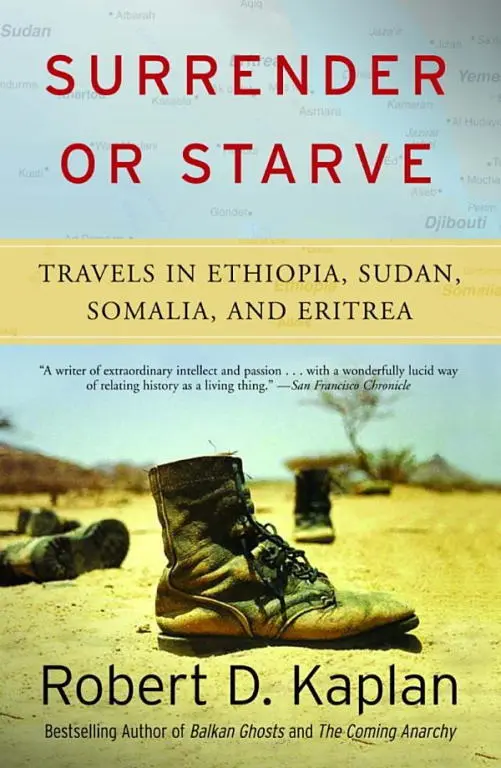
- Название:Surrender or Starve
- Автор:
- Издательство:Vintage Books
- Жанр:
- Год:2003
- Город:New York
- ISBN:978-0-307-54768-2
- Рейтинг книги:5 / 5. Голосов: 1
-
Избранное:Добавить в избранное
- Отзывы:
-
Ваша оценка:
Surrender or Starve: краткое содержание, описание и аннотация
Предлагаем к чтению аннотацию, описание, краткое содержание или предисловие (зависит от того, что написал сам автор книги «Surrender or Starve»). Если вы не нашли необходимую информацию о книге — напишите в комментариях, мы постараемся отыскать её.
, Kaplan illuminates the fault lines in the Horn of Africa, which is emerging as a crucial region for America’s ongoing war on terrorism.
Reporting from Sudan, Ethiopia, Somalia, and Eritrea, Kaplan examines the factors behind the famine that ravaged the region in the 1980s, exploring the ethnic, religious, and class conflicts that are crucial for understanding the region today. He offers a new foreword and afterword that show how the nations have developed since the famine, and why this region will only grow more important to the United States. Wielding his trademark ability to blend on-the-ground reporting and cogent analysis, Robert D. Kaplan introduces us to a fascinating part of the world, one that it would behoove all of us to know more about.
Surrender or Starve — читать онлайн бесплатно полную книгу (весь текст) целиком
Ниже представлен текст книги, разбитый по страницам. Система сохранения места последней прочитанной страницы, позволяет с удобством читать онлайн бесплатно книгу «Surrender or Starve», без необходимости каждый раз заново искать на чём Вы остановились. Поставьте закладку, и сможете в любой момент перейти на страницу, на которой закончили чтение.
Интервал:
Закладка:
The refugees on whom Cultural Survival’s study was based were at Damazin for months in 1985, but few members of the media had bothered to interview these refugees. Even after Clay and Holcomb’s report was published, journalists tended to write about the skeptical reaction in the relief community, rather than to hunt down the actual victims in order to hear their firsthand accounts. Harden had planned to do this, but as he explained to me, “I had a whole continent to cover and after several straight months in Ethiopia and Sudan, just as I heard about the Damazin story, I had to do a stint in West Africa.” By the time Harden was able to return to Sudan, the refugees had been scattered to other locations, but another group of about one thousand had arrived from Ethiopia, and this group had been through an experience that was far more horrible than the experience of the people whom Clay, Niggli, and Holcomb had interviewed. As Harden wrote in his story, which ran March 11, 1986, in the International Herald Tribune:
The dismal odyssey of the young Ethiopian mother began last spring with a false promise of free food in the Ethiopian government resettlement program….
En route, she said she was forced by Ethiopian soldiers to abandon her two children. She said she watched her husband die of disease in an overcrowded transit camp. After fleeing Ethiopia, she said, she was robbed, beaten, raped and held as a slave by Sudanese rebel soldiers.
The rebels belonged to the Ethiopian-backed Sudanese People’s Liberation Army (SPLA), which was at war with the Khartoum government and in control of the jungles on Sudan’s southeastern frontier. The escapees from resettlement fell prey to the rebel soldiers in the bush just as the Vietnamese boat people fell prey to pirates on the high seas. According to interviews conducted by Khartoum-based relief officials, several hundred Tigrean women and children escaped from resettlement camps only to be taken into captivity by the SPLA. The women and girl children were raped repeatedly, while the boys were forced to become fighters.
Harden pointed out in his article that “the stories told here… come not from outsiders, but from peasant farmers [who] in 13 separate interviews… told a remarkably consistent story.” He and Powers spent two days at Damazin doing nothing but interviewing a completely new set of refugees, and both reporters came up with exactly the same information as had Clay. In the lobby of the Khartoum Hilton, Harden told me that despite his reservations about aspects of the Cultural Survival report, he found nothing in Damazin to contradict the basic tenets of Clay’s research. Referring to the large-scale human rights abuses in Ethiopia, Harden shook his head and said, “It’s really happening over there.”
Harden’s report triggered a moving editorial in The Washington Post a few days later, but not much else. The television networks as usual were preoccupied elsewhere. Yet what I find particularly disturbing was that at no point in 1985 or 1986 did The New York Times send a reporter to Damazin. Neither Clifford May, Nairobi-based Sheila Rule, nor anyone from the Times Cairo bureau had ever gone there. Even the best newspapers cannot be expected to cover every single story, but the refugees at Damazin were at the center of the whole resettlement controversy, and they were available to journalists for months at a time. The Times dutifully editorialized about resettlement and reported the controversy in the relief community surrounding it, but the most prestigious daily in the United States never really probed the issue in the same aggressive manner in which it had probed human rights violations and other misdeeds of far lesser magnitude in other areas of the world, particularly the Middle East and South Africa.
In spring 1986, a few weeks after The Washington Post published Harden’s Damazin dispatch, former RRC head Dawit Wolde Giorgis, who had defected to the West several months earlier, admitted publicly that “force had to be used [in the resettlement program], and a vast number of people were herded like cattle, loaded on trucks and airplanes, and sent to the south. The whole operation was run by the Workers’ Party and its cadres in the various provinces.” This was the same Dawit who consistently had defended resettlement at the height of the famine emergency, and many of the media reports that had cast a somewhat favorable light on the program had made use of statements from him and his chief assistant in the RRC, Berhane Deressa, who also defected.
Around the same time that Dawit was recanting what he previously had told scores of journalists, the Ethiopian government announced that as of December 1985, 552,000 peasants had been resettled. Yet the previous summer, the government had claimed that as of May 1985, 547,000 had been resettled. Clay thus put forth the question: “What happened to the 100,000 to 250,000 people that were surely moved in the last few months of 1985, but who are no longer in the resettlement camps?” Not only did nobody have an answer, but few others were even aware of the question.
It is intriguing that resettlement received so little attention in the United States. After all, as I’ve demonstrated, the body of evidence was substantial. It is possible that more blacks were killed in the program in less than two years than had been killed directly by South African security forces in forty years. The manner in which Ethiopians died evoked the well-known slaughter of millions of Cambodians by the Khmer Rouge in the mid 1970s. Yet not only was the U.S. public more concerned about the abuses in South Africa, but both the media and the public also evinced more interest in the fate of a few hundred South Korean students, who had been detained by the police, than about tens of thousands of peasants in Ethiopia who had been starved, beaten, and worked to death in a veritable jungle gulag.
In the opinion of Chester Crocker, the U.S. assistant secretary of state for African affairs, the lack of public awareness was the fault of the media. In a conversation with me in Washington in early 1987, Crocker explained that in the mid 1980s
there was a rapid growth of American public interest in Africa due to two radically different events—one, the unrest in South Africa, became a white-hot, made-in-Hollywood media issue; the other, Ethiopia, affected millions yet had less of a profile because of the problem: who do you blame? The media are very dependent on access, and access to resettlement areas in Ethiopia was more restricted than to most places in South Africa.
Crocker, of course, was a very embattled figure during the Reagan years because of his controversial policy of “constructive engagement” toward the white minority regime in South Africa. The media was relentless in its pursuit of that story, and Crocker’s general attitude toward the Fourth Estate could not have been particularly warm.
Although it’s true that the magnitude of the abuses warranted more dramatic coverage than the story got, more than “access” was involved. As I see it, the fundamental flaw in the resettlement story was that it was a foreign news item with no domestic spinoff. Because the United States, despite its generous aid, was not influential in Ethiopia—and had not been for a decade—it was a tragedy for which the Reagan administration bore absolutely no responsibility. Although private donations to certain charities were indirectly assisting resettlement, as were public donations from other governments, USAID always was careful to channel U.S. aid to relief operations unconnected with the program. Thus, there was nothing to dig up against the administration, and the herd instinct in the media never was activated. Even after the MSF visit, journalists almost never raised the matter at State Department briefings. Ethiopia had been “lost” years before, and U.S. interests were not being jeopardized by the inhuman actions of Ethiopia’s regime. The country now was part of that zone of darkness where literally anything could happen away from the television cameras. Had the deaths occurred at the hands of a colorful madman, like Idi Amin or Muammar Gaddafi, or even someone less well known but just as crazy, like the former “emperor of the Central African Empire,” Jean-Bedel Bokassa, the story could have been rescued from oblivion. But Mengistu was far too efficient a killer to be distracted by buffoonery, so his crimes had little mass-market appeal.
Читать дальшеИнтервал:
Закладка:
Похожие книги на «Surrender or Starve»
Представляем Вашему вниманию похожие книги на «Surrender or Starve» списком для выбора. Мы отобрали схожую по названию и смыслу литературу в надежде предоставить читателям больше вариантов отыскать новые, интересные, ещё непрочитанные произведения.










Обсуждение, отзывы о книге «Surrender or Starve» и просто собственные мнения читателей. Оставьте ваши комментарии, напишите, что Вы думаете о произведении, его смысле или главных героях. Укажите что конкретно понравилось, а что нет, и почему Вы так считаете.