Robert Kaplan - Surrender or Starve
Здесь есть возможность читать онлайн «Robert Kaplan - Surrender or Starve» весь текст электронной книги совершенно бесплатно (целиком полную версию без сокращений). В некоторых случаях можно слушать аудио, скачать через торрент в формате fb2 и присутствует краткое содержание. Город: New York, Год выпуска: 2003, ISBN: 2003, Издательство: Vintage Books, Жанр: Публицистика, nonf_military, на английском языке. Описание произведения, (предисловие) а так же отзывы посетителей доступны на портале библиотеки ЛибКат.
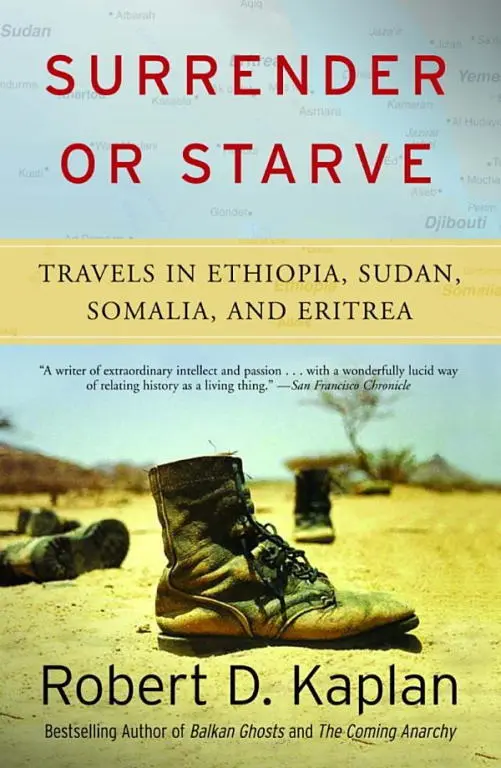
- Название:Surrender or Starve
- Автор:
- Издательство:Vintage Books
- Жанр:
- Год:2003
- Город:New York
- ISBN:978-0-307-54768-2
- Рейтинг книги:5 / 5. Голосов: 1
-
Избранное:Добавить в избранное
- Отзывы:
-
Ваша оценка:
Surrender or Starve: краткое содержание, описание и аннотация
Предлагаем к чтению аннотацию, описание, краткое содержание или предисловие (зависит от того, что написал сам автор книги «Surrender or Starve»). Если вы не нашли необходимую информацию о книге — напишите в комментариях, мы постараемся отыскать её.
, Kaplan illuminates the fault lines in the Horn of Africa, which is emerging as a crucial region for America’s ongoing war on terrorism.
Reporting from Sudan, Ethiopia, Somalia, and Eritrea, Kaplan examines the factors behind the famine that ravaged the region in the 1980s, exploring the ethnic, religious, and class conflicts that are crucial for understanding the region today. He offers a new foreword and afterword that show how the nations have developed since the famine, and why this region will only grow more important to the United States. Wielding his trademark ability to blend on-the-ground reporting and cogent analysis, Robert D. Kaplan introduces us to a fascinating part of the world, one that it would behoove all of us to know more about.
Surrender or Starve — читать онлайн бесплатно полную книгу (весь текст) целиком
Ниже представлен текст книги, разбитый по страницам. Система сохранения места последней прочитанной страницы, позволяет с удобством читать онлайн бесплатно книгу «Surrender or Starve», без необходимости каждый раз заново искать на чём Вы остановились. Поставьте закладку, и сможете в любой момент перейти на страницу, на которой закончили чтение.
Интервал:
Закладка:
None of those interviewed in the camp were drought victims…. Half used gravity-fed irrigation. They laughed at the suggestion that they might be famine victims. Those interviewed produced more than 670 kg. of cereals, grains and beans, per person, for extended families which were twice as large as their nuclear families. While this level of production is more than three times basic subsistence needs, those interviewed insisted that these crops were not their primary food staple. Instead, they relied on a variety of yam, which… was interplanted with other crops.
Most of the respondents grew chat, potatoes and red onions as cash crops, and half produced coffee and groundnuts….
More than 92 percent of those interviewed owned livestock….
When asked why production had declined… 25 percent said that drought had reduced production but that it had not caused significant declines. Some 30 percent reported that uncompen-sated, forced labor, required by government or local officials, did not allow them enough time to cultivate their fields. Most said their herds had decreased because they were forced to sell animals to pay taxes… and because local officials stole their animals.
In the face of these realities, nobody believed that the program was meant to combat drought, famine, and underdevelopment, as the Ethiopian government authorities claimed. Ray Wilkinson reported in Newsweek (May 5, 1986) that diplomats and relief officials told him that “villagization is really a smoke-screen for collectivization of the sort that Soviet leaders forced upon Russian peasants in the 1930s. The Ethiopian government’s real aim… is to herd peasants into centralized communities where the Army can keep them under control—and where communist cadres can indoctrinate them in Marxism-Leninism.”
The basic outline of the fate of millions of peasants, mostly Moslem Oromos, under villagization was not in dispute. The army would move into a group of villages, requisition the crops and livestock, and force the inhabitants to tear down their huts piece by piece. Then the peasants were made to walk, with the remnants of their homes on their backs, to a new, central location that had been selected by the party cadres. The new site almost always would lack a mosque, a school, and an adequate, nearby water source. But it would come equipped with a guard tower, a red flag, and a banner of the Workers’ Party of Ethiopia. In the Hararghe region of eastern Ethiopia, thousands of such villages sprung up in the mid 1980s, each with several hundred rebuilt huts put up in straight rows. Gilles Hertzog, a French relief official writing in L’Express (October 3, 1986), described the new sites as “black rectangles where the huts are aligned like on parade.” Hertzog asked, “What kind of crazy vision [has been] imposed on one of the oldest inhabited regions of Africa?” The tearing down and rebuilding usually occurred at harvest time at the peasants’ own expense, when they should have been in the field bringing in their crops. Just the time wasted on relocation served to lower agricultural productivity.
“As we understand human rights in the West, this program is a gross violation of those rights,” a Westerner in Ethiopia told Wilkinson; “This country’s communist rulers are breaking up a centuries-old culture, and the only people they asked are themselves. On these grounds alone the program is indefensible.” Yet, although nobody defended it, no Western government really condemned it either. Even the Reagan administration’s criticism was muted, compared to the way it attacked resettlement. Rarely in modern times have so many people had their human rights abused in so organized a fashion with hardly a whimper of real protest or sustained media coverage than in the case of villagization.
The utter brutality of the experience was far worse than the Newsweek and L’Express articles had suggested. In the first month of 1986, fifty thousand Moslem Oromos escaping villagization stampeded over the border into northwestern Somalia, where they were held temporarily in a squalid refugee camp, located a few miles from the Ethiopian frontier, called Tug Wajale B. In the spring, Jason Clay of Cultural Survival and Lance Clark of the independent, nonprofit Refugee Policy Group in Washington, D.C., went to Tug Wajale to interview the new arrivals about their experience in Ethiopia. All the Oromos interviewed told a similar story of a whole way of life being systematically destroyed, not only by the razing of ancestral villages, but through a deliberate policy—implemented by the army—of wrecking mosques, raping women, and removing children to far-off schools. Lance Clark reported the following testimony from a “woman of about 35 years of age.”
My husband is one of those who leads the prayers in the mosque. One day when another man was leading prayer, some military came. They threatened to kill anyone who prayed, anyone whose head touched the ground (in prayer). The prayer leader began to pray, and they shot him. The troops said that anyone who touched his body would be killed also. They then took his body outside of town and threw it out for the hyenas to eat.
Said another “woman of about 45 years of age”:
The government says… that there is to be no religion, that your child does not belong to you, is not under your control. We had a good crop this year, but then the government came and even took away our oxen. But we have not left because of hunger, but because of freedom.
A “man of about 40 years of age” told Clark:
The problems began when all of our things were nationalized; all of our resources, and our women. There is to be no individual and no religion. The government cadre began talking about this three months ago, but when they actually started to do it, we had to leave. The government has been attacking our religion—they are making mosques into stores, and into toilets.
One woman told Clay “that in her village the standard rape ratio was five militia per woman and that the militia were ‘turned loose’ twice a week.” As to the food supply, the Oromo refugees “insisted that they had been told [by the cadre] not to give milk to their children; since all cows belong to the state [and] it is the state’s responsibility to feed the children.”
Officials at the State Department in Washington said that the main reason why a greater protest wasn’t made against villagization was because unlike in the case of Cultural Survival’s resettlement study, the United States was unable to verify independently the stories told to Clay by the refugees in Somalia. I was told that the U.S. Embassy in Addis Ababa mounted a special effort to investigate villagization in the Hararghe region but was unable to confirm, or to deny, the accounts about mosques being destroyed and women being raped. I then asked myself, How are observers based in the Ethiopian capital supposed to find out about the specific acts of militia troops in small places out in the bush when the entire relief community in Addis Ababa knew nothing about the flight of the fifty thousand Oromos to Somalia while it actually was occurring? (As thousands of Oromos were pouring over the border, international observers in Addis Ababa were telling their counterparts in the Somali capital of Mogadishu that it shouldn’t be happening because they had no information about it!) Moreover, because the basic facts about how the program was being administered were already well known and chilling enough, was it really necessary to have independent verification for every gory detail before the State Department could scream bloody murder? Even in the most controlled and manipulated circumstances, journalists who were taken to showcase sites in Hararghe with Ethiopian government guides could not escape the feeling that something awful was taking place. One doesn’t have to read in between the lines of Sheila Rule’s June 22, 1986, story in The New York Times (buried on page eleven) to get this message.
Читать дальшеИнтервал:
Закладка:
Похожие книги на «Surrender or Starve»
Представляем Вашему вниманию похожие книги на «Surrender or Starve» списком для выбора. Мы отобрали схожую по названию и смыслу литературу в надежде предоставить читателям больше вариантов отыскать новые, интересные, ещё непрочитанные произведения.







Обсуждение, отзывы о книге «Surrender or Starve» и просто собственные мнения читателей. Оставьте ваши комментарии, напишите, что Вы думаете о произведении, его смысле или главных героях. Укажите что конкретно понравилось, а что нет, и почему Вы так считаете.