Robert Kaplan - Surrender or Starve
Здесь есть возможность читать онлайн «Robert Kaplan - Surrender or Starve» весь текст электронной книги совершенно бесплатно (целиком полную версию без сокращений). В некоторых случаях можно слушать аудио, скачать через торрент в формате fb2 и присутствует краткое содержание. Город: New York, Год выпуска: 2003, ISBN: 2003, Издательство: Vintage Books, Жанр: Публицистика, nonf_military, на английском языке. Описание произведения, (предисловие) а так же отзывы посетителей доступны на портале библиотеки ЛибКат.
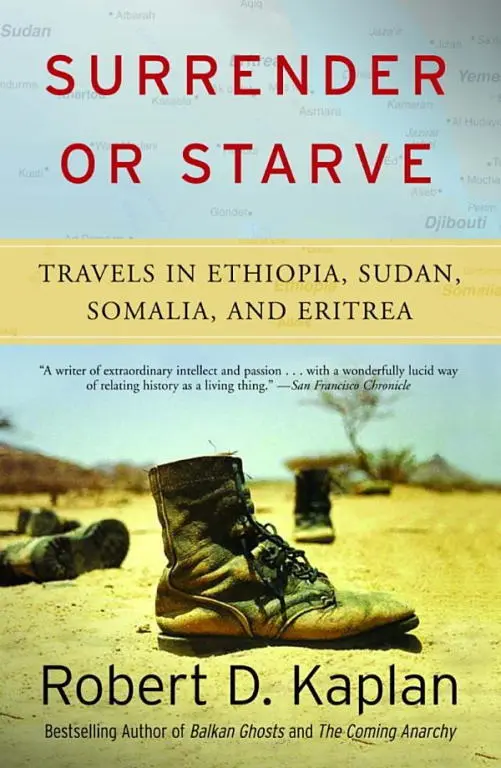
- Название:Surrender or Starve
- Автор:
- Издательство:Vintage Books
- Жанр:
- Год:2003
- Город:New York
- ISBN:978-0-307-54768-2
- Рейтинг книги:5 / 5. Голосов: 1
-
Избранное:Добавить в избранное
- Отзывы:
-
Ваша оценка:
Surrender or Starve: краткое содержание, описание и аннотация
Предлагаем к чтению аннотацию, описание, краткое содержание или предисловие (зависит от того, что написал сам автор книги «Surrender or Starve»). Если вы не нашли необходимую информацию о книге — напишите в комментариях, мы постараемся отыскать её.
, Kaplan illuminates the fault lines in the Horn of Africa, which is emerging as a crucial region for America’s ongoing war on terrorism.
Reporting from Sudan, Ethiopia, Somalia, and Eritrea, Kaplan examines the factors behind the famine that ravaged the region in the 1980s, exploring the ethnic, religious, and class conflicts that are crucial for understanding the region today. He offers a new foreword and afterword that show how the nations have developed since the famine, and why this region will only grow more important to the United States. Wielding his trademark ability to blend on-the-ground reporting and cogent analysis, Robert D. Kaplan introduces us to a fascinating part of the world, one that it would behoove all of us to know more about.
Surrender or Starve — читать онлайн бесплатно полную книгу (весь текст) целиком
Ниже представлен текст книги, разбитый по страницам. Система сохранения места последней прочитанной страницы, позволяет с удобством читать онлайн бесплатно книгу «Surrender or Starve», без необходимости каждый раз заново искать на чём Вы остановились. Поставьте закладку, и сможете в любой момент перейти на страницу, на которой закончили чтение.
Интервал:
Закладка:
The majority of those interviewed who had fled the resettlement camps had not been hit hard by the famine. On average, those taken from Tigre who were interviewed claimed that they had produced 80 percent of their subsistence cereal needs in 1984. They had possessed on the average more than 22 head of livestock at the time of their resettlement. Those taken from Wollo, while having experienced severe food shortages and absence of rainfall, cited government policies of confiscating surpluses critical to survival in a transitional zone as the underlying causes of their plight.
Niggli wrote that of the Tigreans he interviewed who had escaped from resettlement camps, “only 14 percent… had had no harvest in the last year and can be regarded as drought victims or famine victims.” Of the rest, many had had an average harvest prior to being resettled, and some even had had a good harvest. Niggli mentioned there were even “absurd cases” such “as Tewolde Gebregziabher who had owned an irrigated fruit plantation and who was a rich peasant by Ethiopian standards” prior to being forcibly removed to the south. The studies indicated that most of the abducted peasants lived not in the worst, drought-affected regions, but in the vicinity of roads strategically vital to the government’s war effort.
The criteria the government used in the resettlement selection process had more to do with a peasant’s potential for assisting guerrillas than with his or her need for fertile land. For example, although most of the Amharas in Wollo were Christians, most of the Amharas taken for resettlement were Moslem Oromos, whose fathers and grandfathers had Oromo names, and who traditionally had supported warlords and other insurgents against the ruling Amharas of Shoa. Rather than a catastrophe—as it had been for Haile Selassie—the famine was a godsend for this regime. The famine created a pool of millions of peasants, who whatever their political leanings, now had no choice but to rely on the government for help. The government now had a legitimate excuse to relocate those it thought to be hostile, as well as the wherewithal to do it, partly because of relief supplies pouring in from the West.
Rather than work to alleviate the famine, the regime appeared to deliberately exacerbate it for the peasants targeted for eventual resettlement. Said one farmer, “The Dergue is the best friend of the pigs and the monkeys. He allows them free access to the fields while we sit imprisoned in useless harangues about paying more tax out of the crop that at that time is mostly eaten by animals.” Remarked another, “They should put the baboons in the meetings and let us go to farm the field. Then we could eat and get fat like the animals do.” In addition to the problem of animals, more than a quarter of those interviewed by Cultural Survival said that the army had stolen their farm equipment (plows, seed bags, leather straps, and other tools).
Not only did the resettlement program destroy the livelihoods of peasants in the north, but the program destroyed those in the south, too. Many of the new sites in fact had been successfully farmed for years before the indigenous inhabitants had their land expropriated by the state to make way for the new arrivals. The rationale for this seemingly irrational act was military and political: most of the sites were located along access routes used by the Oromo Liberation Front in its war against the government. Thus, not only would the Tigrean rebels in the north be deprived of their base of peasant support, but so would the Oromo rebels in the south. Moving people around became another way to prosecute a war. Amhara imperialism simply had evolved into a more sophisticated form. A look at the placement of resettlement sites on a map reveals a pattern strikingly similar to the military expeditions of Menelik in the late nineteenth century.
Because restoring agricultural productivity was not the aim of resettlement, the government put up with miserable results without attempting to change the program. About three-quarters of all the tractors at the new sites reportedly were out of order in 1984, and the production level of the resettlement camps was even lower than at the state farms. Yet the government, backed by segments of the aid and diplomatic community in Addis Ababa, kept insisting that “there was no other way.”
In Cambodia in the mid 1970s, a horde of primitive peasants, the Khmer Rouge, brutalized an urban elite. In Ethiopia in the mid 1980s, an urban elite brutalized a class of primitive peasants. Although for several years, until the release of the film The Killing Fields, the crimes of the Khmer Rouge were partially obscured by the closure of Cambodia to the outside world and the shadowy nature of the group’s leader, Pol Pot, there was never really a tendency in the West to portray the forced relocation of urban Cambodians to the countryside as anything less than wholesale murder; nor was it really necessary to prove that that’s what the relocation was. The Khmer Rouge, because they were primitive peasants, lacked the sophistication to con Western relief officials into subsidizing the reorganization of a society along Stalinist lines. But in Ethiopia, not only were Western officials dealing with an urban elite, but with the most sophisticated, Westernized stratum within that elite, composed of people who were able to convince others of what they themselves did not wholly believe. Forced collectivization thus was marketed successfully as famine relief.
Resettlement, however, was just one aspect of collectivization. The other, much larger, component was villagization. In 1984 and 1985, the government managed to resettle about 500,000 of the 1.5 million people targeted; the program was resumed again in 1987 after the last unsteady flickers of the media spotlight had been snuffed out. But in roughly the same time frame, 1984–1986, ten times that many people—approximately five million—had been forcibly uprooted through villagization, with another 27 million scheduled for the same fate by the mid 1990s.
Villagization—a more grandiose, amorphous, and incomprehensible program than resettlement—made even less of an impact on the outside world. Villagization happened deep in the bush, far away from the diplomats, television camera crews, and other Western monitors, and it was too great a cataclysm to be grasped through the medium of print alone. (I think a main reason why Stalin’s war against ethnic Ukrainians made less of an impact in the West than did Hitler’s war against the Jews—even though the former may have claimed more lives—was because there were far fewer pictures of it; as with villagization, the destruction of the Ukrainian peasantry happened in secret, inside the sealed perimeters of a Marxist police state.)
Moreover, the most descriptive and penetrating article about villagization was an October 3, 1986, cover story in the French news magazine L’Express, which isn’t read in the United States. Although effectively written articles and editorials on the subject did appear (notably in Newsweek, The Washington Post, and The Wall Street Journal ), almost all were published in mid-1986, long after the Ethiopia story had been submerged by developments in South Africa. If resettlement came to light too late in the day to make a strong impact, villagization came to light even later.
However, unlike resettlement, villagization had no real defenders in the Western relief community in Addis Ababa. Even the Swedes, who in the past had been the most sympathetic to Marxist-style agricultural experiments, publicly criticized villagization and reduced their aid budget in Ethiopia on account of it. The reasons for this more realistic attitude were several. First, villagization did not become an issue until the very end of 1985. By then, the defection of Dawit, the publication of the Cultural Survival and MSF reports, and the demonstrated refusal of the Ethiopian regime to moderate its policies in the face of famine all had a cumulative effect on those, who the year before, had been willing to give the regime the benefit of the doubt. Second, the very size of the program—designed to affect three-quarters of the country’s entire population—denied it credibility. Third, the RRC, in the throes of high-level defections, was less successful in selling it. (Once in exile, Dawit condemned villagization as “another ill-conceived policy.”) Fourth, and most importantly, villagization was more blatantly ideological than resettlement was. Mengistu had spoken out openly against “kulaks” and, in a separate study done in Somalia, on escapees from villagization, Cultural Survival reported that, indeed, all those interviewed had been relatively prosperous farmers prior to being “villagized.”
Читать дальшеИнтервал:
Закладка:
Похожие книги на «Surrender or Starve»
Представляем Вашему вниманию похожие книги на «Surrender or Starve» списком для выбора. Мы отобрали схожую по названию и смыслу литературу в надежде предоставить читателям больше вариантов отыскать новые, интересные, ещё непрочитанные произведения.








Обсуждение, отзывы о книге «Surrender or Starve» и просто собственные мнения читателей. Оставьте ваши комментарии, напишите, что Вы думаете о произведении, его смысле или главных героях. Укажите что конкретно понравилось, а что нет, и почему Вы так считаете.