Robert Kaplan - Surrender or Starve
Здесь есть возможность читать онлайн «Robert Kaplan - Surrender or Starve» весь текст электронной книги совершенно бесплатно (целиком полную версию без сокращений). В некоторых случаях можно слушать аудио, скачать через торрент в формате fb2 и присутствует краткое содержание. Город: New York, Год выпуска: 2003, ISBN: 2003, Издательство: Vintage Books, Жанр: Публицистика, nonf_military, на английском языке. Описание произведения, (предисловие) а так же отзывы посетителей доступны на портале библиотеки ЛибКат.
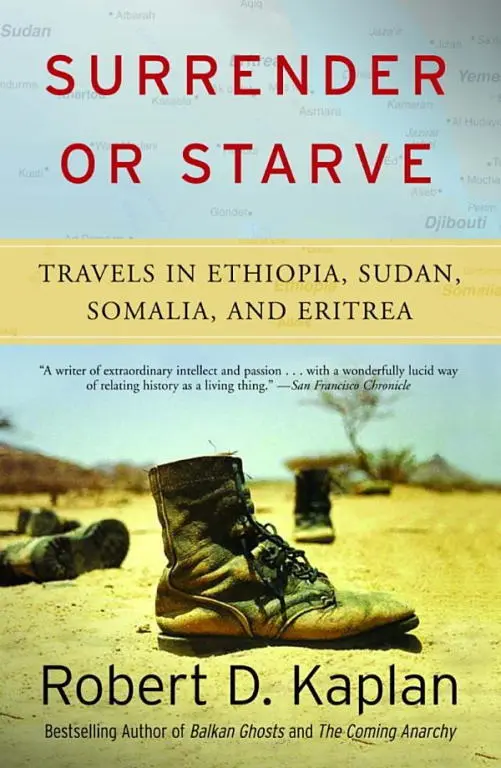
- Название:Surrender or Starve
- Автор:
- Издательство:Vintage Books
- Жанр:
- Год:2003
- Город:New York
- ISBN:978-0-307-54768-2
- Рейтинг книги:5 / 5. Голосов: 1
-
Избранное:Добавить в избранное
- Отзывы:
-
Ваша оценка:
Surrender or Starve: краткое содержание, описание и аннотация
Предлагаем к чтению аннотацию, описание, краткое содержание или предисловие (зависит от того, что написал сам автор книги «Surrender or Starve»). Если вы не нашли необходимую информацию о книге — напишите в комментариях, мы постараемся отыскать её.
, Kaplan illuminates the fault lines in the Horn of Africa, which is emerging as a crucial region for America’s ongoing war on terrorism.
Reporting from Sudan, Ethiopia, Somalia, and Eritrea, Kaplan examines the factors behind the famine that ravaged the region in the 1980s, exploring the ethnic, religious, and class conflicts that are crucial for understanding the region today. He offers a new foreword and afterword that show how the nations have developed since the famine, and why this region will only grow more important to the United States. Wielding his trademark ability to blend on-the-ground reporting and cogent analysis, Robert D. Kaplan introduces us to a fascinating part of the world, one that it would behoove all of us to know more about.
Surrender or Starve — читать онлайн бесплатно полную книгу (весь текст) целиком
Ниже представлен текст книги, разбитый по страницам. Система сохранения места последней прочитанной страницы, позволяет с удобством читать онлайн бесплатно книгу «Surrender or Starve», без необходимости каждый раз заново искать на чём Вы остановились. Поставьте закладку, и сможете в любой момент перейти на страницу, на которой закончили чтение.
Интервал:
Закладка:
The media, however, bore only part of the responsibility for the limited public response. Elliott Abrams, a former assistant secretary of state for human rights and humanitarian affairs in the Reagan administration, told me that
there has to be some kind of pressure from a human rights group for a human rights issue to be considered legitimate. U.S. government statements alone can’t do it. And for a long time, human rights groups were saying nothing about resettlement because a lot of democratic governments were assisting the Ethiopian Marxist regime. Human rights groups of the left were certainly reluctant to criticize. The U.S. government’s criticism therefore looked political rather than humanitarian. And remember, at the time we were in the middle of a struggle over South Africa. You have to ask: if the Reagan administration hit the government of Ethiopia hard, who would support us and who would criticize us? Would the main effect be to help the people of Ethiopia, or merely to add fuel to the fire over our Africa policy? I think part of the problem is the reluctance of human rights organizations to criticize left-wing governments.
Abrams remarks contained a subtle, deliberate, and fascinating contradiction: first, he suggested that the Reagan administration did attack the Ethiopian government for its resettlement practices, but then he implied that the administration didn’t. I strongly suspect that Abrams, one of the more ideologically motivated of Reagan’s political appointees, felt that as much as the administration did to publicize human rights abuses in Ethiopia, it could have done even more. I think he, as well as others, felt that had the administration wanted to pull out all the stops, it had it in its power to make resettlement a big media issue.
On the face of it, the Reagan administration did all that normally could have been expected. Crocker and Vice President George Bush spoke out against resettlement on a handful of occasions. USAID administrator M. Peter McPherson rarely missed an opportunity to bash the Ethiopian authorities over the head about it. McPherson made resettlement his pet issue, telling me that “from the start, we were totally disgusted with the Ethiopian regime.” Richard Shifter, who replaced Abrams as the human rights undersecretary (when Abrams became assistant secretary for inter-American affairs), made the investigation of resettlement abuses a priority. Finally, there was Alan L. Keyes, the assistant secretary of state for international organization affairs, who as a black was perhaps in a better position to publicly articulate what many others were saying only privately. On March 6, 1986, Keyes told the Senate Subcommittee on African Affairs that
those who condemn the white government of South Africa for its injustice against Blacks but who do not even wish to verify the injustices that may be perpetrated by Ethiopia’s Government against its people obviously imply that a higher standard of human rights is to be applied to whites than to peoples of other races or colors. We reject this implication. If it is racist not to care when Black people are denied their rights, then it is racist not to care when Black governments deny them.
Nevertheless, if ever there were an issue tailor-made for a president who was forever searching his file cards for examples of why fighting communism around the world was not just a strategic imperative, but a moral one as well, it was resettlement. Here was a difficult-to-dispute example of an undeniably Marxist Third World government mistreating its people on a grander scale than had any right-wing regime anywhere, particularly those in South Africa, the Philippines, and Chile. Here was an example of what happens to people when their country is “lost” to the Soviet bloc. Resettlement constituted powerful moral ammunition for the Reagan Doctrine. But when did President Reagan ever speak out about it? Maybe he did, once or twice. If so, it was a reference too obscure for even Ethiopia experts to remember. Resettlement was the issue Ronald Reagan had been waiting for all his presidency.
If not Reagan, why not Bush, at least? As one State Department official observed cynically, “Bush should have taken on resettlement as his issue. If ever there was a guy who needed— and was always looking for—his own issue it was Bush.” Reset-tlement, which Bush criticized in the context of his trips to Africa but never really jumped on in Washington, was perhaps the only cause available to him at the time that was original and would have helped to shore up his credentials as a presidential candidate among conservatives, without alienating moderate elements in the Republican party.
Some felt that the reason resettlement never made it past the door of the State Department was because Chester Crocker stood in the way. According to this theory, Crocker’s overriding obsession was his South Africa policy. He had gotten his job on account of his views on South Africa, and his performance as assistant secretary was being judged solely by how he implemented them. The last thing he needed was another complication to further erode his already strife-torn policy toward that country. Therefore, he seemed to some observers to be gun-shy about having the White House launch a frontal human rights attack against a black African regime at a time when President Reagan was being chastised for his indulgence of the white minority government in Pretoria. One State Department official explained the situation to me this way: “If you don’t have an issue that you can fully justify and explain in ten or fifteen seconds before a TV camera, then you don’t have an issue. It would have taken longer than that to show why there was nothing hypocritical in attacking Ethiopia harder than South Africa.” Alan Keyes went a step further: “If the Ethiopian government does away with tens of thousands of people nobody is interested, while if the South African government does away with thousands of people over a period of several years you can’t keep the media away.”
But, again, it wasn’t only the media, nor even just the human rights organizations that weren’t interested, but Western governments as well. Keyes said that at a meeting of the U.N. Human Rights Commission in February–March 1986, he
actually got the feeling that the Europeans wanted it all swept under the rug. They didn’t even want to investigate. …The Western Europeans (and Canadians) didn’t like us harping on resettlement, because they saw it as harming the famine hostages in Ethiopia. It came through pretty clearly that their attitude was, “What’s all the fuss about? This is the way the Ethiopian government has treated its people for centuries.”
In fact, as a National Security Council staffer revealed, after the United States got independent intelligence confirmation of the main findings of Clay’s report, Secretary of State George Shultz was ready to enter a U.N. resolution condemning the Mengistu regime, but backed down after receiving absolutely no support from the United States’ Western allies, who did not want their aid programs in Addis Ababa jeopardized.
The oft-heard argument of all of those who discounted the conclusions of the U.S. government, Cultural Survival, MSF, Berliner Missionswerk, and others was that resettlement was a necessary step toward the prevention of future famines, even if, for the time being, it was being carried out badly. This was the line of thinking transmitted to the public by the media, as in the case of the ABC World News Tonight report by Lou Cioffi, who along with many other journalists heard this argument from relief workers and diplomats in Addis Ababa. I don’t know how many times it was pointed out to me that resettlement was originally a USAID–World Bank idea proposed to the Ethiopian government in the late 1960s during the reign of Haile Selassie. The question I usually asked in return was, So what? Isn’t it beside the point if it was a great concept in the abstract? Weren’t the goals motivating USAID and the World Bank very different from those motivating the Ethiopian authorities who now were in charge of the program? For this was the most startling and convincing, albeit ignored, finding of the Cultural Survival report—more significant in a way than even the extrapolation of death rates. Interviews with dozens of peasants revealed that the drought and famine were of marginal relevance to the resettlement program. The report stated:
Читать дальшеИнтервал:
Закладка:
Похожие книги на «Surrender or Starve»
Представляем Вашему вниманию похожие книги на «Surrender or Starve» списком для выбора. Мы отобрали схожую по названию и смыслу литературу в надежде предоставить читателям больше вариантов отыскать новые, интересные, ещё непрочитанные произведения.








Обсуждение, отзывы о книге «Surrender or Starve» и просто собственные мнения читателей. Оставьте ваши комментарии, напишите, что Вы думаете о произведении, его смысле или главных героях. Укажите что конкретно понравилось, а что нет, и почему Вы так считаете.