Robert Kaplan - Surrender or Starve
Здесь есть возможность читать онлайн «Robert Kaplan - Surrender or Starve» весь текст электронной книги совершенно бесплатно (целиком полную версию без сокращений). В некоторых случаях можно слушать аудио, скачать через торрент в формате fb2 и присутствует краткое содержание. Город: New York, Год выпуска: 2003, ISBN: 2003, Издательство: Vintage Books, Жанр: Публицистика, nonf_military, на английском языке. Описание произведения, (предисловие) а так же отзывы посетителей доступны на портале библиотеки ЛибКат.
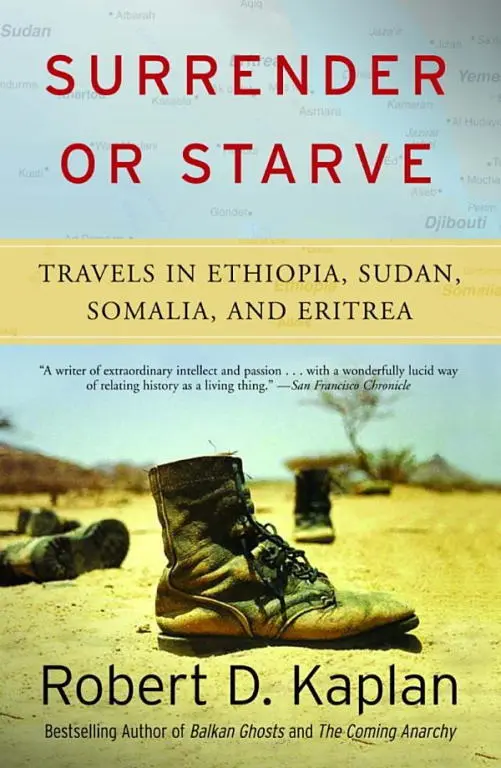
- Название:Surrender or Starve
- Автор:
- Издательство:Vintage Books
- Жанр:
- Год:2003
- Город:New York
- ISBN:978-0-307-54768-2
- Рейтинг книги:5 / 5. Голосов: 1
-
Избранное:Добавить в избранное
- Отзывы:
-
Ваша оценка:
Surrender or Starve: краткое содержание, описание и аннотация
Предлагаем к чтению аннотацию, описание, краткое содержание или предисловие (зависит от того, что написал сам автор книги «Surrender or Starve»). Если вы не нашли необходимую информацию о книге — напишите в комментариях, мы постараемся отыскать её.
, Kaplan illuminates the fault lines in the Horn of Africa, which is emerging as a crucial region for America’s ongoing war on terrorism.
Reporting from Sudan, Ethiopia, Somalia, and Eritrea, Kaplan examines the factors behind the famine that ravaged the region in the 1980s, exploring the ethnic, religious, and class conflicts that are crucial for understanding the region today. He offers a new foreword and afterword that show how the nations have developed since the famine, and why this region will only grow more important to the United States. Wielding his trademark ability to blend on-the-ground reporting and cogent analysis, Robert D. Kaplan introduces us to a fascinating part of the world, one that it would behoove all of us to know more about.
Surrender or Starve — читать онлайн бесплатно полную книгу (весь текст) целиком
Ниже представлен текст книги, разбитый по страницам. Система сохранения места последней прочитанной страницы, позволяет с удобством читать онлайн бесплатно книгу «Surrender or Starve», без необходимости каждый раз заново искать на чём Вы остановились. Поставьте закладку, и сможете в любой момент перейти на страницу, на которой закончили чтение.
Интервал:
Закладка:
Despite all the accusations, the government is going ahead with resettlement. The land in the north is dry and dead, nothing grows there. In the south it is rich and fertile. There is plenty of water. In this camp with proper irrigation, they can grow two crops a year…. This settlement [near Jimma, in Kefa province] has become for them a showcase, a demonstration that despite difficulties the resettlement program can be made to work. …As for the settlers, there are personal problems. Many are homesick, others were concerned about families left behind. …This massive movement of almost one and a half million people will not be easy. But even those western officials who are critical of the program admit there may be no other way.
Jimma, as it turned out, was one of the camps about which Cultural Survival had obtained first-hand information concerning massive human rights abuses.
For the two months that they were in Sudan, Niggli, Holcomb, and Clay were relatively unobtrusive. They went about their business quietly and didn’t socialize with the crowd of journalists and relief workers in Khartoum. A year later, when the results of their research were being hotly discussed, few could even remember them. (I was fortunate to be tipped off to their operation by a diplomat, who casually mentioned that “there was this guy here from Harvard a few months back, Jason Clay, conducting research on resettlement, who seemed a lot more serious and professional than the others passing through this place. You ought to get in touch with him.”)
Cultural Survival, based in Cambridge, Massachusetts, came to Sudan with especially impressive credentials. Founded in 1972 by a group of social scientists at Harvard University, its reports on endangered ethnic groups in Africa, Asia, and Latin America have criticized right-wing and left-wing governments alike and have been utilized by the World Bank, USAID, and foreign governments to judge a country’s human rights record and need for development assistance. Clay’s team interviewed 277 Ethiopian refugees at six sites in eastern Sudan (Fau II, Tawawa, Wad Kowli, Damazin, Kirmuk, and Yabuus) using local translators who were not connected with the TPLF. (Bonnie Holcomb, who speaks Oromo, helped with some of the translations.) All interviews were taped and then translated a second time by other translators back in the United States. More than half those interviewed were selected at random and, in almost all cases, involved more than 5 percent of the total population of each camp. This was a statistically huge sample. (Harris Polls, for instance, rely on .0004 of 1 percent of the U.S. population.) As Clay told me in a letter, “Methodologically, you cannot touch [criticize] the data that we collected” about conditions in Ethiopia “as it relates to the refugees in Sudan.”
Nevertheless, by the time Clay and his team completed their work in Sudan at the end of March 1985, between 300,000 and 400,000 peasants from the north of Ethiopia already had been resettled, according to the authorities in Addis Ababa. From a strictly scientific point of view, as Clay admitted to me, his findings could not claim to provide a wholly accurate picture of what was happening to those still in Ethiopia, who did not escape. This is because the Ethiopian refugees in Sudan, for a variety of reasons, may not have been representative of those who were resettled. Clay said, however, “the information that we collected was so similar on so many fronts, that it has to be taken seriously” regarding the present situation inside Ethiopia. Although this obviously was a researcher’s opinion of his own work, Clay’s words found an echo in the remarks of author William Shawcross, in The Quality of Mercy, about the situation inside Cambodia in the mid 1970s.
Although it was hard to find a rationale for the Khmer Rouge conduct that the refugees described, their testimony was the same as that given to other people along the border. And their stories rang true; I just could not believe that these people had invented their tales or that they were simply being manipulated by the CIA or by Thai military intelligence. Refugees fleeing dictatorships—Stalin’s USSR, Hitler’s Europe, Pinochet’s Chile, Husak’s Czechoslovakia— have all been reliable witnesses of the states they left behind.
Clay told me that he tried to get permission for Cultural Survival to conduct research inside Ethiopia itself, but his queries never were answered. Nevertheless, certain scientific reservations notwithstanding, the work carried out in eastern Sudan by Clay, Niggli, and Holcomb was not only more thorough and unrestricted than was any other investigation of Ethiopian resettlement practices, but the work also stands as one of the most richly detailed, academically guided studies of the actual process of forced collectivization and its attendant human rights abuses in the reality of the Third World. To my knowledge, no study of the Great Leap Forward in China or the actions of the Khmer Rouge in Cambodia was as well packaged as was Cultural Survival’s Politics and the Ethiopian Famine 1984–1985, a 250-page monograph, served up with an array of attractive maps, whose results—if you could wade through the overwhelming details (few could)—were absolutely devastating.
“All those interviewed insisted that they had been captured by government troops and forced to resettle. …Ten percent of all those interviewed reported that they witnessed people being killed who tried to escape.” More than 40 percent said they were beaten. More than 85 percent said they had been separated from at least one member of their immediate families; 70 percent were separated from all members of their immediate families. Amete Gebremedhin, a Tigrean in her early forties, stated that after she and a group of other captured women protested to the militia about being separated from their husbands and children, “the soldiers laughed and said: ‘What do you care about your children, you will find new ones in Asosa.’”
According to the report, resettlement often occurred in the process of fighting between the government and the TPLF. The government would surround a village, burn the crops, take the animals, and round people up. But in other instances, various lures were used; as in the case of Woldeselassie, the government would advise peasants to bring their oxen to a certain place for vaccination and then abduct those peasants. The most common lure was the promise of food at government feeding centers. Here Western grain deliveries played a direct part in the resettlement process. It also explains why hundreds of thousands of northern peasants, mostly Tigreans, ran away from the food that U.S. relief workers were donating in November 1984, rather than toward it, and trekked for weeks on foot to Sudan instead.
More than 30 percent of those taken for resettlement, according to Clay’s report, “were held in regular prisons with common criminals or in military barracks until transport was arranged…. People reported that as many as 20 percent of those captured at the same time from their village died in the holding camps even before beginning the trip.” Relatives trying to bring food to those in holding areas were denied entry and were beaten by soldiers.
Some of the peasants were held in proper feeding camps, accessible to Western journalists. But “only the meek, quiet people were allowed to see the journalists. Group leaders and known resisters were moved out of camp areas where journalists were permitted to roam.” In one case, an Ethiopian government official announced that “white guests are coming. …Whether you speak positively or negatively we will translate positively to the journalists.” Tsegay Wolde Giorgis, a Tigrean in his fifties, said that in November 1984 “the inmates in the camp at Makelle were told to select ten speakers who should talk to western journalists. The speakers were supposed to talk about drought and famine that had affected their villages… and that they had no other desire but to be resettled.” Another Tigrean, Haili Kelela, claimed that in front of a group of “white people” who had arrived in “a white car with a red cross painted on it,” he and seven others told party cadres that they didn’t want to be resettled. The cadres assured them that “we will give you food… and lead you back to your village.” But after the “white people” had left, he and the others were thrown in prison and beaten until “I had to vomit blood.”
Читать дальшеИнтервал:
Закладка:
Похожие книги на «Surrender or Starve»
Представляем Вашему вниманию похожие книги на «Surrender or Starve» списком для выбора. Мы отобрали схожую по названию и смыслу литературу в надежде предоставить читателям больше вариантов отыскать новые, интересные, ещё непрочитанные произведения.








Обсуждение, отзывы о книге «Surrender or Starve» и просто собственные мнения читателей. Оставьте ваши комментарии, напишите, что Вы думаете о произведении, его смысле или главных героях. Укажите что конкретно понравилось, а что нет, и почему Вы так считаете.