Robert Kaplan - Surrender or Starve
Здесь есть возможность читать онлайн «Robert Kaplan - Surrender or Starve» весь текст электронной книги совершенно бесплатно (целиком полную версию без сокращений). В некоторых случаях можно слушать аудио, скачать через торрент в формате fb2 и присутствует краткое содержание. Город: New York, Год выпуска: 2003, ISBN: 2003, Издательство: Vintage Books, Жанр: Публицистика, nonf_military, на английском языке. Описание произведения, (предисловие) а так же отзывы посетителей доступны на портале библиотеки ЛибКат.
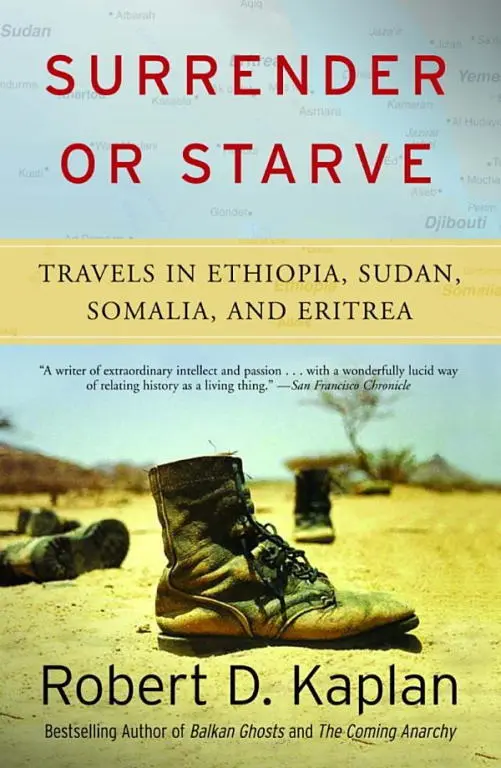
- Название:Surrender or Starve
- Автор:
- Издательство:Vintage Books
- Жанр:
- Год:2003
- Город:New York
- ISBN:978-0-307-54768-2
- Рейтинг книги:5 / 5. Голосов: 1
-
Избранное:Добавить в избранное
- Отзывы:
-
Ваша оценка:
Surrender or Starve: краткое содержание, описание и аннотация
Предлагаем к чтению аннотацию, описание, краткое содержание или предисловие (зависит от того, что написал сам автор книги «Surrender or Starve»). Если вы не нашли необходимую информацию о книге — напишите в комментариях, мы постараемся отыскать её.
, Kaplan illuminates the fault lines in the Horn of Africa, which is emerging as a crucial region for America’s ongoing war on terrorism.
Reporting from Sudan, Ethiopia, Somalia, and Eritrea, Kaplan examines the factors behind the famine that ravaged the region in the 1980s, exploring the ethnic, religious, and class conflicts that are crucial for understanding the region today. He offers a new foreword and afterword that show how the nations have developed since the famine, and why this region will only grow more important to the United States. Wielding his trademark ability to blend on-the-ground reporting and cogent analysis, Robert D. Kaplan introduces us to a fascinating part of the world, one that it would behoove all of us to know more about.
Surrender or Starve — читать онлайн бесплатно полную книгу (весь текст) целиком
Ниже представлен текст книги, разбитый по страницам. Система сохранения места последней прочитанной страницы, позволяет с удобством читать онлайн бесплатно книгу «Surrender or Starve», без необходимости каждый раз заново искать на чём Вы остановились. Поставьте закладку, и сможете в любой момент перейти на страницу, на которой закончили чтение.
Интервал:
Закладка:
Then the trip continued to Addis by plane. Trucks came to bring us to the airfield. The old and the sick were thrown onto the trucks like sacks by the soldiers: one held only the legs, one by the arms…. Then the healthy people were pushed on. But this was still bearable.
Soviet-made Antonovs, provided by the Soviet Union and Libya, were used in the operation. The planes, whose unpressurized cargo bays were designed for 50 paratroopers, carried 300–350 people on each flight to Addis Ababa. As Woldeselassie and many others described it, the sick people were laid on the floor in the middle of the plane, then the healthier ones were packed in. “We stood like sticks tied together. Those stretched out on the floor in the middle suffered most. People stepped on them, fell on them, squashed them. One person died before my eyes.” Bonnie K. Holcomb, who worked alongside Niggli interviewing survivors, told Spin magazine that people “were crushed to death on the impact of takeoff and landing. They were suffocating, throwing up on each other, literally being asphyxiated. …Children had to be held over people’s heads so they wouldn’t be smashed. Women miscarried and bled.” At Bole airport in Addis Ababa, troops carried off the dead bodies, and a fire brigade hosed out the pool of vomit and piss from the floor of the plane.
Although water was not scarce, the peasants were given only one cup of water each before being packed tightly onto buses for the long journey to Welega, a province in western Ethiopia astride the border with Sudan. “We were simply dropped off in the middle of the jungle, all around nothing but grass and bamboo of a man’s height. I felt like garbage that had been dropped in the middle of nowhere,” said another captured peasant, who like Woldeselassie, was used to living in the highlands of Tigre.
The jungly no-man’s-land was near Asosa, a town about twenty-five miles from the Sudanese border. Woldeselassie said that no food was provided for two days after his group had arrived. He and other Tigreans tried to escape. But after three days in the bush they were caught by Berta tribesmen and brought back to Asosa. “The administrator asked us why we tried to run away. ‘No one had forced us to come,’ he said. …We nodded in agreement, hoping to reduce our punishment: yes, we had all come here voluntarily. Then we complained that there was no food, how should we survive? He answered that the government was begging other governments to feed us.”
Woldeselassie was fortunate, however. A few days later, he made a second escape attempt and this time succeeded in reaching Sudan, where Niggli interviewed him at Damazin on March 6, 1985.
At this time, 42,000 people already had been relocated to the Asosa region, mainly east of the Dabus River, in order to make escapes to Sudan more difficult. Not a single installation awaited the peasants, and food and water were scarce. For those not lucky enough to escape soon after arrival, several months of hard labor followed: savannah grass had to be cut, trees were felled, and bamboo forests were cleared. Houses of corrugated iron were built for the militia and party cadres, and large grass huts were put up for assemblies. Only afterward were the peasants allowed to build smaller grass huts for themselves. In the intervening period, the peasants either slept out in the open or in the larger assembly huts, where two hundred to three hundred people were squeezed together, side to side, each night. Because the grass was so dry, fires were frequent. It is possible that some of the fires were set by Tigreans as a form of protest. In any case, the consequences were horrific. Hundreds of people reportedly were burned. Those who died were buried in mass graves. Among the victims were women and children, who on account of being ill from starvation, couldn’t run fast enough from the flames. Others who were not hurt had their clothes destroyed. Because new clothing was not available, the cadres handed out empty sacks to the peasants so that they could make new garments.
The workday began at six, but most had to rise by three in the morning in order to stand in line for a cooking pan to roast the little bit of peeled grain that was distributed. Except for a short break in the middle of the afternoon for a second, similar meal, work continued until dusk, when graves were dug for those who had died during the day. New settlers usually received unground wheat. Only sometimes was wheat flour distributed. According to Niggli, the wheat rations varied considerably, from eleven pounds per person per month to fifty-five pounds. (A person needs at least sixty-five pounds per month to meet his or her minimum protein requirement through wheat alone.) Special food for the cadres and militia troops was brought in from the town.
The peasants were divided into work brigades of twenty-five, called a guad. Twenty guads equaled a tabia (center in Amharic) of five hundred people. An amba (village) usually consisted of about seven thousand people, or fourteen tabias. Each amba was commanded by seventy militia troops, who in turn were under the power of fourteen armed cadres from the Workers’ Party of Ethiopia. A study prepared by Cultural Survival, an independent human rights organization staffed mainly by Harvard professors, explained how the militia troops lived in fear of the Marxist cadres.
In some cases, militia were beaten in front of the camp residents…. One escapee reported that three militia in his site had been accused of letting colonists escape. They were summarily hanged and then shot in the head. The militia took the examples to heart. As one escapee reported, “The main job of the militia is to kick us.” …Beatings occurred, reportedly, when people urinated without permission or… if they slowed the rate of work in the fields.
Two escaped peasants told Niggli that the troops “liked to order their victim to lift his arms, look into the sun and spin around quickly. Blows with bamboo sticks ensured the proper acceleration, until the victim lost his balance and fell to the ground.” Another punishment was to make a person walk around the amba holding his (or her) excrement in his (or her) bare hands.
Of course, there were shortages of everything, especially farm implements and medicines. However, a hospital for 100,000 settlers was being constructed in Asosa with Soviet aid, and Soviet doctors already were at work during this period. One Tigrean peasant whom Niggli interviewed said those who were caught trying to escape had to dig latrines for the Soviets.
When Niggli, Bonnie Holcomb, and the research director of Cultural Survival, Dr. Jason W. Clay, arrived in Sudan in February 1985 to interview the Tigreans and others who had escaped over the border, the resettlement issue was an interesting sideshow to the main famine story. Western journalists and diplomats in Ethiopia had caught glimpses of people being herded onto trucks and airplanes. One U.S. diplomat went so far as to say that “the selection process recalled Auschwitz.” From the little that could be discerned, resettlement appeared to be yet another indication, if any was needed, of the Marxist regime’s insensitivity to its own people. But there the issue ground to a halt for lack of evidence. Resettlement areas simply were off limits to almost all foreigners, except those on prearranged tours to model camps. The government denied that the program was not voluntary or that it was motivated by any factor besides the humanitarian desire to relocate drought-stricken peasants to more fertile areas in the west and southwest of the country. Western relief officials stationed in Addis Ababa, whose presence depended on the good will of the local authorities, tended to back up the regime’s assertions. The obfuscations no doubt influenced Friedman’s Newsday article, as well as a report aired April 1, 1985, on ABC’s World News Tonight by correspondent Lou Cioffi, who depicted resettlement as a necessary evil.
Читать дальшеИнтервал:
Закладка:
Похожие книги на «Surrender or Starve»
Представляем Вашему вниманию похожие книги на «Surrender or Starve» списком для выбора. Мы отобрали схожую по названию и смыслу литературу в надежде предоставить читателям больше вариантов отыскать новые, интересные, ещё непрочитанные произведения.







Обсуждение, отзывы о книге «Surrender or Starve» и просто собственные мнения читателей. Оставьте ваши комментарии, напишите, что Вы думаете о произведении, его смысле или главных героях. Укажите что конкретно понравилось, а что нет, и почему Вы так считаете.