Robert Kaplan - Surrender or Starve
Здесь есть возможность читать онлайн «Robert Kaplan - Surrender or Starve» весь текст электронной книги совершенно бесплатно (целиком полную версию без сокращений). В некоторых случаях можно слушать аудио, скачать через торрент в формате fb2 и присутствует краткое содержание. Город: New York, Год выпуска: 2003, ISBN: 2003, Издательство: Vintage Books, Жанр: Публицистика, nonf_military, на английском языке. Описание произведения, (предисловие) а так же отзывы посетителей доступны на портале библиотеки ЛибКат.
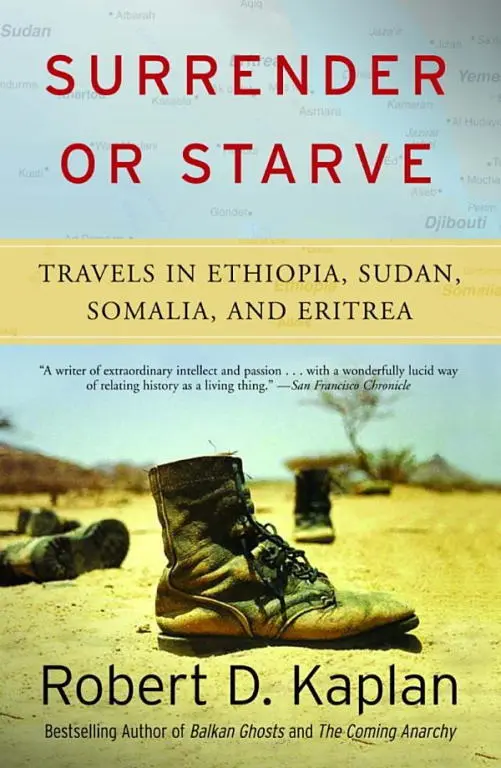
- Название:Surrender or Starve
- Автор:
- Издательство:Vintage Books
- Жанр:
- Год:2003
- Город:New York
- ISBN:978-0-307-54768-2
- Рейтинг книги:5 / 5. Голосов: 1
-
Избранное:Добавить в избранное
- Отзывы:
-
Ваша оценка:
Surrender or Starve: краткое содержание, описание и аннотация
Предлагаем к чтению аннотацию, описание, краткое содержание или предисловие (зависит от того, что написал сам автор книги «Surrender or Starve»). Если вы не нашли необходимую информацию о книге — напишите в комментариях, мы постараемся отыскать её.
, Kaplan illuminates the fault lines in the Horn of Africa, which is emerging as a crucial region for America’s ongoing war on terrorism.
Reporting from Sudan, Ethiopia, Somalia, and Eritrea, Kaplan examines the factors behind the famine that ravaged the region in the 1980s, exploring the ethnic, religious, and class conflicts that are crucial for understanding the region today. He offers a new foreword and afterword that show how the nations have developed since the famine, and why this region will only grow more important to the United States. Wielding his trademark ability to blend on-the-ground reporting and cogent analysis, Robert D. Kaplan introduces us to a fascinating part of the world, one that it would behoove all of us to know more about.
Surrender or Starve — читать онлайн бесплатно полную книгу (весь текст) целиком
Ниже представлен текст книги, разбитый по страницам. Система сохранения места последней прочитанной страницы, позволяет с удобством читать онлайн бесплатно книгу «Surrender or Starve», без необходимости каждый раз заново искать на чём Вы остановились. Поставьте закладку, и сможете в любой момент перейти на страницу, на которой закончили чтение.
Интервал:
Закладка:
Imperial exploitation intensified under the rule of Menelik’s successor, Haile Selassie, which led to a peasant revolt in 1943 against both the emperor and Tigre’s own feudal aristocracy. The rebellion was put down with the help of a British bombing raid on Makelle, and reprisals were swift in coming. The peasants were disarmed, dispossessed of their land, and burdened by a brutal onslaught of taxation that filled the coffers of the emperor, the local nobility in Tigre, and the Coptic church. There was never any investment from any of these quarters back into the province, which is why there is no industry and almost no working class. There is so little money in circulation that halite (rock salt) is often used as currency. More than 90 percent of the people are peasant farmers, who have overworked the soil merely to eke out a living from it. The result has been five famines in the past thirty years alone. In 1959, 90,000 Tigreans starved to death. In the 1972–1973 period, 200,000 in Tigre and nearby Wollo died.
It was from the exceedingly thin strata of educated people that an underground resistance was formed in the early 1970s, which was active in the overthrow of the emperor. After the coup, the local aristocracy, led by a descendant of Emperor Yohannes IV, Ras Mangasha Seyum, established the Tigre Liberation Front (TLF) to oppose new rulers in Addis Ababa. But as the revolution progressed, the TLF itself became radicalized, adopted a Marxist program, and changed its name to the Tigre People’s Liberation Front. War was declared on the Dergue in February 1975, after it had become clear that Mengistu and his cohorts, although ideologically in step with the TPLF, were bent on the same imperial approach to Tigre as was used by the deposed emperor. As usual in the Third World, Marxism counted for little when pitted against centuries of ethnic hatred.
In typical Ethiopian fashion, the late 1970s in Tigre saw another pageant of internecine bloodletting as macabre as it was incomprehensible, with the TPLF fighting not only the Dergue, but two other Tigrean groups as well: the royalist Ethiopian Democratic Union of Ras Mangasha, and the Marxist Ethiopian People’s Revolutionary party, which was estranged from the TPLF because of hair-splitting disagreements about liberation doctrine. But taking place as they did in the atmosphere of paranoia accompanying the Dergue’s Jacobin reign of terror, these theoretical debates between different sets of hunted extremists led to armed clashes. Thanks partly to help from the Eritrean guerrillas, the TPLF defeated the other groups in 1978, thereby allowing for an expanded war with the Dergue, which, in the early 1980s, equaled anything transpiring in Southeast Asia or Central America for sheer horror.
Firebrace, in the Minority Rights Group report, describes the government’s 1980–1981 offensive against the TPLF.
Continuous aerial bombardment with cluster bombs, incendiary bombs and napalm left dry fields ablaze. Further plots were burned by government forces wishing to… put a squeeze on civilian food supplies. At the same time, thousands of infantry soldiers on the move with heavy Russian-built T-54 and T-55 tanks left huge tracts of cropland flattened in their wake.
Tens of thousands of peasants were forced to flee their homes, and many had to seek shelter in damp caves where the incidence of disease was increased by overcrowding. Essential parts of the cultivation cycle were abandoned.
That offensive was a failure. The next, in western Tigre in early 1983, occurred just after the harvest season in the only part of the province with a grain surplus. As Firebrace related, “Grain was seized, grain stores and fodder supplies burnt, oil presses and mills removed, and whole villages destroyed.” Once more, it was all for naught, as the TPLF regained the area after two months. While relief and rehabilitation aid requested by the government from the U.N. poured into other war-torn provinces during this period, nothing was allocated for Tigre, because 85 percent of the countryside was in guerrilla hands. The legacy of mass destruction combined with neglect triggered the 1984 famine, which most of the media would ascribe to “drought.” For journalists arriving in Addis Ababa direct from Europe and the United States, not only the distant past in Tigre but the recent past too might as well never have existed. The “war”—it rarely got more specific than that one word—was listed as just another reason for the calamity in the north.
Allen Pizzey was one of the few U.S. journalists who traveled in TPLF territory in order to explain the relationship between war and famine. Pizzey reported that “the Ethiopian government calls the rebels terrorists, but here they’re more like Robin Hood figures, protectors of the traders. Almost every teenager in Tigre wants to be a fighter. Recruits come in as fast as refugees stream out.” Although Pizzey’s account reached millions of viewers on CBS Evening News with Dan Rather, it is questionable how much effect the March 22, 1985, report had. It was a one-shot item lost in a barrage of countless other reports about Sudan and Ethiopia that barely mentioned the war and if they did, dismissed both the Eritreans and the Tigreans as “Marxist rebels.”
From a public relations point of view, the TPLF had much more working against it than did the EPLF. With the Eritreans, the problem was mainly one of getting the whole truth out. But the truth about the TPLF, even if one could get it out, was not wholly palatable. Unlike the Eritreans, the Tigrean guerrillas never disowned the Marxist label. In fact, the TPLF underwent a further radicalization in July 1985, when the Marxist-Leninist League of Tigre was established in the “liberated” area. The league’s founding document, which attacked “revisionism of all hues,” evoked the perverse extremism of the Albanian communists. This created another barrier to U.S. support for Tigre at a time when the outside world was just beginning to recognize REST as an exemplary force against famine. But nobody need have been surprised. The TPLF was created out of the same crucible of revolutionary violence as was the Dergue. Language and group loyalty, not ideology, have separated the two. The fact that the TPLF does not share the Dergue’s penchant for indiscriminate brutality may be merely a matter of circumstances; the TPLF does not have to police an unwieldy empire of disparate ethnic groups. The TPLF has only its own peasants to worry about, and its battlefield success partially depends upon their well-being, but the killing of two Ethiopian relief workers in Alamata does indicate what the Tigrean guerrillas are capable of when they are not dealing with their own kind. Although the Eritrean revolt was born during the rule of the emperor, the one in Tigre was very much a child of the revolution.
But the circumstances under which the TPLF operates are not going to change. Tigre and some depopulated areas of Gondar are all the guerrillas want, or ever need, to control. Thus, the issues— for donors interested in famine relief and for strategists interested in knocking a Soviet piece off the board—is how the TPLF fights and how it treats its own people in its own backyard. Marxist pretensions notwithstanding, the TPLF land reform program, the guerrillas’ emphasis on women’s rights, the creation of a rural health service, the building of schools to augment a literacy campaign, and other infrastructure improvements undertaken by the TPLF in the countryside are exactly the kinds of things that USAID encourages every government in Africa to do. “Marxism” in Tigre is—for example—little different than the sum of U.S. government proposals for the development of western Sudan. Although the Sudanese authorities never accepted U.S. advice, the “Marxist” rebels in Tigre have. Since 1975, a veritable societal transformation has taken place. Democratically elected councils at the village level have been set up. Firebrace, in the Minority Rights Group report, noted that “local power has shifted to those traditionally excluded from power—the poor peasants, women and particular groups who experienced discrimination such as Muslims in the highland areas and craftsmen.” According to Jon Bennett, a frequent traveler in the province, writing for the British journal The New Statesman (June 17, 1983), “What is unique here…is the extent to which the TPLF has captured the imagination of the Tigrean peasantry and managed to translate political consensus into participation.” Such policies helped account for why escaped peasants previously victimized by the Dergue in Tigre trusted the TPLF enough to risk going back. However, recent attacks by the TPLF on food convoys and feeding camps have undercut the deservedly good reputation the organization has forged among knowledgeable people. But it is worthwhile to keep in mind that these attacks notwithstanding, the human rights record of the TPLF on the whole has been a great deal better than that of the Dergue.
Читать дальшеИнтервал:
Закладка:
Похожие книги на «Surrender or Starve»
Представляем Вашему вниманию похожие книги на «Surrender or Starve» списком для выбора. Мы отобрали схожую по названию и смыслу литературу в надежде предоставить читателям больше вариантов отыскать новые, интересные, ещё непрочитанные произведения.





Обсуждение, отзывы о книге «Surrender or Starve» и просто собственные мнения читателей. Оставьте ваши комментарии, напишите, что Вы думаете о произведении, его смысле или главных героях. Укажите что конкретно понравилось, а что нет, и почему Вы так считаете.