Robert Kaplan - Surrender or Starve
Здесь есть возможность читать онлайн «Robert Kaplan - Surrender or Starve» весь текст электронной книги совершенно бесплатно (целиком полную версию без сокращений). В некоторых случаях можно слушать аудио, скачать через торрент в формате fb2 и присутствует краткое содержание. Город: New York, Год выпуска: 2003, ISBN: 2003, Издательство: Vintage Books, Жанр: Публицистика, nonf_military, на английском языке. Описание произведения, (предисловие) а так же отзывы посетителей доступны на портале библиотеки ЛибКат.
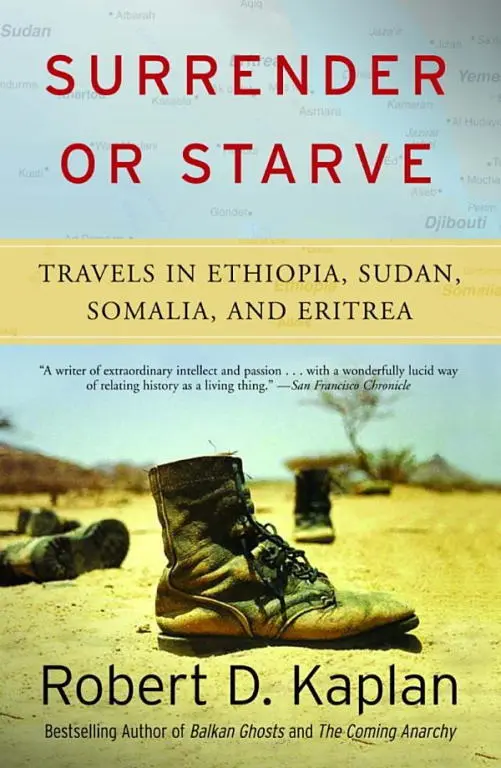
- Название:Surrender or Starve
- Автор:
- Издательство:Vintage Books
- Жанр:
- Год:2003
- Город:New York
- ISBN:978-0-307-54768-2
- Рейтинг книги:5 / 5. Голосов: 1
-
Избранное:Добавить в избранное
- Отзывы:
-
Ваша оценка:
Surrender or Starve: краткое содержание, описание и аннотация
Предлагаем к чтению аннотацию, описание, краткое содержание или предисловие (зависит от того, что написал сам автор книги «Surrender or Starve»). Если вы не нашли необходимую информацию о книге — напишите в комментариях, мы постараемся отыскать её.
, Kaplan illuminates the fault lines in the Horn of Africa, which is emerging as a crucial region for America’s ongoing war on terrorism.
Reporting from Sudan, Ethiopia, Somalia, and Eritrea, Kaplan examines the factors behind the famine that ravaged the region in the 1980s, exploring the ethnic, religious, and class conflicts that are crucial for understanding the region today. He offers a new foreword and afterword that show how the nations have developed since the famine, and why this region will only grow more important to the United States. Wielding his trademark ability to blend on-the-ground reporting and cogent analysis, Robert D. Kaplan introduces us to a fascinating part of the world, one that it would behoove all of us to know more about.
Surrender or Starve — читать онлайн бесплатно полную книгу (весь текст) целиком
Ниже представлен текст книги, разбитый по страницам. Система сохранения места последней прочитанной страницы, позволяет с удобством читать онлайн бесплатно книгу «Surrender or Starve», без необходимости каждый раз заново искать на чём Вы остановились. Поставьте закладку, и сможете в любой момент перейти на страницу, на которой закончили чтение.
Интервал:
Закладка:
The freed prisoners provided a fount of information about jail conditions in Ethiopia. The Paris-based International Federation of Human Rights sent an Anglo-French legal team, led by Alex Lyon, a former minister in the British Home Office, to take evidence from the former detainees. According to an article by Colin Legum, a noted expert on African affairs, that appeared in the International Herald Tribune (May 20, 1986), “The lawyers found that the civilian population of Tigre were victims of arbitrary arrest and torture, and detained without charge in overcrowded, insanitary conditions. Evidence from people who had been in other prisons showed that conditions in Makelle prison were not exceptional.” Several different methods of torture were employed, which included submersion in a barrel of hot, dirty water and beatings with a leather whip called the “ox penis.” Legum wrote that one prisoner “said he was forced to confess to murder by having a rachet screwed into his hand.” Lassa fever and typhoid reportedly were common.
The same week as the prison break, REST began a three-month program of repatriation of Tigrean refugees from camps in eastern Sudan. It was a benchmark event of epic proportions that signified the end of the famine emergency in northern Ethiopia: 80,000 of the 300,000 Tigreans in the border area were trekking several hundred miles back to their homes in an operation planned by their own relief organizations with little outside help. In political terms, the return exodus was the last in a series of referendums in which a large peasant population, by voting with its feet, expressed absolute fear of the internationally recognized government in Addis Ababa and complete faith in a guerrilla group recognized by nobody. The first round was conducted in late 1984, when 200,000 Tigrean refugees stampeded over the border into Sudan, joining another 100,000 Tigreans already there. Like the Eritreans, the Tigreans were escaping war and drought. They preferred to dodge bombs from MIG runs on refugee columns during the eight-week journey on foot from central Tigre rather than go to nearby government feeding centers for help. Time magazine (January 21, 1985) reported the story of Mohammed Idriss, sixty, and his family of eight.
The house they left sits on a hill overlooking one of the Ethiopian government’s largest refugee camps and emergency feeding centers. Almost from his doorstep, Idriss could see trucks and aircraft ferrying in some of the thousands of tons of foreign relief supplies that are now flowing into the country every day. Yet he preferred to shepherd his family for 23 days across mountainous wasteland to the relief camp of Tekl el Bab, the newest of three centers that have sprung up near the Sudanese town of Kassala, 20 miles from the Ethiopian border.
Why? “We were afraid,” says Idriss. “If we went to the feeding center, the government would ask us for papers; they would turn me away. But first they would take my sons and send them to work on state farms in the south or draft them into the army.”
The feeding centers would give food only to those with identification cards indicating membership in a government peasant association. Because people from TPLF-controlled areas had no such documents, they were denied food and sometimes beaten. For many, if not most, of Tigre’s five million inhabitants, the food that the international community was donating in late 1984 and early 1985 may as well not have been given because it was delivered to the wrong address—that of the Ethiopian government, which was not so much governing Tigre as fighting a war with it. The Reagan administration, in addition to some private charities operating from Khartoum, already was aware of this problem and had begun planning a cross-border feeding program, in cooperation with REST. But others, particularly the United Nations, persisted in believing the Dergue. As late as September 21, 1985, the office of Kurt Jansson, the U.N. emergency coordinator in Addis Ababa, without even consulting REST released a report maintaining that 80 percent of the famine victims in Tigre were receiving help from the RRC, the International Committee of the Red Cross, and Western donor agencies operating from government-held areas. In light of the refugees’ own accounts of what really was happening at government feeding stations, coupled with the fact that the TPLF controlled most of the countryside in the province, the U.N. claim seemed preposterous. As Allen Pizzey of CBS News reported on March 22, 1985, “Three weeks of travel across rebel-held Tigre have shown clearly that the government has no administrative presence… and is not distributing food aid.”
Having escaped to Sudan, the Tigreans entered a new kind of hell. More than one million of Sudan’s 22 million people were refugees, and the Khartoum government—destitute from civil war, drought, and its own corruption and mismanagement—was unable to offer the Tigreans anything except the assurance that they wouldn’t be sent back across the border to Ethiopia. The refugees thus were dependent upon the mercy of international organizations, mainly the United Nations High Commissioner for Refugees (UNHCR), which, having dragged its feet on U.S. government predictions in 1983 of a mass influx of refugees the following year, was ill-prepared for the human flood. The Tigreans were packed into a number of holding camps strung out along a dun-colored moonscape near the towns of Kassala and Gedaref. The largest was Wad Kowli, southeast of Gedaref on the Atbara River, a few miles from the Ethiopian border. According to Sudan Commissioner’s Office of Refugees, there were as many as 90,000 Tigreans at Wad Kowli in early 1985. Gayle Smith, the author of two books on Tigre, who visited the camp in March of that year, said in a telexed report to Grassroots International that the camp presented a “microcosm of an entire society dying out.” More than one hundred people were dying a day of measles, multi-resistant shigella, and a host of other diseases. The daily death rate at the camp was fourteen per 10,000—the highest anywhere in the world, reported UNHCR field officer Jean-Michel Goudstikker. UNHCR explained that due to “a declining and deteriorating supply” of water from the Atbara River, the camp had to be serviced by tanker trucks. The situation was so bad that on February 17, according to Barbara Hendrie, a representative of Grassroots International who was there, Wad Kowli had “one day of surface water left.” The refugees couldn’t even bathe. Hendrie also reported “tremendous shortages of clothing, blankets, cooking utensils and salt and pepper for food.”
The Tigreans were degraded in other ways as well. The refugees’ presence sparked resentment among local Sudanese, who on several occasions stoned whole groups of camp inhabitants. Tigrean women were frequent targets of rape attempts by Sudanese soldiers. The night of February 10, 1986, after men in the camp had tried to help the women resist the soldiers, the army sealed off Wad Kowli and arrested 166 people. All of the men detained received five lashes each, said a UNHCR source. (In a May 16, 1985, dispatch, Paul Vallely quoted a Sudanese official at another camp as saying that “every Ethiopian woman who crosses the border deserves to be raped as the price of admission.”) Therefore, one could hardly blame the fifty-seven thousand Tigreans, who in May 1985, despite continued drought and war conditions in Tigre, elected to return home against the advice of REST and other agencies.
By February 1986, however, drought conditions in western Tigre and parts of central Tigre had improved enough for REST to launch a repatriation program. A large crop in the west the previous spring and the likelihood of early belg (light spring) rains on the eastern escarpment of the central highlands meant that refugees returning to those areas would be able to sustain themselves until the first harvest of maize and sorghum, expected in June. The returning refugees were divided into groups of forty, according to village, and each peasant was given water, 100 grams of sugar, and five days worth of biscuits upon leaving Sudan. In addition, the International Rescue Committee in Wad Kowli distributed chloroquin for use against malaria contracted along the way. The TPLF, in cooperation with REST, had set up relief stations every three days walk, where fresh rations were provided along with medicine for the sick. At the last relief station, tools and seeds were to be distributed for planting. Those who lived in the central highlands had a month of walking ahead of them.
Читать дальшеИнтервал:
Закладка:
Похожие книги на «Surrender or Starve»
Представляем Вашему вниманию похожие книги на «Surrender or Starve» списком для выбора. Мы отобрали схожую по названию и смыслу литературу в надежде предоставить читателям больше вариантов отыскать новые, интересные, ещё непрочитанные произведения.










Обсуждение, отзывы о книге «Surrender or Starve» и просто собственные мнения читателей. Оставьте ваши комментарии, напишите, что Вы думаете о произведении, его смысле или главных героях. Укажите что конкретно понравилось, а что нет, и почему Вы так считаете.