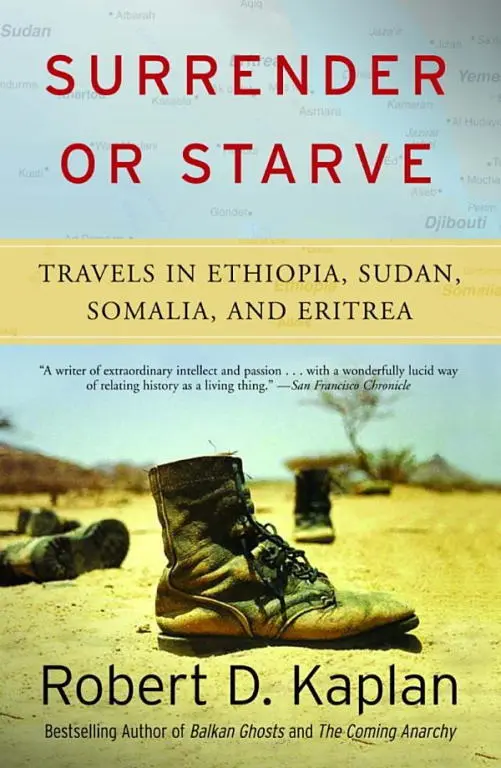
Robert Kaplan - Surrender or Starve
Здесь есть возможность читать онлайн «Robert Kaplan - Surrender or Starve» весь текст электронной книги совершенно бесплатно (целиком полную версию без сокращений). В некоторых случаях можно слушать аудио, скачать через торрент в формате fb2 и присутствует краткое содержание. Город: New York, Год выпуска: 2003, ISBN: 2003, Издательство: Vintage Books, Жанр: Публицистика, nonf_military, на английском языке. Описание произведения, (предисловие) а так же отзывы посетителей доступны на портале библиотеки ЛибКат.
- Название:Surrender or Starve
- Автор:
- Издательство:Vintage Books
- Жанр:
- Год:2003
- Город:New York
- ISBN:978-0-307-54768-2
- Рейтинг книги:5 / 5. Голосов: 1
-
Избранное:Добавить в избранное
- Отзывы:
-
Ваша оценка:
Surrender or Starve: краткое содержание, описание и аннотация
Предлагаем к чтению аннотацию, описание, краткое содержание или предисловие (зависит от того, что написал сам автор книги «Surrender or Starve»). Если вы не нашли необходимую информацию о книге — напишите в комментариях, мы постараемся отыскать её.
, Kaplan illuminates the fault lines in the Horn of Africa, which is emerging as a crucial region for America’s ongoing war on terrorism.
Reporting from Sudan, Ethiopia, Somalia, and Eritrea, Kaplan examines the factors behind the famine that ravaged the region in the 1980s, exploring the ethnic, religious, and class conflicts that are crucial for understanding the region today. He offers a new foreword and afterword that show how the nations have developed since the famine, and why this region will only grow more important to the United States. Wielding his trademark ability to blend on-the-ground reporting and cogent analysis, Robert D. Kaplan introduces us to a fascinating part of the world, one that it would behoove all of us to know more about.
Surrender or Starve — читать онлайн бесплатно полную книгу (весь текст) целиком
Ниже представлен текст книги, разбитый по страницам. Система сохранения места последней прочитанной страницы, позволяет с удобством читать онлайн бесплатно книгу «Surrender or Starve», без необходимости каждый раз заново искать на чём Вы остановились. Поставьте закладку, и сможете в любой момент перейти на страницу, на которой закончили чтение.
Интервал:
Закладка:
From the moment the Tigreans left the thatched tukuls at Wad Kowli there was no shade. It was a never-ending climb into the highlands. The passage through the vast ocean of dust in northern Gondar was as monotonous and unfriendly as a sea voyage. Some had donkeys. But most slung their sacks and plastic jerry cans on sticks over their shoulders. One old man had a leg injury and could barely walk, yet somehow he was walking. They were all half-naked in their ragged shammas. But this was no march of sorrow. These people were going home and, according to relief officials, were healthier than they had been in years. But because they were not visibly starving, it was not a news story.
I followed the returning refugees across Gondar almost as far as the border with Tigre, riding in a grain convoy that closely paralleled their route. I saw firsthand what food aid specialist Jack Shepherd of the Carnegie Endowment said was unique in the Third World: a guerrilla army that was feeding its people rather than feeding off them.
At dawn, two thousand refugees straggled into the TPLF relief station at Gichew, where I had arrived the night before after a five-hour truck journey from Wad Kowli. I had slept out on the open plain and was awakened in my sleeping bag by the sound of feet pounding nearby. Except for the shrill racket of cicadas, there were no other noises: the refugees were too tired to talk. Gichew was one of the transit camps set up by the TPLF in late 1984 to aid starving peasants escaping to Sudan. Now it was being used for the second time to assist the same people coming back. The site was selected because the thick brush made it hard to spot from the air and the high ground made it difficult to attack. Otherwise, Gichew was indistinguishable from the rest of the Gondar wasteland. My recollections of it are in black and white; drought had drained the color out of the landscape. All the trees looked stunted. Only the termite hills appeared tall (some were as high as six feet). The relief station was manned by sixty TPLF fighters and ten staff members of REST. The commander, Alem Ayel, was twenty-six years old.
The guerrillas doled out water to the refugees from oil drums. The line was silent and orderly. People sought out shade in tukuls and in the folds of the hills. In an underground slate bunker, chloroquin, Tylenol, rehydration salts, antibiotics, children’s multivitamins, and an iron supplement were available. Grain was distributed by the TPLF in the afternoon, and in the evening a cup of flour was given out to each group leader; the flour was supposed to be enough to make dinner for forty. A guerrilla soldier with a notebook went around making sure every group was accounted for. Beads and silver charms dangled from black shoelaces around the women’s necks as they prepared the enjerra. The smoke from the cooking fires at dusk drew a charcoal veil over the darkening tableau. “It is obvious we are afraid our relatives have died of hunger or have been taken by the government soldiers. So we are in a hurry to get back to see how they are,” said Lete Gebreal, thirty-three, of Damo village, which was nearly a month’s walk from Gichew.
It was an eight-hour journey by nighttime convoy from Gichew to Kaza, where the refugees would arrive after another three-day walk. Kaza had been firmly in TPLF hands since early 1984, and 100 guerrillas and REST personnel now occupied the cluster of tukuls on a flat-topped mountain (amba) overlooking a stream bordered by white oleanders. The meager trickle of water and the blooming, poisonous shrubs, along with a pack of colobus monkeys shrieking in the acacia branches, brought a sparkle of life to an otherwise dying landscape. The trees concealed 1,200 50-kilogram bags of U.S.-donated grain from the eyes of Ethiopian pilots.
In addition to being a relief station, Kaza functioned as a hospital and as an orphanage for 112 children whose parents had died of starvation en route to Sudan in 1984. The word “hospital” was misleading because a few basic medicines and bedding for up to 130 people were all that was provided. (In this respect, as in many others, conditions in Tigre were far more primitive than in Eritrea.) Haile Geremesken, the local TPLF commander, said that of the first nine thousand returning refugees who reached Kaza, eight hundred had spent at least one night in the hospital and three had died along the way. He showed me a notebook full of names as proof. This was relatively close to a normal death rate. If the commander’s figures were even partially correct, it meant an extraordinary achievement for REST and the TPLF.
The returning refugees arrived at Kaza one night after plodding through a dust that filled their nostrils and attacked their eyes and throat but was only a few feet away from clear water and oleanders. Although the drought was over, the villages that these refugees were going back to were by no means secure. From the standpoint of the Ethiopian government, these villages were “strategic hamlets” in the middle of a war zone. The government aim had been to depopulate them by starvation and aerial bombardment, thereby driving the people to the main roads and government reception centers, where many were separated from their families, and sent to resettlement camps in the southwest of the country. This policy still was continuing.
The fact that these Tigreans were voluntarily marching back to perhaps the same destiny owed much to the awful conditions in Sudan and to their all-consuming desire to learn the fate of their relatives left behind in Tigre. But the march also required an astonishing degree of faith in the TPLF. Some of these marchers— maybe one thousand of them—actually had been in resettlement camps and were among the lucky few to have escaped to Sudan. They now were completing a circle of migration: from village to government reception center to resettlement camp to safety in Sudan, then north along the Sudanese border to Wad Kowli or one of the other sites near Gedaref or Kassala, and finally back to the same village where the nightmare had started, and where it conceivably would start all over again.
As these refugees filed past with everything they owned tied up in bundles slung over their shoulders, it seemed to me that this repatriation revealed a lot more about the political preferences of a people than did all the rigged and semirigged elections that were forever taking place in Africa and elsewhere in the Third World. It seemed to me that TPLF, upon which these returning refugees in fact were staking their lives, warranted a closer look by U.S. policymakers concerned with turning the tables on a Soviet-backed tyranny whose actions had caused the famine in the first place.
The TPLF was borne out of ethnic conflict and a system of economic exploitation that even the most rapacious Western capitalist barely could imagine. For more than one hundred years, Tigre’s five million people, 70 percent of whom are Christian and speak Tigrinya, have been on a treadmill of war and famine that makes the 42,500-square-mile province (the size of Ohio, Liberia, or East Germany) an environmental disaster zone. In fact, by the second half of the nineteenth century, subsistence-level agriculture was being ravaged by fighting among various feudal armies. The orgy of violence left Menelik, the Amhara negus of Shoa, the most dominant of the warlords. In 1889, he became Emperor Menelik II, succeeding the Tigrean Yohannes IV, who died in a battle with the Sudanese. Tigre bore the brunt of the Amhara emperor’s war with the Italians. In 1896, Menelik led an army of one hundred thousand soldiers northward through Tigre as far as Adowa, where he defeated an Italian force that was poised to expand Italy’s colonial claim beyond Eritrea. In the words of the Minority Rights Group report on Tigre, authored by James Firebrace, Menelik’s “army fed itself from local food supplies leaving grain and seed stocks empty, and slaughtering the oxen used for ploughing. Seven years of famine followed [in Tigre].”
Читать дальшеИнтервал:
Закладка:
Похожие книги на «Surrender or Starve»
Представляем Вашему вниманию похожие книги на «Surrender or Starve» списком для выбора. Мы отобрали схожую по названию и смыслу литературу в надежде предоставить читателям больше вариантов отыскать новые, интересные, ещё непрочитанные произведения.











Обсуждение, отзывы о книге «Surrender or Starve» и просто собственные мнения читателей. Оставьте ваши комментарии, напишите, что Вы думаете о произведении, его смысле или главных героях. Укажите что конкретно понравилось, а что нет, и почему Вы так считаете.