Robert Kaplan - Surrender or Starve
Здесь есть возможность читать онлайн «Robert Kaplan - Surrender or Starve» весь текст электронной книги совершенно бесплатно (целиком полную версию без сокращений). В некоторых случаях можно слушать аудио, скачать через торрент в формате fb2 и присутствует краткое содержание. Город: New York, Год выпуска: 2003, ISBN: 2003, Издательство: Vintage Books, Жанр: Публицистика, nonf_military, на английском языке. Описание произведения, (предисловие) а так же отзывы посетителей доступны на портале библиотеки ЛибКат.
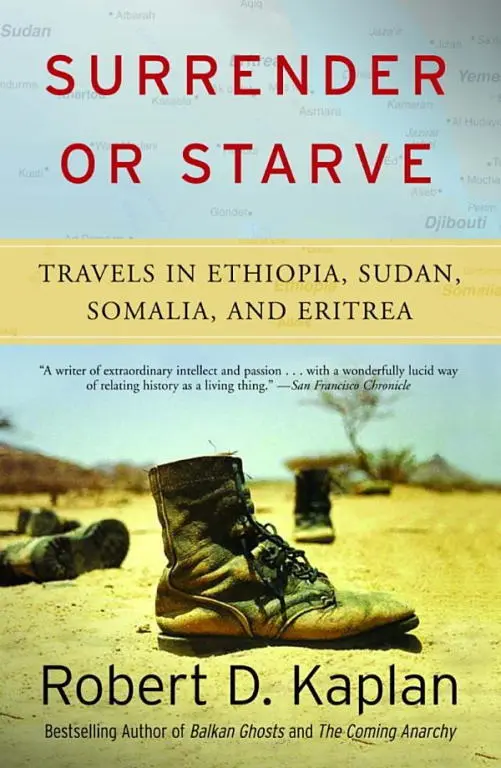
- Название:Surrender or Starve
- Автор:
- Издательство:Vintage Books
- Жанр:
- Год:2003
- Город:New York
- ISBN:978-0-307-54768-2
- Рейтинг книги:5 / 5. Голосов: 1
-
Избранное:Добавить в избранное
- Отзывы:
-
Ваша оценка:
Surrender or Starve: краткое содержание, описание и аннотация
Предлагаем к чтению аннотацию, описание, краткое содержание или предисловие (зависит от того, что написал сам автор книги «Surrender or Starve»). Если вы не нашли необходимую информацию о книге — напишите в комментариях, мы постараемся отыскать её.
, Kaplan illuminates the fault lines in the Horn of Africa, which is emerging as a crucial region for America’s ongoing war on terrorism.
Reporting from Sudan, Ethiopia, Somalia, and Eritrea, Kaplan examines the factors behind the famine that ravaged the region in the 1980s, exploring the ethnic, religious, and class conflicts that are crucial for understanding the region today. He offers a new foreword and afterword that show how the nations have developed since the famine, and why this region will only grow more important to the United States. Wielding his trademark ability to blend on-the-ground reporting and cogent analysis, Robert D. Kaplan introduces us to a fascinating part of the world, one that it would behoove all of us to know more about.
Surrender or Starve — читать онлайн бесплатно полную книгу (весь текст) целиком
Ниже представлен текст книги, разбитый по страницам. Система сохранения места последней прочитанной страницы, позволяет с удобством читать онлайн бесплатно книгу «Surrender or Starve», без необходимости каждый раз заново искать на чём Вы остановились. Поставьте закладку, и сможете в любой момент перейти на страницу, на которой закончили чтение.
Интервал:
Закладка:
What the famine emergency revealed, for the few who cared to look, was that in terms of development policy at least, the guerrillas in both Tigre and Eritrea stood alongside the United States, which, by virtue of its massive economic assistance programs, usually has acted in the interests of the African peasantry. The Soviet Union, on the other hand, tended to support urban elites who exploited the peasants. Whatever the case in Nicaragua and El Salvador, in Sudan and Ethiopia at least, the U.S. government was on the right side of a long-brewing historical conflict. Unfortunately, the Reagan administration’s conservative supporters never really emphasized this aspect of the famine story. Nor did they take advantage of opportunities to undermine the Ethiopian government by promoting guerrilla groups whose fighting records have been superior to those of other insurgents whom the administration supported. Conservatives never really focused on the guerrillas because the media didn’t. Although conservatives generally are more critical of the establishment media than are liberals, in the case of the famine conservatives were just as manipulated by the media. The major newspapers, and especially television, determined the agenda for political debate in the United States. Eritrea and Tigre—ravaged by Africa’s bloodiest war and home to half the Ethiopian famine victims—never made it as hot items on the media’s list.
THREE
The African Killing Fields
I have never been a “village politician,” was never enthralled by romantic notions of “the land,” but it bothered me when we communists abruptly turned our backs on the peasants and subjected them to economic and police pressures.
—Milovan Djilas, Rise and FallMao Zedong said that a guerrilla army “swims in the sea of the people.” Another communist theorist (according to Peter Niggli’s report for Berliner Missionswerk), this one a young cadre of the Workers’ Party of Ethiopia, explained the corollary to that argument to a group of Tigrean peasants at Makelle after he had lost his temper with them: “If you dry out the sea the fish die.”
He continued, “We will dry out Tigre and force the bandits to give up. You are the backbone of the bandits, so we have to break you first; then we can also destroy the marrow.” Added another party cadre to another group of captured peasants, “We will not stop with the people, but we will destroy the whole land unto the last tree.”
Ethiopia’s communist rulers were aware that the Tigrean guerrillas could not be defeated by military means alone. So the government’s office of nationalities, run by Ethiopian Amharas assisted by Soviet advisers, came up with a plan at the beginning of the 1980s to exterminate the TPLF’s rural power base. But the plan didn’t really get rolling until the famine-inspired Western relief effort did. Here is what happened to one of the fish in the sea.
Woldeselassie Gebremariam, a Tigrean priest in his late thirties, was one of fifty Ethiopian refugees interviewed in March 1985 at a camp in eastern Sudan by Peter Niggli, a Swiss investigator for the German church group Berliner Missionswerk.
My village is in the TPLF area. A cattle plague broke out last fall [1984] in the whole region. …The animals screamed, didn’t feed anymore, they shit blood, fell away to the bones and finally died. The government announced it was going to vaccinate all the cattle free of charge at Adwa [in the north-central part of the province]…. The TPLF gave us permission [to cross into government territory] for the vaccination. We rounded up 750 head of cattle in our village and started off.
Woldeselassie, expecting to return home in a few days, left his wife and three children back in his village. This was about the time that a Newsday report (December 9, 1984) entitled, “New Start for Chosen Few” by Josh Friedman, indicated that a number of resettlement abuses, including the forced separation of families, had ended.
We arrived in Adwa on December 9 [1984] and were surrounded by soldiers in the middle of the town. [Woldeselassie explained how the soldiers picked out the youngest and strongest looking of the peasants and took them to prison.] We shouted, “Who was going to take care of our cattle?” …They answered it would be no loss if we lost our cattle, the government was going to resettle us and would replace our cattle in the new settlement.”
There were more than 1,000 people in the prison at Adwa. A cadre by the name of Debesai was responsible for our registration. He declared that Tigre was only stones and rocks and the soil had lost all fertility, therefore the government had to bring us to more fertile areas. …We shouted all at once and started a big row which enraged our cadre Debesai very much. Debesai went to the administrator…. That man got angry too, came to prison and called us out, insulted us and finally ordered us to crawl back into the prison yard on our knees. The soldiers watched over the execution of his order and beat us as we crawled….
We were kept in the prison for ten days. There was an absolute shortage of water. I don’t know whether the old, the sick and the women got any at all. Every time the water was brought, a fight… started and only those who had the support of young, strong men received some water…. Some people tried to break out… my friend Makonnen, for example, but he was recaptured… and beaten the whole night. …The next morning he had to roll in the dirt before our eyes, water was poured over him until he was covered with mud. Then they ordered him to crawl back and forth on his elbows and knees. …He had to shout with his breaking voice that this would happen to anyone who tried to run away. He was not allowed to clean himself the whole day and his wounds were not treated.
For food, the prisoners were given two pieces of bread a day. The soldiers reportedly ate from grain bags, whose markings indicated they had been donated by the European Economic Commission and the governments of Canada and West Germany. On the eleventh day, Soviet pilots transported Woldeselassie and the others from Adwa to Makelle by helicopter. They couldn’t go by land because the countryside in between was controlled by the TPLF.
We were kept in an open field. There was no shade during the day and no shelter from the cold at night. The field, which contained 7,000 to 8,000 people from all over Tigre, was surrounded by three rows of soldiers. …Water was brought to the camp in two pipes. One pipe was reserved for the soldiers. The other pipe was for us but also served the soldiers if they wanted to wash their clothing. When they washed, we didn’t get water. In between there were long queues…. When it was your turn, you ran to the pipe and tried to scoop up as much water as you could with both hands and also to drink a few drops—there were no containers for water. Meanwhile the next person was already pushing….
There was a camp prison for those who protested. …I was there. …Altogether, we were about 70 prisoners and we had to clear away the excrements every day.
Others at the camp explained how on account of catastrophic sanitary conditions, people fell ill with diarrhea and vomiting. Many died before even leaving Makelle. But when foreigners, including journalists, visited near the camp, the Tigreans temporarily were moved elsewhere.
During the eight days I was there the cadre Debesai hung about [Woldeselassie continued]. He was brought in an official car in the morning and picked up in the evening. When he could no longer stand the stink that covered the field he had the car [pick him up in the afternoon]. Debesai was young and he wore a nice army jacket of the style the Russians wear…. He loved to say that today we were complaining about resettlement, but tomorrow, after we had been resettled, we would beg them to send our families….
Читать дальшеИнтервал:
Закладка:
Похожие книги на «Surrender or Starve»
Представляем Вашему вниманию похожие книги на «Surrender or Starve» списком для выбора. Мы отобрали схожую по названию и смыслу литературу в надежде предоставить читателям больше вариантов отыскать новые, интересные, ещё непрочитанные произведения.










Обсуждение, отзывы о книге «Surrender or Starve» и просто собственные мнения читателей. Оставьте ваши комментарии, напишите, что Вы думаете о произведении, его смысле или главных героях. Укажите что конкретно понравилось, а что нет, и почему Вы так считаете.