Robert Kaplan - Surrender or Starve
Здесь есть возможность читать онлайн «Robert Kaplan - Surrender or Starve» весь текст электронной книги совершенно бесплатно (целиком полную версию без сокращений). В некоторых случаях можно слушать аудио, скачать через торрент в формате fb2 и присутствует краткое содержание. Город: New York, Год выпуска: 2003, ISBN: 2003, Издательство: Vintage Books, Жанр: Публицистика, nonf_military, на английском языке. Описание произведения, (предисловие) а так же отзывы посетителей доступны на портале библиотеки ЛибКат.
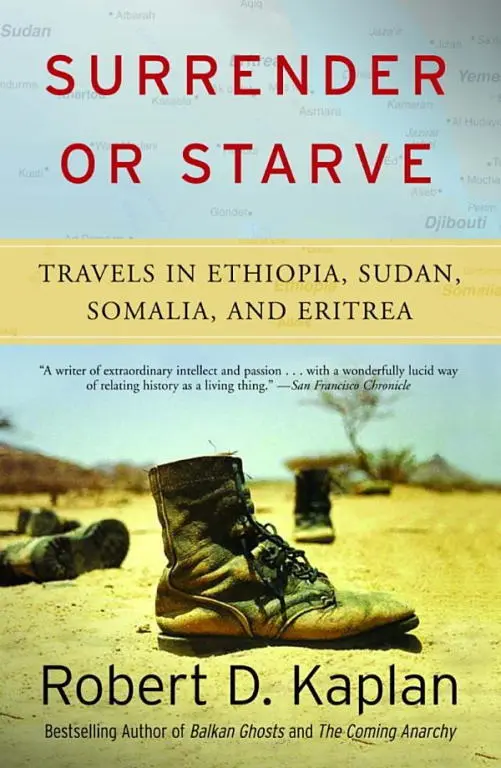
- Название:Surrender or Starve
- Автор:
- Издательство:Vintage Books
- Жанр:
- Год:2003
- Город:New York
- ISBN:978-0-307-54768-2
- Рейтинг книги:5 / 5. Голосов: 1
-
Избранное:Добавить в избранное
- Отзывы:
-
Ваша оценка:
Surrender or Starve: краткое содержание, описание и аннотация
Предлагаем к чтению аннотацию, описание, краткое содержание или предисловие (зависит от того, что написал сам автор книги «Surrender or Starve»). Если вы не нашли необходимую информацию о книге — напишите в комментариях, мы постараемся отыскать её.
, Kaplan illuminates the fault lines in the Horn of Africa, which is emerging as a crucial region for America’s ongoing war on terrorism.
Reporting from Sudan, Ethiopia, Somalia, and Eritrea, Kaplan examines the factors behind the famine that ravaged the region in the 1980s, exploring the ethnic, religious, and class conflicts that are crucial for understanding the region today. He offers a new foreword and afterword that show how the nations have developed since the famine, and why this region will only grow more important to the United States. Wielding his trademark ability to blend on-the-ground reporting and cogent analysis, Robert D. Kaplan introduces us to a fascinating part of the world, one that it would behoove all of us to know more about.
Surrender or Starve — читать онлайн бесплатно полную книгу (весь текст) целиком
Ниже представлен текст книги, разбитый по страницам. Система сохранения места последней прочитанной страницы, позволяет с удобством читать онлайн бесплатно книгу «Surrender or Starve», без необходимости каждый раз заново искать на чём Вы остановились. Поставьте закладку, и сможете в любой момент перейти на страницу, на которой закончили чтение.
Интервал:
Закладка:
Everyone interviewed said people had died en route to the resettlement sites; 60 percent said they actually saw people die. Clay’s analysis of the death figures was the most comprehensive and the most controversial part of his research.
The death rates reported by the refugees ranged from 33 deaths per 10,000 people per day to 270 deaths per 10,000. These rates are extremely high given that the camp populations were comprised almost entirely of adults. Such figures were consistently reported from a number of different refugees from different areas. Furthermore, they were relayed by people who did not know each other. Some of the resettled people were undoubtedly malnourished as a result of declining agricultural production in their homelands, but many had not experienced famine until they were captured for resettlement. …Perhaps it is more important to note that the settlers received minuscule amounts of food for as long as a month before they arrived in the resettlement camps and then were expected to work 11 hours each day for six and a half days each week. …Many of the settlers were forced to sleep in open fields. …Finally, there were probably a number of diseases to which colonists had little or no resistance….
These figures raise… the question of how many of the 400,000 people who were resettled by June of 1985 are still alive. If even the most conservative estimates of the death rate (33 per 10,000 per day) are halved and then halved again (i.e., reduced by 75 percent), then 50,000 to 100,000 of those resettled in this massive program may already have been dead by July 1985.
The figure of “50,000 to 100,000” dead set the aid communities in Khartoum and Addis Ababa ablaze. It was a higher death rate than that at the emergency feeding camps on the Sudanese border at the height of the famine, and most of the Ethiopians who perished in Sudan were children and old people—of which there were very few in the resettlement program. Father Jack Finucane, the head of Concern, an Irish aid group in Addis Ababa, saw the death rates in an article I wrote for The Wall Street Journal about Cultural Survival’s report and told a group of sixty foreign aid workers assembled on October 19, 1985, at the RRC headquarters, “I’ve read it and I don’t believe it.” Finucane said that in visits he and other members of Concern made to the resettlement area, there were no indications of any such horrors. But as it turned out, one month earlier, at a private meeting at the Hilton Hotel where only Western ambassadors and some aid officials were present, Finucane told a different tale; about a half million people were being displaced in “horrible conditions.” Of seventy-seven resettlement areas, only two or three had succeeded, he had said. In a July 29, 1985, letter to his home office, Finucane wrote it was safe to assume that 25 percent—or 125,000—of the settlers had died.
Finucane’s reversal, whereby he independently confirmed from the Ethiopian side the main points of Cultural Survival’s Sudan-based research, only to deny it all at a public forum in the presence of Ethiopian officials, was laid out in a November 3, 1985, article by David Blundy in the Sunday Times (of London). When Blundy, then one of the paper’s leading foreign correspondents, asked the chair of the Band Aid coordinating committee in Addis Ababa, Brother Augustus O’Keefe, about the discrepancy, O’Keefe replied, “That was a private meeting [the meeting between Finucane and the ambassadors]. I won’t talk about it. The press have done a lot of damage here. I have never heard about any problems with resettlement.”
It was a familiar pattern: back up the research of Cultural Survival and Berliner Missionswerk in private, but condemn it in public. The Red Cross League, for example, did a study on resettlement in the summer of 1985 that corroborated much of what Clay’s resettlement study had found, including the death rate. But the report was kept secret. (Oddly enough, the Canadian Embassy in Addis Ababa was a true believer in resettlement, even in private. One Canadian diplomat actually told me that the West had to get involved in a big way in resettlement, in order to have “influence here.” When I mentioned to another Canadian official, whom I met in Sudan, that Canada was assisting resettlement through funding to private agencies involved in the program, he got very angry and proceeded to launch a tirade against U.S. human rights abuses in the Third World. At the time I knew of no other country about which the views of the Canadian and U.S. governments were as divergent as on Ethiopia. Officials in the U.S. State Department and National Security Council had been extremely critical of Canada’s policy toward resettlement. In Addis Ababa, the two embassies literally represented opposing camps. Some of the Canadians I met appeared absolutely driven about proving that—at least as far as Ethiopia was concerned— they had a foreign policy truly different from that of the United States. In Canada itself this policy was criticized. This was one of the stranger aspects of the famine emergency.)
The spinelessness of the aid community in Addis Ababa was demonstrated a few months later, in December 1985, when the inevitable happened—one of their own went public about the appalling consequences of resettlement. Medecins sans Frontieres published a report entitled, “Mass Deportation in Ethiopia,” alleging that with a death rate of 20 percent, as many as 300,000 people were likely to die in the resettlement program, of which up to 100,000 already had. The report noted that “one of the most massive violations of human rights” was “being carried out with funds and gifts from international aid.” The French group quickly was expelled from Ethiopia, while the rest of the aid community chastised the group for getting involved in “politics” when it should have been keeping its nose to the grindstone of relief work. Apparently, nobody in Addis Ababa was drawing the distinction between “politics” and gross violations of human rights. The kiss of death to the French group’s presence in Ethiopia was administered by the United Nations, which publicly defended resettlement by saying that the French organization’s charges could not be taken seriously because it was the only group in the field making such accusations.
The U.N. statement, reported January 30, 1986, on the BBC’s hourly broadcast, was yet another example of the aid community closing its eyes and ears to unpleasant facts that would have further complicated its working relationship with the Marxist regime, although these facts were easy to come by. Relief workers saw six hundred people at Korem, in Wollo province, being herded onto trucks by militia troops using sticks and whips. Within twenty-four hours, ten thousand other peasants fled the Korem camp fearing their turn would be next. Relief workers also knew that women and children were being denied food at Korem as punishment by the government because the husbands had escaped from resettlement camps. It was no secret that thousands of other women and children were being cut off from intensive feeding programs in Wollo in order to pressure people to volunteer for resettlement.
In early 1986, MSF took its case to the court of U.S. public opinion, which barely paid attention, even though the United States was providing almost as much aid to Ethiopia as was the rest of the world combined. A Washington press conference, among other activities, got the French doctors onto the front page of The New York Times for a day and into the editorial pages of several important dailies. But the story had difficulty making the evening news on the major networks because there was no footage of the settlers being abused. Also, this was the period of the Challenger disaster. Therefore, the impact of MSF’s revelation on the general public was marginal. And as one refugee official in Washington explained to me, “Suzanne Garment of The Wall Street Journal was the only big columnist to write about it, so everyone around here dismissed it as just a right-wing issue.” As limited as MSF’s effect was, it was still greater than that of Cultural Survival. This was in a way unfortunate because MSF, a relief group whose investigation was not as well grounded academically proved a much softer target for supporters of resettlement than did the Harvard-based Cultural Survival. Because the resettlement debate began in 1986 to swirl around MSF, it was assumed by many that the accounts of human rights violations were exaggerated. Most observers forgot that the French doctors’ report was merely part of a growing body of evidence corroborating what Clay’s group initially revealed. The daily news media, by this time obsessed with the southern part of the African continent in place of the Horn, did little to put the findings into perspective or to investigate the matter further. The editorial page of The Wall Street Journal was a constant exception to this rule, but like all opinion pages, it didn’t have quite the credibility of a hard news section, and the page’s conservative slant meant that liberals often distrusted it. A breakthrough of sorts occurred in early March 1986, after a visit to the Damazin refugee camp by Blaine Harden of The Washington Post and Charles Powers of the Los Angeles Times.
Читать дальшеИнтервал:
Закладка:
Похожие книги на «Surrender or Starve»
Представляем Вашему вниманию похожие книги на «Surrender or Starve» списком для выбора. Мы отобрали схожую по названию и смыслу литературу в надежде предоставить читателям больше вариантов отыскать новые, интересные, ещё непрочитанные произведения.









Обсуждение, отзывы о книге «Surrender or Starve» и просто собственные мнения читателей. Оставьте ваши комментарии, напишите, что Вы думаете о произведении, его смысле или главных героях. Укажите что конкретно понравилось, а что нет, и почему Вы так считаете.