Robert Kaplan - Surrender or Starve
Здесь есть возможность читать онлайн «Robert Kaplan - Surrender or Starve» весь текст электронной книги совершенно бесплатно (целиком полную версию без сокращений). В некоторых случаях можно слушать аудио, скачать через торрент в формате fb2 и присутствует краткое содержание. Город: New York, Год выпуска: 2003, ISBN: 2003, Издательство: Vintage Books, Жанр: Публицистика, nonf_military, на английском языке. Описание произведения, (предисловие) а так же отзывы посетителей доступны на портале библиотеки ЛибКат.
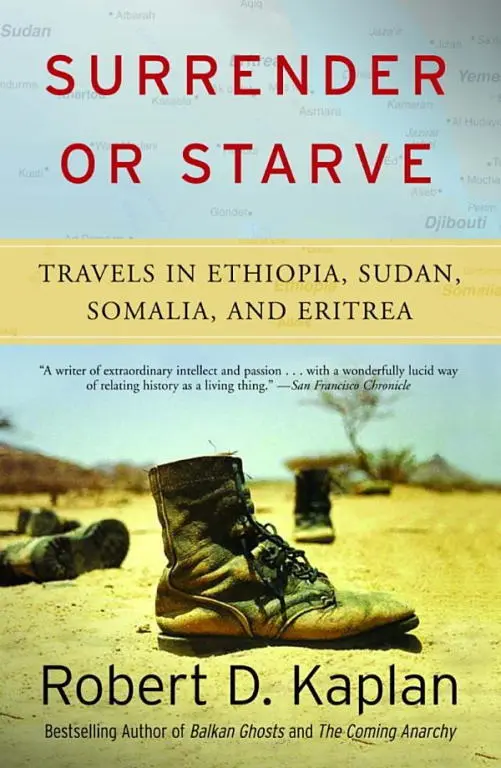
- Название:Surrender or Starve
- Автор:
- Издательство:Vintage Books
- Жанр:
- Год:2003
- Город:New York
- ISBN:978-0-307-54768-2
- Рейтинг книги:5 / 5. Голосов: 1
-
Избранное:Добавить в избранное
- Отзывы:
-
Ваша оценка:
Surrender or Starve: краткое содержание, описание и аннотация
Предлагаем к чтению аннотацию, описание, краткое содержание или предисловие (зависит от того, что написал сам автор книги «Surrender or Starve»). Если вы не нашли необходимую информацию о книге — напишите в комментариях, мы постараемся отыскать её.
, Kaplan illuminates the fault lines in the Horn of Africa, which is emerging as a crucial region for America’s ongoing war on terrorism.
Reporting from Sudan, Ethiopia, Somalia, and Eritrea, Kaplan examines the factors behind the famine that ravaged the region in the 1980s, exploring the ethnic, religious, and class conflicts that are crucial for understanding the region today. He offers a new foreword and afterword that show how the nations have developed since the famine, and why this region will only grow more important to the United States. Wielding his trademark ability to blend on-the-ground reporting and cogent analysis, Robert D. Kaplan introduces us to a fascinating part of the world, one that it would behoove all of us to know more about.
Surrender or Starve — читать онлайн бесплатно полную книгу (весь текст) целиком
Ниже представлен текст книги, разбитый по страницам. Система сохранения места последней прочитанной страницы, позволяет с удобством читать онлайн бесплатно книгу «Surrender or Starve», без необходимости каждый раз заново искать на чём Вы остановились. Поставьте закладку, и сможете в любой момент перейти на страницу, на которой закончили чтение.
Интервал:
Закладка:
In theory, the U.S. government did not deal with these guerrillas. Rather, it dealt only with REST, which was supposed to have complete control over the trucks and the grain. But this trail in Gondar was a long way from Washington, and legalistic divisions tended to get submerged beneath the overpowering imperatives of war in this remote corner of Ethiopia. Not that there was evidence of grain being diverted to the soldiers. But, as I was to learn (during my trip in February 1986), nothing was easily verifiable in TPLF areas. The conditions in Tigre were even more primitive than those in Eritrea. Water was not always available even for washing. After living for days on crushed biscuits and marmalade, I felt ill more often than not. In such a state, traveling only at night and sleeping much of the day, it was difficult for an outsider to judge just what was going on. The guerrillas and our Tigrean guides often were not cooperative. The successive scenes of biblical-like migrations, patrolling soldiers, and trucks moving in the night created an imagery so rich it may have concealed as much as it illuminated. In Tigre, there were no trenches defining areas of control, no tanks or artillery pieces indicating troop concentrations, and no set-piece battles whose results were a matter of record. The TPLF, with an estimated 15,000 soldiers and no heavy equipment, was waging a classic insurgency campaign similar to those being waged in Cambodia, El Salvador, Mozambique, and elsewhere. The Dergue was responding in kind: crops were burned, markets razed, and drinking wells poisoned in the midst of a drought in order to “deny the enemy valuable resources and cover.” Villages frequently changed hands, meaning that peasants were caught in the middle even more than occurred in Eritrea. This was a small-scale version of Vietnam and Afghanistan, except that there was a famine here as well.
Unlike Eritrea, this wasn’t a war of conquest on the fringes of the empire. This was the empire devouring its own heart. Ethiopia, as an imperial concept, grew up out of Tigre. Axum, in the northwest of the province, was the legendary birthplace of Ethiopia’s first emperor, Menelik I, son of the Hebrew king Solomon and the queen of Sheba. Only a century ago, a Tigrean emperor, Yohannes IV, ruled all of Ethiopia from Makelle before Addis Ababa was built by the Amharas. Now it was the same old story: the Amharas—who prevailed in the Dergue—were fighting the Tigreans, who resented the domination. In a sense, little had changed since the Scottish explorer James Bruce visited Gondar and Tigre in 1770, when, as Alan Moorehead wrote in The Blue Nile, there were “endless marchings and counter-marchings of futile little armies,” with an “atmosphere of Grand Guignol … of horror piled upon horror until everything dissolves into a meaningless welter of brutality and bloodshed.” Western journalists in the 1980s found northern Ethiopia as baffling and incomprehensible as Bruce must have found it more than two hundred years earlier. The TPLF, like the Dergue, was the product of a secretive, self-contained culture that for centuries eschewed contacts with the outside world. One could draw fewer conclusions from a tour of Tigre than from a tour of Eritrea.
Yet basic patterns did emerge. Not everything was unclear. Much that was clear went unreported, and much of what was reported was not properly explained. As in the case of Eritrea, one could visit the government-held areas of Tigre on a day trip from the Hilton in Addis Ababa, with a box lunch to go along. Or, one could visit the TPLF side from Khartoum; it took two weeks, the food and accommodations were even worse than in Eritrea, and the trip was less rewarding. Thus, while legions of journalists followed entertainers and politicians to Makelle, on the government side, where RRC officials lectured about the Dergue’s ability to provide the entire province of Tigre with relief supplies, the TPLF roamed the countryside all around Makelle, and in response, the Dergue was literally burning crops and blasting peasants out of their tukuls (huts) in places such as Abbi Adi, sixty miles from where all the journalists stood.
For most correspondents on the government side, the TPLF was never more than a vaguely defined, evil-bent force whose only goal, it seemed, was to disrupt the RRC’s relief efforts. The March 1986 killings of two Ethiopian employees of World Vision by the TPLF provided ample justification for this view. But if one looked beyond the “policies of relief” to the politics of war, the guerrillas’ hostility to the presence of Western relief workers in Alamata was not difficult to fathom.
From a relief standpoint, World Vision’s actions were unassailable. The private charity was transporting food as close as possible to the TPLF front lines and feeding as many people as could be fed. However, looked at another way, World Vision’s role was not so benign. The Dergue, with Soviet financial and technical help, in the early months of 1985 had completed a successful offensive that seriously disrupted relief work in TPLF-controlled areas. The MIG bombings of transit camps along the escape route to Sudan and the capture of the Hermi gorge, which linked the densely populated central highlands with western Tigre, trapped thousands of starving peasants in places where no help was available. The towns of Abbi Adi and Sheraro also were taken. Abbi Adi reportedly was bombed on market day, March 1, 1985, and according to eyewitnesses in Sheraro, the hospital was destroyed and the wells were poisoned. Next, Mengistu had to consolidate his battlefield victory, and the Tigre part of the northern initiative that USAID was then pushing on him, as a complement to the cross-border program from Sudan, would help him do just that. Having gotten the Soviets to bankroll the military side of the offensive in Tigre, the Ethiopian leader now got the United States and World Vision to pacify the populations of the newly won areas with grain handouts. As Paul Vallely wrote in The Times of London (June 4, 1985), it amounted to “a bizarre de facto alliance between the United States and the Soviet Union.” Not that USAID or World Vision went to the altar innocently. They were aware that the northern initiative might further the Soviet aim of defeating the TPLF, which, although avowedly Marxist, was fiercely anti-Soviet on account of Moscow’s ties to the Dergue. But that was the price of feeding hungry peasants. The TPLF was not so sentimental. The guerrillas approached the World Vision employees in Alamata as they would have Soviet advisers—through the crosshairs of a rifle.
The media paid scant attention to the Alamata killings. (Blaine Harden’s article in The Washington Post was a notable exception.) But two other events of even greater significance involving the TPLF that occurred around the same time received almost no coverage at all in the United States because they could have been reported only from the TPLF side: the Makelle prison break and the repatriation of eighty thousand refugees in Sudan back to Tigre. Between midnight and 3 a.m. on February 8, 1986, the TPLF stormed the prison at Makelle, the same town where RRC officials had assured throngs of journalists, politicians, and entertainers that the government’s hold over the entire province was secure. The guerrillas claimed to have freed 1,800 prisoners. Without disputing that figure, Western diplomats in Khartoum confirmed that at least seven hundred prisoners escaped, many of whom had been detained for political reasons by the Ethiopian regime for more than a decade. The break was preceded by two diversionary attacks, one on the Makelle airfield and the other on a main road leading out of town. These attacks drew off two brigades of government soldiers. This was a painstakingly planned operation of great cunning and dramatic execution behind enemy lines that demonstrated what Western military analysts already knew: although lacking the equipment and infrastructure development of their Eritrean guerrilla counterparts, the TPLF was still one of the best-trained, nongovernmental fighting forces in the world.
Читать дальшеИнтервал:
Закладка:
Похожие книги на «Surrender or Starve»
Представляем Вашему вниманию похожие книги на «Surrender or Starve» списком для выбора. Мы отобрали схожую по названию и смыслу литературу в надежде предоставить читателям больше вариантов отыскать новые, интересные, ещё непрочитанные произведения.







Обсуждение, отзывы о книге «Surrender or Starve» и просто собственные мнения читателей. Оставьте ваши комментарии, напишите, что Вы думаете о произведении, его смысле или главных героях. Укажите что конкретно понравилось, а что нет, и почему Вы так считаете.