Robert Kaplan - Surrender or Starve
Здесь есть возможность читать онлайн «Robert Kaplan - Surrender or Starve» весь текст электронной книги совершенно бесплатно (целиком полную версию без сокращений). В некоторых случаях можно слушать аудио, скачать через торрент в формате fb2 и присутствует краткое содержание. Город: New York, Год выпуска: 2003, ISBN: 2003, Издательство: Vintage Books, Жанр: Публицистика, nonf_military, на английском языке. Описание произведения, (предисловие) а так же отзывы посетителей доступны на портале библиотеки ЛибКат.
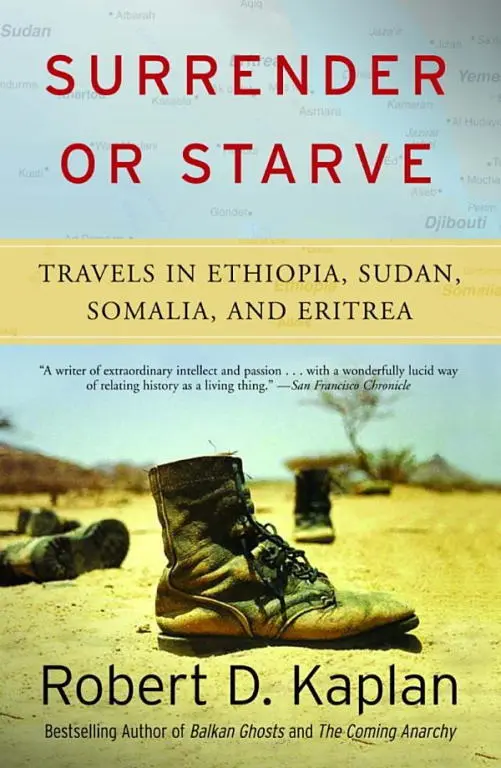
- Название:Surrender or Starve
- Автор:
- Издательство:Vintage Books
- Жанр:
- Год:2003
- Город:New York
- ISBN:978-0-307-54768-2
- Рейтинг книги:5 / 5. Голосов: 1
-
Избранное:Добавить в избранное
- Отзывы:
-
Ваша оценка:
Surrender or Starve: краткое содержание, описание и аннотация
Предлагаем к чтению аннотацию, описание, краткое содержание или предисловие (зависит от того, что написал сам автор книги «Surrender or Starve»). Если вы не нашли необходимую информацию о книге — напишите в комментариях, мы постараемся отыскать её.
, Kaplan illuminates the fault lines in the Horn of Africa, which is emerging as a crucial region for America’s ongoing war on terrorism.
Reporting from Sudan, Ethiopia, Somalia, and Eritrea, Kaplan examines the factors behind the famine that ravaged the region in the 1980s, exploring the ethnic, religious, and class conflicts that are crucial for understanding the region today. He offers a new foreword and afterword that show how the nations have developed since the famine, and why this region will only grow more important to the United States. Wielding his trademark ability to blend on-the-ground reporting and cogent analysis, Robert D. Kaplan introduces us to a fascinating part of the world, one that it would behoove all of us to know more about.
Surrender or Starve — читать онлайн бесплатно полную книгу (весь текст) целиком
Ниже представлен текст книги, разбитый по страницам. Система сохранения места последней прочитанной страницы, позволяет с удобством читать онлайн бесплатно книгу «Surrender or Starve», без необходимости каждый раз заново искать на чём Вы остановились. Поставьте закладку, и сможете в любой момент перейти на страницу, на которой закончили чтение.
Интервал:
Закладка:
Sending a squad of helicopters to deliver a relatively small amount of grain to a few thousand hungry Falata tribespeople, stuck in the middle of nowhere 115 miles from Sudan’s border with the Central African Republic, was indeed a daring and generous act. All over western Sudan as well as in Ethiopia that summer, the United States was winning hearts and minds with similar feats. According to Brussels-based columnist Giles Merritt, writing in an October 1985 International Herald Tribune, 1985 was “the year when the United States went into Africa, one of the few remaining areas of the world it had managed to stay out of. In the past Washington has been glad to leave much of Africa under the influence of the former European colonial powers. But three million tons of U.S. food aid… changed that.” Merritt feared that such a generous outpouring of emergency aid was bound to get the United States involved in “the quagmires of African politics. The sacks of emergency grain and the seed that the Sudanese have named ‘Reagan’ may prove as sure a hook as President Kennedy’s handful of military advisors in Vietnam.”
If only the columnist’s fear had been borne out! For if the United States had become a factor in “the quagmires of African politics,” then the helicopter drops might not have turned out to be one-time-only, quixotic acts that had no effect on the destiny of the region. Even though U.S. aid in Ethiopia and Sudan, on account of the famine, shot up fourfold in one year and cost almost $1 billion, in political terms the aid achieved nothing. At the same time that the United States was putting food into the hands of starving peasants in the wilderness, Libya was putting cash into the hands of Sudanese politicians in Khartoum. As it turned out, 1985 was the year when both Libyan and Soviet influence in the region, already substantial, increased dramatically, while U.S. influence actually decreased, despite the fact that the Libyans and the Soviets provided almost no relief aid.
There was nothing ironic or contradictory about this. Famine aid helps peasants, who in postcolonial Africa have no political power. In fact, it is largely because peasants have no power that famines occur in the first place. The urban elites who run African nations know that peasants do not start coups. Coups are started by disgruntled city dwellers. One way African politicians keep city dwellers satisfied is by providing them with cheap bread obtained from peasant farmers who are forced to sell their grain at artificially low prices. (In Ethiopia, as we have seen, this economic exploitation has overlapped with the imperial strategy of the ruling ethnic group.)
African rulers by and large—unlike the bureaucrats at USAID—are not interested in the kind of rural development (the building of roads, drainage systems, and grain storage facilities) that helps peasant farmers feed themselves and the rest of the country even during times of flooding and drought. For three decades, African rulers have been more interested in brutally maintaining power. The Soviets and their allies simply have created opportunities for themselves by becoming directly involved in either supporting or putting down the rebellions that arise in response to this brutality.
Despite what African rulers say, the lack of an imperial tradition in the United States has hindered, rather than helped, its ability to be a force for positive change in Africa. For instance, in recent years, France intervened in Chad more boldly than did the United States in Angola, yet France suffered far less opprobrium, even though the Marxist government in Luanda that the United States has been trying to topple is more ill-suited than Muammar Gaddafi’s regime in Libya to better the lives of the people under its control. The drama played out between the United States and Libya in the mid 1980s in Sudan highlighted the tactical disadvantages of employing only humanitarian means to deal with problems that are in essence humanitarian, even if they have been narrowly defined as “strategic.”
Sudan, like Ethiopia, although for different reasons, never has been a nation in the modern sense. While Addis Ababa functions not only as the capital of a country but of an empire, Khartoum, at the other extreme, functions as neither. Khartoum, a dust-ridden city of 2.5 million at the confluence of the Blue and White Niles that teems with hungry beggars and Mercedes Benzes is more a trading post than a political center, a base from which Arab merchants traditionally have exploited the seminomadic tribal configurations, some Arab and some not, in the vast stretches of desert under their tenuous control. Although Sudan is as large as the United States east of the Mississippi River, the sole bond joining a place such as Buram, in the westernmost province of Darfur, to Khartoum is an arbitrary line on a map drawn by a European colonialist at the end of the last century. The physical and psychological links between the famine-stricken west of Sudan and the capital of Khartoum are infinitesimally more slender than, say, the links between New York City and the Midwest corn belt. As a Western diplomat said, “The people of Akron, Ohio, care more about the people of Darfur than do the people in Khartoum.” Or, as a certain politically active, Khartoum University professor said to me on the eve of the April 1985 coup that toppled President Jaafar Nimeiri, “We don’t care if millions starve, so long as we get rid of Nimeiri.”
Libya, in every sense, acted according to an understanding that Sudan was a country in name only, whose politicians could be bought for a price, which was best paid in military assistance to fight southern rebels rather than in food for drought victims. The United States, which saw Sudan in more charitable terms, was no match for such a strategy. As a result, by 1987, Darfur peasants were in an even more pathetic position vis-à-vis their own government than they were at the start of the famine in late 1984. From then on, the most humane thing the United States could do for Sudan was to work with the Egyptians to replace the democratically elected regime of incompetent, insensitive landowners with a more efficient group of politically moderate soldiers, who, because they would be more dependent on U.S. support, might be forced to help peasants in a manner that Western donors always have recommended.
Call this interpretation cynical, meanspirited, or right wing if you like, but first take a look at what actually has happened in Sudan: for at least twelve of the sixteen years that Jaafar Nimeiri held power, he was, by the continent’s own dismal standards, one of its better rulers. His May 1969 military coup was popular at the time because it ushered in a period of relative stability after five changes of government and two general elections in five years. Democracy may have been wonderful in the abstract, but for a sprawling, largely illiterate country fractured by tribal divisions it meant stagnation, chaos, and death. Although Nimeiri came in as an Arab radical, in 1971, after surviving a Soviet-inspired attempt to topple him, he turned toward the West, and the following year, by granting local autonomy to the black south, he managed to end a seventeen-year civil war that had cost more lives than had all the Arab-Israeli wars put together. Throughout most of his rule, Nimeiri’s dictatorial style was generally benign. Despite having ninety-eight Libyan-backed mercenaries executed in 1975 for trying to depose him, three years later he granted an amnesty to all his political enemies and allowed them to return home from exile abroad. From the vantage point of 1980, Los Angeles Times Africa correspondent David Lamb was able to write in his book The Africans that “while other presidents have solidified their power, Nimeiri has loosened his…. He… has given his people a precious gift, a sense of unity and purpose that grew from the ashes of a shattered nation.” During the middle period of Nimeiri’s rule, Sudan was closer than it ever had been to achieving the illusive goal of becoming a real nation.
Читать дальшеИнтервал:
Закладка:
Похожие книги на «Surrender or Starve»
Представляем Вашему вниманию похожие книги на «Surrender or Starve» списком для выбора. Мы отобрали схожую по названию и смыслу литературу в надежде предоставить читателям больше вариантов отыскать новые, интересные, ещё непрочитанные произведения.








Обсуждение, отзывы о книге «Surrender or Starve» и просто собственные мнения читателей. Оставьте ваши комментарии, напишите, что Вы думаете о произведении, его смысле или главных героях. Укажите что конкретно понравилось, а что нет, и почему Вы так считаете.