Robert Kaplan - Surrender or Starve
Здесь есть возможность читать онлайн «Robert Kaplan - Surrender or Starve» весь текст электронной книги совершенно бесплатно (целиком полную версию без сокращений). В некоторых случаях можно слушать аудио, скачать через торрент в формате fb2 и присутствует краткое содержание. Город: New York, Год выпуска: 2003, ISBN: 2003, Издательство: Vintage Books, Жанр: Публицистика, nonf_military, на английском языке. Описание произведения, (предисловие) а так же отзывы посетителей доступны на портале библиотеки ЛибКат.
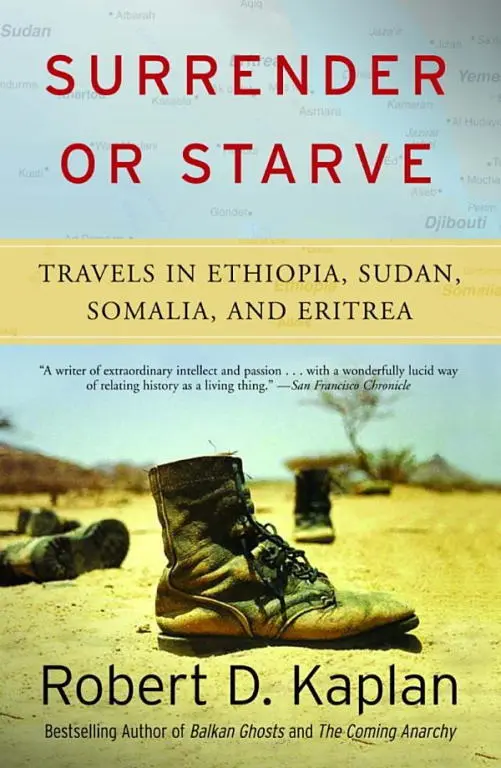
- Название:Surrender or Starve
- Автор:
- Издательство:Vintage Books
- Жанр:
- Год:2003
- Город:New York
- ISBN:978-0-307-54768-2
- Рейтинг книги:5 / 5. Голосов: 1
-
Избранное:Добавить в избранное
- Отзывы:
-
Ваша оценка:
Surrender or Starve: краткое содержание, описание и аннотация
Предлагаем к чтению аннотацию, описание, краткое содержание или предисловие (зависит от того, что написал сам автор книги «Surrender or Starve»). Если вы не нашли необходимую информацию о книге — напишите в комментариях, мы постараемся отыскать её.
, Kaplan illuminates the fault lines in the Horn of Africa, which is emerging as a crucial region for America’s ongoing war on terrorism.
Reporting from Sudan, Ethiopia, Somalia, and Eritrea, Kaplan examines the factors behind the famine that ravaged the region in the 1980s, exploring the ethnic, religious, and class conflicts that are crucial for understanding the region today. He offers a new foreword and afterword that show how the nations have developed since the famine, and why this region will only grow more important to the United States. Wielding his trademark ability to blend on-the-ground reporting and cogent analysis, Robert D. Kaplan introduces us to a fascinating part of the world, one that it would behoove all of us to know more about.
Surrender or Starve — читать онлайн бесплатно полную книгу (весь текст) целиком
Ниже представлен текст книги, разбитый по страницам. Система сохранения места последней прочитанной страницы, позволяет с удобством читать онлайн бесплатно книгу «Surrender or Starve», без необходимости каждый раз заново искать на чём Вы остановились. Поставьте закладку, и сможете в любой момент перейти на страницу, на которой закончили чтение.
Интервал:
Закладка:
By the early 1980s, however, ten years of absolute power had taken its toll on Nimeiri’s personality. He was becoming increasingly cruel, corrupt, and paranoic. Had African or Arab politics evolved to the point where rulers could safely hand over power after a limited period in office, Nimeiri might have gone down in history as one of the continent’s few political success stories. But it was not to be. Looking back, September 1983 is as good a date as any to mark Nimeiri’s transition from a U.S. asset to a U.S. liability. That was when Islamic Sharia law, henceforth known in Sudan as “the September laws,” took effect. Banks no longer could charge interest. Anyone convicted of stealing the equivalent of $50 could have his right hand amputated at the wrist. Even non-Moslem foreigners could be whipped in public for being found in possession of alcohol. (Not only liquor, but rubbing alcohol became difficult to obtain.) Nimeiri sought to apply the Sharia statutes in the non-Moslem south as well as in the north. This and his inexplicable decision to abrogate the 1972 autonomy agreement with the non-Moslem south helped ignite a renewal of the civil war in 1984. When I interviewed Nimeiri in December of that year, a few months before his overthrow, he was a hated and desperate figure. I remember him leaning back in his chair behind his desk eyeing the entrance to his office with the look of a punch-drunk prize fighter. Bedecked with medals and slurring his words, he seemed like the worst, comic book stereotype of a Third World dictator. When I asked him about Islamic law, he delivered what amounted to a temperance lecture about the hazards of alcohol consumption.
Nimeiri, at this point, was being kept in power by the thirty-thousand-man Al Amen al Goumi (the State Security Force), a financially pampered group of plainclothes thugs, whose budget was as large as the sixty-five-thousand-troop regular army. With 6,000 cars and 400 safe houses, the security force was described in Sudanese as “a holy state within a state.” But in comparison with other Arab and African security forces, the Sudanese force was a group of choirboys. Disappearances, torture, and executions were rare. The newspaper articles and human rights reports about Islamic law far outnumbered the actual number of amputations, which was about fifty in the eighteen-month period between the implementation of the September laws and Nimeiri’s overthrow. Although Sudan in the last days of Nimeiri’s rule still was one of the freest societies in the Arab world, nearly every Sudanese I met in Khartoum in December 1984 heaped abuse on him. The fact that they were able to do so without risking prison proves my point. I cannot imagine anyone so openly criticizing a ruler in Libya, Syria, Iraq, or Saudi Arabia in the company of a foreign journalist. Yet to read what was being written about Nimeiri in the foreign press, one would have thought he was infinitely worse. One of Nimeiri’s last acts before being toppled was to turn a blind eye to the transfer of seven thousand five hundred starving Ethiopian Jews to Israel via Sudan. After the coup, when Nimeiri’s vice president and security chief, Omar el Tayeb, was dragged off to jail for his role in the operation, he had less blood on his hands than almost any other security chief in the entire Moslem world.
Nimeiri’s overthrow was more like an abdication. On March 27, 1985, the day after taking the financially practical but politically dangerous step of removing the subsidies on basic commodities, Nimeiri—dressed in a white suit and Panama hat—flew off to Washington. As his presidential jet wheeled over Khartoum and adjacent Omdurman, “bread riots” already were in progress. Peaceful, well-organized demonstrations by under-paid urban professionals followed a few days later. The United States could do nothing to save him. Khartoum, in the throes of revolt, paid no attention to his audience with President Reagan. The $60 million in aid that finally was released to Nimeiri following the meeting did the embattled Sudanese leader absolutely no good because he never had admitted to his own people that the aid had been withheld in the first place. As for the awarding of an additional 225,000 metric tons of wheat and sorghum to Sudan while Nimeiri was in Washington, this also had no effect because a famine hundreds of miles away in the far west of the country was making no impact on strike organizers in the capital. During the three weeks I spent in Khartoum before, during, and after the coup, I rarely heard any discussion about the famine among Sudanese. At Khartoum University, the center of political activity, the students and professors hotly debated everything, except the famine. While millions were dying from hunger in Darfur, Khartoum’s educated elite spent hours discussing the type of democracy a country that still was almost totally illiterate should have. It was a noble preoccupation, but a selfish and unrealistic one, too. While journalists like myself, in the 100-degree heat of the moment, were emphasizing the noble side of the whole drama, diplomats and aid experts already were worrying about it being too noble.
Painted in the broad brush strokes of newspaper copy, the unfolding events in Khartoum should have heartened U.S. policymakers. The 1985 coup was about as bloodless and orderly a transition of power as Africa ever has seen. No radical elements, either Islamic or secular leftist, played a significant role. Nimeiri never returned and instead went into exile in Egypt. Power was transferred for twelve months to a military council headed by General Abdul Rahman Swareddahab, who deliberately maintained a low profile and proved sincere in his pledge to hold parliamentary elections the following year. After twelve days of orderly voting in April 1986, in the freest elections ever conducted in the Arab world, the Umma (Nation) party leader, Sadiq al Mahdi, was chosen prime minister. Sudan couldn’t have done better, at least so it seemed. A former prime minister in the 1960s who was pardoned by Nimeiri after leading the 1975 Libyan-backed coup attempt, Sadiq—as he is known in Sudan— had more political savvy than did any other Sudanese politician and by 1986 had clearly established a reputation as a political moderate and Islamic modernist. During his years in exile in London, Oxford-educated Sadiq had spoken out on such matters as the nature of Islam (about which he contributed an essay for a Festschrift in honor of the late Jordanian prime minister, Abd al-Hamid Sharaf), and he was on record as favoring the liberalization of the harsh Sharia code promulgated by Nimeiri. Sadiq also had personal magnetism based on inherited historical legitimacy. He was the great-grandson of the fabled Mahdi, whose Ansar warriors ejected the British from Sudan in 1885, killing General Charles George Gordon in the process. From a distance of a few thousand miles, Sadiq certainly must have appeared as the very culmination of a Western Arabist’s, or Africanist’s, dream come true. The manner of Sadiq’s ascension, and the résumé he brought along with him, provided an answer to all the mudslinging about the Arabs’ and Africans’ penchant for violence and tyranny and their inability to create modern political systems.
During this momentous period in its history, Sudan in fact became one of the few countries in the Third World to be praised by Amnesty International for a dramatic improvement in the human rights situation because of the release of political detainees and the banning of amputations and other extreme aspects of Sharia law after Nimeiri’s departure. But while the new, liberal procedures may have directly benefited a few thousand people, if that many, millions of others suffered. What from a comfortable distance was a textbook case of political modernization was in point of fact causing chaos in the relief effort, penetration by hostile neighbors, and the total abdication of responsibility regarding economic and agricultural reform.
Читать дальшеИнтервал:
Закладка:
Похожие книги на «Surrender or Starve»
Представляем Вашему вниманию похожие книги на «Surrender or Starve» списком для выбора. Мы отобрали схожую по названию и смыслу литературу в надежде предоставить читателям больше вариантов отыскать новые, интересные, ещё непрочитанные произведения.










Обсуждение, отзывы о книге «Surrender or Starve» и просто собственные мнения читателей. Оставьте ваши комментарии, напишите, что Вы думаете о произведении, его смысле или главных героях. Укажите что конкретно понравилось, а что нет, и почему Вы так считаете.