David Rosenberg - Inside Pine Gap
Здесь есть возможность читать онлайн «David Rosenberg - Inside Pine Gap» весь текст электронной книги совершенно бесплатно (целиком полную версию без сокращений). В некоторых случаях можно слушать аудио, скачать через торрент в формате fb2 и присутствует краткое содержание. Город: Melbourne, Год выпуска: 2011, ISBN: 2011, Издательство: Hardie Grant Books, Жанр: Биографии и Мемуары, Политика, на английском языке. Описание произведения, (предисловие) а так же отзывы посетителей доступны на портале библиотеки ЛибКат.
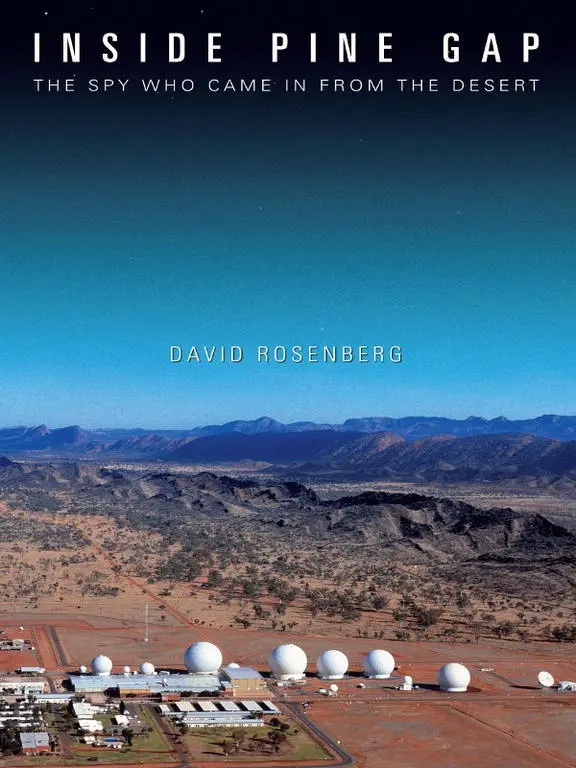
- Название:Inside Pine Gap
- Автор:
- Издательство:Hardie Grant Books
- Жанр:
- Год:2011
- Город:Melbourne
- ISBN:978-1-742-70173-8
- Рейтинг книги:4 / 5. Голосов: 1
-
Избранное:Добавить в избранное
- Отзывы:
-
Ваша оценка:
Inside Pine Gap: краткое содержание, описание и аннотация
Предлагаем к чтению аннотацию, описание, краткое содержание или предисловие (зависит от того, что написал сам автор книги «Inside Pine Gap»). Если вы не нашли необходимую информацию о книге — напишите в комментариях, мы постараемся отыскать её.
Author David Rosenberg details his career with an American intelligence agency during a tumultuous period in history that covered the terms of three American Presidents, four Australian Prime Ministers, the end of the Cold War, a peace treaty between Israel and Jordan, two wars in Iraq, genocide in Rwanda, as well as the ‘War against Terror’ and the emergence of North Korea as a nuclear-armed nation. This is a fascinating glimpse inside the top-secret world of military surveillance.
[This book contain a table.]
Inside Pine Gap — читать онлайн бесплатно полную книгу (весь текст) целиком
Ниже представлен текст книги, разбитый по страницам. Система сохранения места последней прочитанной страницы, позволяет с удобством читать онлайн бесплатно книгу «Inside Pine Gap», без необходимости каждый раз заново искать на чём Вы остановились. Поставьте закладку, и сможете в любой момент перейти на страницу, на которой закончили чтение.
Интервал:
Закладка:
As world politics shifted and changed and the world moved forward, I decided to apply for a second two-year tour in Australia. The ‘hardship tour’ was fast becoming a pleasant experience akin to The Life of Riley since, as I’ve said, agency employees based overseas received very good benefits (seen in Appendix E). This, coupled with extra money from shift work, helped me to rapidly pay for my divorce and allowed me to put money into my Maryland home and other investments. I jokingly told my family that United States Government employees had only three expenses, which I called the Three Fs—Food, Phone, and Fun. My life had finally turned around and the hardship tour had turned into an easy, somewhat catered lifestyle that I was determined to prolong. I had no idea in 1992 that my time in Alice Springs would eventually extend to almost two decades.
Probably one of the reasons life seemed so good was that I had also started dating again after almost two years of avoiding a relationship—time I really needed, not only to save money and pay for my divorce, but to reflect on life as well. In 1992 I met Colleen in Alice Springs, where she worked at Antica Roma, a local pizza restaurant. She was from Vancouver, Canada and was half-Japanese. Colleen enjoyed the outdoors and had been backpacking around Australia. We travelled within the Alice Springs area, visiting the various gaps and gorges, and once drove out to a remote homestead called Glen Helen that had a rather large lake adjacent to the property—a rare feature in the dry outback. Colleen eventually moved in with me but she had only stayed for a few months when her visa required her to return home.
As Colleen wasn’t a US citizen, I had to complete one of the Foreign Contact forms issued by the Office of Security that NSA required me to submit for each romance with a non-American that I considered ‘close and continuing’. The United States Government had rough guidelines for this, leaving it to individuals’ judgement to determine just what that was. For me, dating Australian or other foreign women was slightly complicated because of this paperwork, which also applied to friendships with non-Americans of either gender who became good mates. I’d been briefed on the possibility of espionage in Alice Springs and was required to submit in writing everything I knew about a person. I sometimes found myself in the ridiculous situation of asking a woman I was interested in, ‘Where were you born? When is your birthday? Are you a communist? Have you ever committed an act of terrorism?’ Not exactly the language of love!
Shortly after Colleen left for Canada, I planned a long trip to the United States to see my family and friends after having accrued enough home leave for seven weeks of R&R. Almost everyone I knew back home earned between two and four weeks’ annual leave every year, and my friends couldn’t believe that United States Government employees could take so much paid time off work. This perk of being overseas was a real incentive for me to remain in Alice Springs. Colleen and I kept in touch and a year later I visited her in Vancouver. After a holiday juggling snowballs in the freezing cold and eating elk and moose at her father’s home, I was sad to leave. We said our goodbyes and spoke occasionally by phone but we eventually lost contact. It was simply too hard to sustain a long-distance relationship, as I really already knew by then from past experience.
I received approval for my new two-year tour and was now not scheduled to return to Maryland until 1994. My work in analysis and reporting had enhanced my reputation in the eyes of my close-knit community. I had also begun training new operators and received my third promotion, to Grade 12, the highest grade attainable in the NSA at that time on the more lucrative Government Overseas Engineer pay scale.
With the 1992 presidential election over, many of us at Pine Gap were disappointed to see President Bush leave office, but as President-elect Clinton had won a fair election he deserved a chance to show us how he would lead the country. But President Bush left him with the difficult job of enforcing sanctions against Iraq while keeping Saddam Hussein contained. The legacy of leaving his successor with the responsibility of cleaning up after his fateful decisions in Iraq would be repeated sixteen years later by his son, George W Bush. The Bush presidencies forced many of us in the intelligence community to focus on the ‘Iraq problem’ for most of my eighteen years in Australia, equivalent to the time it takes a child to grow to an age where they can enlist in the military.

6: BILL CLINTON (1993–2000)
Somalia; Russia; Bosnia-Herzegovina, Serbia and Kosovo; Al-Qaeda
Before Bill Clinton had become president, the United Nations approved a United States-led force to guard food intended for the starving masses in Somalia. [1] http://www.infoplease.com/year/1992.html
Africa’s worst drought of the century coincided with factional fighting, leaving many in Somalia unable to feed themselves. The resulting famine devastated the country, killing around 300,000 people. [2] http://www.infoplease.com/ipa/A0107979.html?pageno=2
The situation on the ground was dangerous, with warlords controlling various portions of the country. When President Clinton took office, it was no secret that the extended intelligence community was looking for various leaders, particularly Mohamed Farah Aideed. Intelligence obtained allowed policymakers and military planners to know some of what was happening on the ground, and the intelligence helped the UN-approved forces to mobilise as safely as possible within lawless Somalia. But Somalia was a ‘low-tech’ country, and this limited the usefulness of the intelligence community’s satellites in that environment.
The resultant ‘Black Hawk Down’ incidents (helicopters shot down by rocket-propelled grenades) and appalling images of the bodies of American soldiers being dragged through the streets of the capital eventually resulted in the United States withdrawing its forces from Somalia. Although President Clinton couldn’t be faulted for these specific incidents, he was responsible for any subsequent actions taken by the US. He pursued Aideed, using intelligence available to him, but his attempts to kill the warlord failed. Aideed eventually died three years later from battle wounds. [3] http://www.encyclopedia.com/doc/1P2-790761.html
The complete withdrawal of US troops in 1994 showed that the United States wasn’t willing to continue risking American lives in a part of the world where its troops weren’t wanted and where it had virtually no control over its strategic interests.
While parts of Africa continued the ongoing struggle to feed themselves, the intelligence community was still concerned with Saddam Hussein, who managed to remain in control of Iraq. The intelligence community continued to monitor Iraq’s electronic transmissions, providing valuable intelligence on what was happening on the ground as Saddam remained relatively quiet while rebuilding his power structure.
The United Nations also continued monitoring Iraq’s compliance with the Memorandum of Understanding between the United Nations and the Republic of Iraq. This set out to destroy a large portion of Iraq’s military arsenal under the auspices of the United Nations Special Commission and the verification of Iraq’s stocks of natural and low-enriched uranium by the International Atomic Energy Agency. [4] http://news.bbc.co.uk/2/hi/events/crisis_in_the_gulf/59543.stm
Russia was still the focus of much of the wider intelligence community’s collection efforts due to its large nuclear arsenal. The new presidency of Boris Yeltsin was popular in the West, but even though the Cold War thaw continued, Russia still possessed a great number of advanced weapons and continued to develop more capable conventional weapons. The collapse of the Soviet Union didn’t mean that Russia’s weapons testing program had ceased. The community was still concerned with the pace of testing in Russia, and the intelligence community continued to monitor the testing of many of these weapon systems. The Strategic Arms Reduction Treaty I (START I), begun in 1982 and signed in 1991 between the United States and the Soviet Union, provided that the Russians inform the United States, and vice versa, of the telemetry frequencies used whenever ballistic missiles were test-launched. [5] The START I bilateral treaty between the United States of America and the Union of Soviet Socialist Republics was designed to reduce and limit strategic nuclear weapons. The treaty expired on 5 December 2009 but remains in force pending agreement of a new treaty.
A statement made in 1988 by Prime Minister Hawke acknowledged this: ‘Pine Gap is a satellite ground station, whose function is to collect intelligence data which supports the national security of both Australia and the U.S. Intelligence collected at Pine Gap contributes importantly to the verification of arms control and disarmament agreements.'
Интервал:
Закладка:
Похожие книги на «Inside Pine Gap»
Представляем Вашему вниманию похожие книги на «Inside Pine Gap» списком для выбора. Мы отобрали схожую по названию и смыслу литературу в надежде предоставить читателям больше вариантов отыскать новые, интересные, ещё непрочитанные произведения.









Обсуждение, отзывы о книге «Inside Pine Gap» и просто собственные мнения читателей. Оставьте ваши комментарии, напишите, что Вы думаете о произведении, его смысле или главных героях. Укажите что конкретно понравилось, а что нет, и почему Вы так считаете.