David Rosenberg - Inside Pine Gap
Здесь есть возможность читать онлайн «David Rosenberg - Inside Pine Gap» весь текст электронной книги совершенно бесплатно (целиком полную версию без сокращений). В некоторых случаях можно слушать аудио, скачать через торрент в формате fb2 и присутствует краткое содержание. Город: Melbourne, Год выпуска: 2011, ISBN: 2011, Издательство: Hardie Grant Books, Жанр: Биографии и Мемуары, Политика, на английском языке. Описание произведения, (предисловие) а так же отзывы посетителей доступны на портале библиотеки ЛибКат.
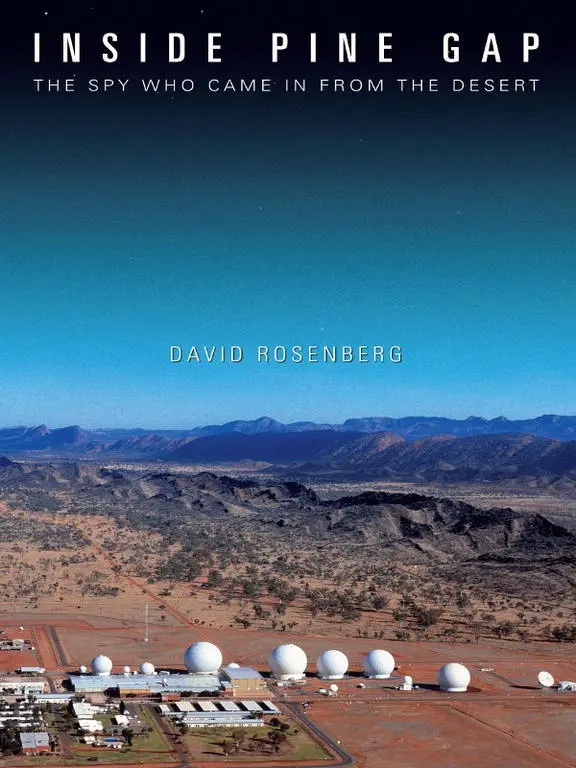
- Название:Inside Pine Gap
- Автор:
- Издательство:Hardie Grant Books
- Жанр:
- Год:2011
- Город:Melbourne
- ISBN:978-1-742-70173-8
- Рейтинг книги:4 / 5. Голосов: 1
-
Избранное:Добавить в избранное
- Отзывы:
-
Ваша оценка:
Inside Pine Gap: краткое содержание, описание и аннотация
Предлагаем к чтению аннотацию, описание, краткое содержание или предисловие (зависит от того, что написал сам автор книги «Inside Pine Gap»). Если вы не нашли необходимую информацию о книге — напишите в комментариях, мы постараемся отыскать её.
Author David Rosenberg details his career with an American intelligence agency during a tumultuous period in history that covered the terms of three American Presidents, four Australian Prime Ministers, the end of the Cold War, a peace treaty between Israel and Jordan, two wars in Iraq, genocide in Rwanda, as well as the ‘War against Terror’ and the emergence of North Korea as a nuclear-armed nation. This is a fascinating glimpse inside the top-secret world of military surveillance.
[This book contain a table.]
Inside Pine Gap — читать онлайн бесплатно полную книгу (весь текст) целиком
Ниже представлен текст книги, разбитый по страницам. Система сохранения места последней прочитанной страницы, позволяет с удобством читать онлайн бесплатно книгу «Inside Pine Gap», без необходимости каждый раз заново искать на чём Вы остановились. Поставьте закладку, и сможете в любой момент перейти на страницу, на которой закончили чтение.
Интервал:
Закладка:
Soon after arriving in Alice Springs, I heard an interesting story about why the Base swimming pool was constructed. It seems that an early chief wanted a swimming pool built on Base, but his request was refused on the basis of insufficient justification. But this clever chief wouldn’t let himself be overruled, so he rewrote his justification pointing out that the weather in Alice Springs is often so hot and dry that the possibility of fire was a very real threat to the facility. Pine Gap needed an ‘emergency water reservoir’ in case one of these fires ever threatened the lives of the workers at the Base. This justification was accepted by the United States Government and Pine Gap got its chlorinated ‘emergency water reservoir’, complete with a diving board, marked swimming lanes and ladders in the deep end. When I asked, I was told there’d never been a fire at the Base, and that the only real environmental heat hazard at Pine Gap was sunburn.
Meanwhile, my association with such a diverse group of coworkers helped me enormously as I struggled to learn my new foreign language—Aussie slang. The local lingo took a while to make sense to me as new words and phrases such as ‘No worries’ were thrown around. I had to learn that being called a ‘bastard’ could be a term of endearment, while calling someone a ‘yobbo’ was not at all flattering. Not dressing to standard meant you could be referred to as looking like a ‘dog’s breakfast’, while ‘cracking onto’ someone could go well, if a mate ‘made it’ with a local lady, or badly if he was told to ‘rack off’. It was worth knowing where the ‘dunny’ was, particularly if an American had just finished a ‘slab’, and was not so ‘off his face’ as to be unable to find it. Was this easy? Not at first, fair dinkum. Learning this new language took a while, but I eventually got the hang of it. It became quite natural to speak like the locals, and I even practised my new way of communicating when I called the United States to speak with friends. I found that I often had to translate as if I were actually speaking in a foreign language and not just adding a few colloquialisms.
I found the Aussie humour genuinely to my liking and often laughed to myself when I heard the new Yanks exposed to parts of the language that they either didn’t understand or didn’t find particularly amusing. Around Australians, I found myself becoming happier and more Aussie-like as my time in Alice Springs stretched on.
For security reasons, Pine Gap is isolated and confined, and some of my friends back home believed I worked underground as other US military facilities were reported to descend several storeys to protect against attack. This wasn’t the case, but I did work literally in the middle of nowhere in a secured fortress. Although there were no windows in Operations, I didn’t find this claustrophobic at all, given the vast open space of the Australian desert surrounding me. When I arrived, I was only thirty-one, with no family members, so I jumped at every opportunity to experience the fresh air and beauty that I found in Central Australia. My first trip outside Alice Springs was in January 1991 to two very significant Aboriginal sacred sites: Ayers Rock and The Olgas—called Uluru and Kata Tjuta, respectively, by the traditional owners of the area, the Anangu people.
The 440-kilometre, three-hour drive on a paved road with no speed limit was exhilarating. Four of us Americans—three blokes and a woman—hired a four-wheel drive from the Base and experienced the elation and freedom of driving at speeds of almost 200 kilometres an hour as we pretended to be Mario Andretti racing through the outback. There aren’t many places in the world that are so remote that you can drive super-fast and not get booked—certainly not back in Maryland or DC. We stopped to see a curious sight that most people on their first visit mistake for Uluru, the table top–looking Mount Connor, a small flat-topped mountain with fairly steep walls known as an ‘inselberg’. [6] http://en.wikipedia.org/wiki/Mt._Connor
On the opposite side of the road is Lake Amadeus, a great salt lake so large it’s visible from space, its white glossy sheen and ‘other world’ appearance in stark contrast to the red dirt of Central Australia. The four of us felt like we were on another planet, not just in a foreign country. But nothing could have prepared us for the sight of Uluru when we saw it for the first time. Depending on the time of day, ‘the Rock’ could be any one of a number of hues: red, orange, brown and even a stunning purple. On this day it was a deep red, with the sun highlighting the ancient markings on its surface. I felt awed by its sheer presence.
As the months passed, I explored the other wonders around Alice Springs, which included Simpson’s Gap, Standley Chasm, Ormiston Gorge and Kings Canyon. Alice Springs was also close to the Tropic of Capricorn, and I visited the official painted line next to the Stuart Highway that indicated exactly where this geographical marker was located.
In Alice Springs, I had found a new life that made my time in Maryland seem, in comparison, like a struggle for survival. It was clear to me, though, that the time away from my wife wasn’t good for our marriage. Although we spoke to each other almost every day, and the extra money allowed us to pay off many bills, the separation was creating further emotional distance. Four months into my tour, as we spoke about our second honeymoon in Hawaii, my wife seemed hesitant to meet, saying that she would go to Hawaii but insisting on separate rooms. At this news, I knew our marriage was already over.
In the end we abandoned all plans for a second honeymoon. I really hadn’t expected this to happen, having made the decisions I had—in many ways—to try and save it, and was sad that my marriage hadn’t worked out. Fortunately, however, I had made many friends at work and was able to keep busy by participating in various sports, and this helped me to move on. In Alice Springs, I was happy in my new home, I loved my job and I didn’t want to leave.
While I was busy discovering my new surroundings, the troops of Operation Desert Shield had positioned themselves for the impending conflict with Iraq as the United Nations–approved campaign appeared likely to begin. I was still apprehensive about potential combat losses as the United States and the coalition of thirty-four nations [7] http://en.wikipedia.org/wiki/Coalition_of_Gulf_War
prepared for a real war with Iraq—a country that in 1991 boasted the world’s fourth-largest army, with about 1.2 million ground troops. [8] http://www.cryan.com/war/
Talk within the intelligence community centred on not if but when hostilities would begin, as Saddam Hussein defiantly held his ground as he described the eventual conflict as ‘the mother of all battles’. Those of us at Pine Gap, the soldiers and the world now waited as President Bush and the coalition prepared to expel Iraq from occupied Kuwait and restore independence to this small nation.

PART II:
GETTING DOWN TO BUSINESS

5: GEORGE HW BUSH (1989–92)
Operation Desert Storm; the end of the Cold War
Before I arrived in Alice Springs, preparations had already begun in earnest at Pine Gap to support the coalition against Iraq for what would become known as the Gulf War. For the first time, Pine Gap was experiencing a long-term deployment of military personnel to supplement the previous ‘civilian-only’ Operations population. There had always been a consistent turnover of civilian employees: as those who ended their tour departed, their places were immediately taken by new civilian arrivals attracted by the relatively lucrative incentives on offer to those willing to move to Alice Springs. But the United States Government was taking no chances in ensuring there were enough competent bodies to perform the work in Operations, and the newly arrived American and Australian military contingent (about five when I arrived) proved to be a capable, dedicated and useful resource that supplemented the civilians who historically occupied every billet within Operations.
Читать дальшеИнтервал:
Закладка:
Похожие книги на «Inside Pine Gap»
Представляем Вашему вниманию похожие книги на «Inside Pine Gap» списком для выбора. Мы отобрали схожую по названию и смыслу литературу в надежде предоставить читателям больше вариантов отыскать новые, интересные, ещё непрочитанные произведения.







Обсуждение, отзывы о книге «Inside Pine Gap» и просто собственные мнения читателей. Оставьте ваши комментарии, напишите, что Вы думаете о произведении, его смысле или главных героях. Укажите что конкретно понравилось, а что нет, и почему Вы так считаете.