Thomas Goltz - Chechnya Diary
Здесь есть возможность читать онлайн «Thomas Goltz - Chechnya Diary» весь текст электронной книги совершенно бесплатно (целиком полную версию без сокращений). В некоторых случаях можно слушать аудио, скачать через торрент в формате fb2 и присутствует краткое содержание. Город: New York, Год выпуска: 2011, ISBN: 2011, Издательство: Thomas Dunne Books, Жанр: Биографии и Мемуары, military_history, Публицистика, на английском языке. Описание произведения, (предисловие) а так же отзывы посетителей доступны на портале библиотеки ЛибКат.
- Название:Chechnya Diary
- Автор:
- Издательство:Thomas Dunne Books
- Жанр:
- Год:2011
- Город:New York
- ISBN:0-312-26874-2
- Рейтинг книги:3 / 5. Голосов: 1
-
Избранное:Добавить в избранное
- Отзывы:
-
Ваша оценка:
Chechnya Diary: краткое содержание, описание и аннотация
Предлагаем к чтению аннотацию, описание, краткое содержание или предисловие (зависит от того, что написал сам автор книги «Chechnya Diary»). Если вы не нашли необходимую информацию о книге — напишите в комментариях, мы постараемся отыскать её.
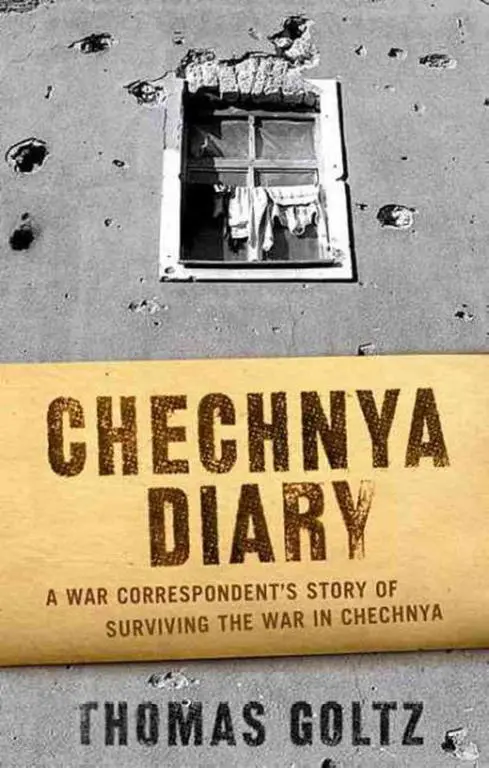
is part of a larger exploration of the role (and impact) of the media in conflict areas. And at its heart,
is the story of Hussein, the leader of the local resistance in the small town that bears the brunt of the massacre as it is drawn into war.
This is a deeply personal book, a first person narrative that reads like an adventure but addresses larger theoretical issues ranging from the history of ethnic/nationalities in the USSR and the Russian Federation to journalistic responsibility in crisis zones.
is a crossover work that offers both the historical context and a ground-level view of a complex and brutal war.
Chechnya Diary — читать онлайн бесплатно полную книгу (весь текст) целиком
Ниже представлен текст книги, разбитый по страницам. Система сохранения места последней прочитанной страницы, позволяет с удобством читать онлайн бесплатно книгу «Chechnya Diary», без необходимости каждый раз заново искать на чём Вы остановились. Поставьте закладку, и сможете в любой момент перейти на страницу, на которой закончили чтение.
Интервал:
Закладка:
The first indication that the show had actually started would be small puffs of smoke rising from the factory grounds. The report of exploding shells would reach the audience after a delay of several seconds. Sometimes the audience would be caught by surprise by the shock-blast of a big hit, with a thick curtain of smoke later rising from the center of the factory, because the shells landing behind it exploded offstage and the concussions coming seemingly from nowhere.
“Look—here comes an SU-27,” said Ibrahim Kazbekov, a functionary in the local town administration. He was pointing at a spec in the sky that grew larger by the second. It was a jet bomber, flying at around five hundred meters above the ground. Silently, it zipped over the administration building and then was gone. The woosh and roar of its engines followed after about three seconds. Then there was a plume of smoke moving upward from the area around the main smokestack in the chemzavod , which turned crimson and then blew upward into a tremendous fireball that rose higher than the jet had been flying. Silence, then Boom. The retort of the explosion, delayed by several seconds, knocked down a ten-year-old kid standing next to me.
“Vacuum bomb,” said Ibrahim clinically, helping the kid back to his feet. “Looks like they managed to hit an underground diesel fuel tank.”
For once I did not feel guilty about being a voyeur of death and destruction, because all the locals were doing the same.
I was there, too, in the nearby neutral town of Novi Atagi for cease-fire negotiations between Chechen commander General Asian Maskhadov and General Genadi Trochev, the supreme commander of Russian forces in the sector. The meeting was held at the house of Rizvan Laylorsanov, the director of the chemzavod at Chiri Yurt during its salad days as the largest cement factory in the Soviet Caucasus. It must have been a position with perks, because Rizvan’s residence did not reflect any sort of penury. Set on a prime acre of real estate at the edge of town, his was a mansion made of red brick and pine. The main quarters, liberally strewn with televisions and deep freezers, must have been three hundred square meters, not including the patio area. The avlu, or traditional reception area for visitors on holidays, seated at least fifty. The toilet was an outhouse tucked away in the garden.
Now it was the venue for Generals Maskhadov and Trochev to work out the modalities of surrendering the chemzavod , and negotiate an exchange of corpses. While fascinating in itself, this was less interesting for me than meeting General Maskhadov and making my own measure of the man. By all accounts, Maskhadov had mounted an extraordinary defensive campaign with the limited means at hand. In Grozny, his adroit use of three-man hit-and-run teams to attack, pin down, and then destroy Russian armor had been so effective that Moscow began making up excuses for its humiliation. My favorite was that the Chechen mafia had hired an army of Amazon mercenaries from Latvia to do its dirty work for it. Reality was a lot more prosaic: Maskhadov had his men travel through the city’s sewer system to pop up behind the lines for lightning strikes, before disappearing down the drains once again.
I had no chance to ask Maskhadov about any of this. After quickly paying his respects to a line of Chechen elders sitting in a row along the avlu wall, he disappeared into Rizvan’s guesthouse, leaving his boots on the steps, lest he sully the interior of the house with the filth of the street. Nor was I given the opportunity to have a word with General Trochev. As soon as he entered the avlu with his bodyguards, he saluted the elders, untied his boots, and walked up the steps to the guesthouse in his stocking feet. Aside from the two aides-de-camp, the only people allowed into the room were the women of the house, as they scurried from the kitchen to the guest house with steaming pots of pilav, soup, spring lamb, and fried potatoes, fresh bread and homemade butter, cottage cheese, local honey, and gallons of tea.
Maskhadov’s and Trochev’s bodyguards waited in the avlu, chatting like old pals about school, favorite football teams, and all the other sort of common memories youth raised in the former Soviet Union-Russian Federation Republic might reasonably share. Often, it seemed that the only thing that really distinguished the two groups were the beards worn by the Chechens and the high-top basketball shoes favored by the Russian grunts. And I had it all on tape.
Finally, after two hours, Generals Maskhadov and Trochev emerged from their room and all fraternization came to an abrupt end. The bodyguards leapt to their feet and reverted to their discrete groups. The Russians followed Trochev out the door, while the Chechen guard escorted their leader over to a knot of twenty elders who had gathered to learn about the fates of their respective towns. All wore astrakhan hats, despite the fact that it was over eighty degrees Fahrenheit.
“Agreement has been reached to clear the cement factory of fighters by giving them free passage out and into the woods,” Maskhadov told the elders. “A delegation of townspeople will be allowed in to help the wounded and to collect bodies for burial. The modalities will be dealt with by the local Russian military authorities and the civil administration of Chiri Yurt.”
Then he turned on his heel, marched with his guard to his transport, and was gone, having shared nothing about the larger peace he was trying to work out with Trochev.
Outside Rizvan’s, I found a baby-faced Russian named Colonel Sergei huddled with Maskhadov’s chief of staff, a captain named Isa, and the local representative of Chiri Yurt, Ibrahim Kazbekov, scratching in the dirt to delineate lines.
“I guarantee your security,” Colonel Sergei was stressing. “At five o’clock, you can come and collect the bodies at this point.”
Captain Isa was not impressed.
“How can you talk of security guarantees when your tanks are still firing?”
“I guarantee your security,” Colonel Sergei repeated. “You have my guarantee.”
A crowd of young men had gathered at the end of the street and were starting to shout ugly epithets at the Russians. Ibrahim and Rizvan stepped in to calm them down.
“They are guests in my house!” roared Rizvan. “They have my personal guarantee!”
At five o’clock, we were back at Chiri Yurt and on our way to the chemzavod . Although it was still belching smoke, it was quiet now. There was Russian armor in the surrounding fields, but the tank crews had stripped to their waists and were washing in the irrigation canals. The front line had shifted again, and Chiri Yurt and the chemzavod were now behind it. I did not even put on my flak jacket as we drove down the shell-splattered road and tried to forget about mines.
The factory grounds were a sorry sight. Huge gaping holes yawned from the asphalt, the gravel, and the grass. All trees within one hundred yards of any building had been reduced to stumps. Used, puke-green ammunition boxes were strewn everywhere.
In the parking lot near the administrative building—or what I assumed to be such—twisted lumps of metal represented what had once been cars. A military truck—Chechen? Russian?—blocked access to what I decided was the company canteen. Sightless eyes had been shot through its windshield exactly where driver and passenger would have been sitting; its front wheels had been amputated by a mine.
Then there were the buildings of the chemzavod . Seemingly every square foot of masonry had been shot at and hit. Smoke still billowed from the windows of those buildings that had not collapsed. It did not require a degree in structural engineering to understand that Rizvan’s beloved chemzavod would have to be rebuilt from scratch in order to ever produce one bag of mortar again. I pointed my camera at the smoldering ruins and scarcely had the frame in focus before I had a rifle barrel pointed at my gut.
Читать дальшеИнтервал:
Закладка:
Похожие книги на «Chechnya Diary»
Представляем Вашему вниманию похожие книги на «Chechnya Diary» списком для выбора. Мы отобрали схожую по названию и смыслу литературу в надежде предоставить читателям больше вариантов отыскать новые, интересные, ещё непрочитанные произведения.






Обсуждение, отзывы о книге «Chechnya Diary» и просто собственные мнения читателей. Оставьте ваши комментарии, напишите, что Вы думаете о произведении, его смысле или главных героях. Укажите что конкретно понравилось, а что нет, и почему Вы так считаете.