Thomas Goltz - Chechnya Diary
Здесь есть возможность читать онлайн «Thomas Goltz - Chechnya Diary» весь текст электронной книги совершенно бесплатно (целиком полную версию без сокращений). В некоторых случаях можно слушать аудио, скачать через торрент в формате fb2 и присутствует краткое содержание. Город: New York, Год выпуска: 2011, ISBN: 2011, Издательство: Thomas Dunne Books, Жанр: Биографии и Мемуары, military_history, Публицистика, на английском языке. Описание произведения, (предисловие) а так же отзывы посетителей доступны на портале библиотеки ЛибКат.
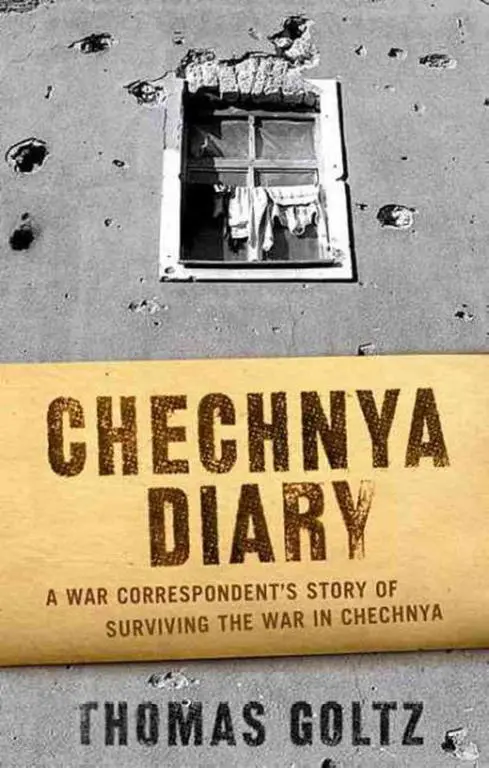
- Название:Chechnya Diary
- Автор:
- Издательство:Thomas Dunne Books
- Жанр:
- Год:2011
- Город:New York
- ISBN:0-312-26874-2
- Рейтинг книги:3 / 5. Голосов: 1
-
Избранное:Добавить в избранное
- Отзывы:
-
Ваша оценка:
Chechnya Diary: краткое содержание, описание и аннотация
Предлагаем к чтению аннотацию, описание, краткое содержание или предисловие (зависит от того, что написал сам автор книги «Chechnya Diary»). Если вы не нашли необходимую информацию о книге — напишите в комментариях, мы постараемся отыскать её.
is part of a larger exploration of the role (and impact) of the media in conflict areas. And at its heart,
is the story of Hussein, the leader of the local resistance in the small town that bears the brunt of the massacre as it is drawn into war.
This is a deeply personal book, a first person narrative that reads like an adventure but addresses larger theoretical issues ranging from the history of ethnic/nationalities in the USSR and the Russian Federation to journalistic responsibility in crisis zones.
is a crossover work that offers both the historical context and a ground-level view of a complex and brutal war.
Chechnya Diary — читать онлайн бесплатно полную книгу (весь текст) целиком
Ниже представлен текст книги, разбитый по страницам. Система сохранения места последней прочитанной страницы, позволяет с удобством читать онлайн бесплатно книгу «Chechnya Diary», без необходимости каждый раз заново искать на чём Вы остановились. Поставьте закладку, и сможете в любой момент перейти на страницу, на которой закончили чтение.
Интервал:
Закладка:
An advertisement. Maybe two. Then Kisilov.
“Thanks for staying with us,” he said. “Our insider’s report from Samashki comes not from one of our regular reporters, but the Amerikanski Journalist To-mas Gol-tes …
Flip to self-shot Goltz, in Muslim prayer cap, standing in front of the bullet-ridden “Samashki” sign in mid-March.
“It doesn’t look like much, but for the residents of this muddy farm town in the Chechen plain, it is a place worth fighting for. Its name is Samashki, which in the Chechen tongue means ‘the place of deer.’”
In contrast to the usual visual diet of triumphant Russian soldiers pushing forward against “bandit nests filled with militant Islamists,” there followed generic material on the perfectly normal people of the town, and its bombing, and then newer material, of soldiers at Post 13 stopping Red Cross vehicles heading toward refugees trudging down an empty road. Finally, shots of a stricken village filled with corpses in the streets or on the way to the cemetery.
“Reportadja To-masa Gol-tza ,” intoned Yevgeni Kisilov, ending the broadcast.
I had just become a Russian television personality.
It was now time to replace that 90-second news brief on ABC with a 90-minute documentary along the lines of the Itogi piece, exposing the full horror of the Chechen war, and to explore ways how to stop it. I made up a target list of channels and networks I would contact: ABC, NBC, CBS, Fox—the works. One of them was sure to bite.
Not.
On April 19, 1995, someone blew up the Federal Building in Oklahoma City—and the massacre at Samashki was instantly relegated to footnote status in the annals of an obscure and forgotten war.
14
GDEJE FRONT? (WHERE’S THE FRONT?)
The fiftieth year anniversary of Victory in Europe Day loomed, and Moscow was the venue. Bill Clinton, John Major, and Francois Mitterand were all Boris Yeltsin’s special guests, scheduled to arrive in the Russian capital to celebrate the Allied victory over fascism. The most delicate diplomatic question was whether any units that served in Chechnya would be included in the march-by parade of arms.
Covering the parade was not, however, why ABC wanted me to stay in Russia. Peter Jennings and a host of other State Department, diplomatic, presidential, and foreign news network bigwigs would be doing that and taking care of celebration meetings, greetings, and other press protocols. The Network Most Americans Get Their News From needed a fireman. In television press lingo, that meant they needed someone to station in Chechnya, just in case anything untoward and nasty happened during the big bash. It made no difference that they really had no intention of using anything I might shoot. I got a salary and expenses and a camera, and they got an emergency asset pinned to the ABC assignment board. Chechnya: Goltz.
They wanted me and I wanted the war.
It was a match made in heaven.
My assignment, such as it was, was to capture a day in the presumably miserable life of a Great War veteran still resident in Grozny. The piece, filled with as much irony as possible, would include said veteran attending the brass-band VE-Day celebrations in Grozny, and then flip over to the veteran at home, remembering how the Red Army had conquered Berlin in May of 1945. The obvious point was to compare the state of the German and Chechen capitals, fifty years apart.
The reality, however, was for me to just “be there.” And the fact that I was nothing more than a resource statistic was made clear by the home-video camera I was issued. It was American system NTSC—in other words, a camera that was incompatible with the European PAL system needed to make a satellite uplink. What this meant was that I was expected to send tapes to Moscow via courier, meaning the airport in Ingushetia. This was difficult enough when covering Samashki, and more or less required that I be at the airport to beg or bribe someone to courier my material to Moscow by four in the afternoon. Although only some fifty miles farther away from the airport than Samashki as the crow flies, Grozny was in fact much farther away in terms of time, due to checkpoints, ruined roads, and the general, unknowable chaos of war. If I were to record anything of interest in and around the Chechen capital, it had better happen before noon, because anything that happened after could never be delivered on time, and would instantly join the general category of yesterday’s papers—i. e.: no longer news.
Still, I took my new fireman assignment seriously—or at least took advantage of the assignment to be serious about the war.
I was there at the newly set up Organization of Security and Cooperation in Europe housed in Grozny, where the American diplomat Phillip Remler had been tasked with finding out anything he could about the missing American aid worker, Fred Cuny. The Cuny corpse had developed the unique function of being found anywhere the Chechens were under bombardment. The phenomenon was due to the belief that a Cuny sighting, even as a corpse, would result in Washington putting heavy pressure on Moscow to suspend hostilities in the vicinity while a forensic investigation team was sent in to identify dental records and other telltale signs about the identity of the cadaver.
“I have become an expert in the dentals of the dead,” smirked Remler, relating his most recent visit to a Cuny “corpse site.” “But unless Fred grew two gold teeth recently and sprouted a metal thigh implant like the body I saw today, it was not him.”
I was there, too, in Shamil Basayev’s hometown of Vedeno when the Chechens shot down a Russian fighter-bomber, killing the pilot. The smoldering wreck of the plane proved that Yeltsin was in clear violation of his own unilateral cease-fire that he had announced for VE-Day. I was in Shatoi with the BBC’s Andrew Harding after Russian missiles hit the town, deep in the mountains and way out of any area that could have been explained away as incidental “localized” violations of the cease-fire accord. Ours was a gut-wrenching, two-wheeling ride around blind corners carved into cliff sides, with me hanging out the passenger window using my arm as a pole and an old laundry bag as a white flag, just in case some distant attack helicopter chose to distinguish between our car and the trucks shuttling Chechen fighters up and down the gutted mountain road.
“Allah ul Akbar! ” they shouted as they roared by, as if trying to draw fire. “God is the Greatest!”
Checking for casualties among the strangely casual population—women selling fruit and Polaroid film in the market, a kid teaching himself how to walk on stilts, men boiling vast vats of beef to celebrate the Muslim Feast Of The Sacrifice—we got to the hospital just in time to record the awful, literal moment of expiration of a local man lying in a pool of blood, as a team of truly courageous Belgian doctors desperately tried to punch the man’s heart back to life, only to reach despair right in front of the family.
And then I was in Grozny on VE-Day, as per my assignment, hunting for one camera-friendly ancient veteran from the Great War against fascism, as the forefathers (and mothers) of the conquerors of Grozny turned out in their post-Soviet splendor on parade at the Khankale airport, vests dripping with medals. A brass band blared, and all the ancients were treated to a remembrance shot of vodka at the Khankale canteen, before a bus came to take them home under escort, due to the dangers of the night—and thus whisk away my personal, ancient veteran before I ever learned his name or address. How was I going to find another talkative old codger at this hour to record a day in his miserable life? It actually did not make much difference, because Victory Day was over and there was no way I could send the material to Moscow, even if it had been the purest gold.
Читать дальшеИнтервал:
Закладка:
Похожие книги на «Chechnya Diary»
Представляем Вашему вниманию похожие книги на «Chechnya Diary» списком для выбора. Мы отобрали схожую по названию и смыслу литературу в надежде предоставить читателям больше вариантов отыскать новые, интересные, ещё непрочитанные произведения.




Обсуждение, отзывы о книге «Chechnya Diary» и просто собственные мнения читателей. Оставьте ваши комментарии, напишите, что Вы думаете о произведении, его смысле или главных героях. Укажите что конкретно понравилось, а что нет, и почему Вы так считаете.