Thomas Goltz - Chechnya Diary
Здесь есть возможность читать онлайн «Thomas Goltz - Chechnya Diary» весь текст электронной книги совершенно бесплатно (целиком полную версию без сокращений). В некоторых случаях можно слушать аудио, скачать через торрент в формате fb2 и присутствует краткое содержание. Город: New York, Год выпуска: 2011, ISBN: 2011, Издательство: Thomas Dunne Books, Жанр: Биографии и Мемуары, military_history, Публицистика, на английском языке. Описание произведения, (предисловие) а так же отзывы посетителей доступны на портале библиотеки ЛибКат.
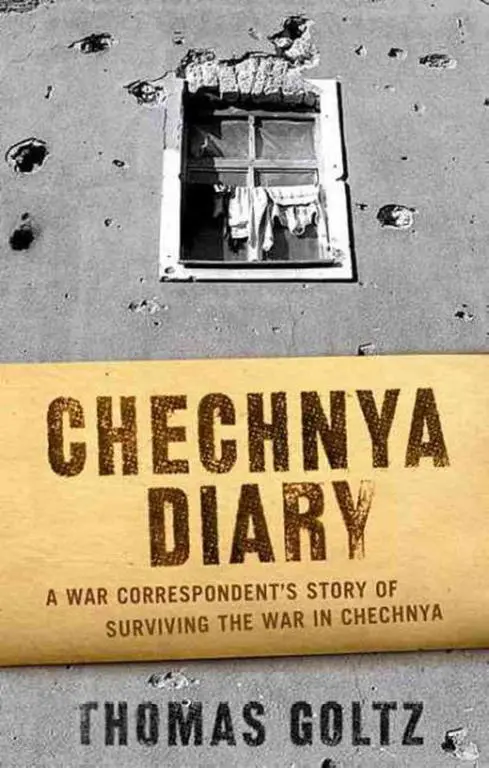
- Название:Chechnya Diary
- Автор:
- Издательство:Thomas Dunne Books
- Жанр:
- Год:2011
- Город:New York
- ISBN:0-312-26874-2
- Рейтинг книги:3 / 5. Голосов: 1
-
Избранное:Добавить в избранное
- Отзывы:
-
Ваша оценка:
Chechnya Diary: краткое содержание, описание и аннотация
Предлагаем к чтению аннотацию, описание, краткое содержание или предисловие (зависит от того, что написал сам автор книги «Chechnya Diary»). Если вы не нашли необходимую информацию о книге — напишите в комментариях, мы постараемся отыскать её.
is part of a larger exploration of the role (and impact) of the media in conflict areas. And at its heart,
is the story of Hussein, the leader of the local resistance in the small town that bears the brunt of the massacre as it is drawn into war.
This is a deeply personal book, a first person narrative that reads like an adventure but addresses larger theoretical issues ranging from the history of ethnic/nationalities in the USSR and the Russian Federation to journalistic responsibility in crisis zones.
is a crossover work that offers both the historical context and a ground-level view of a complex and brutal war.
Chechnya Diary — читать онлайн бесплатно полную книгу (весь текст) целиком
Ниже представлен текст книги, разбитый по страницам. Система сохранения места последней прочитанной страницы, позволяет с удобством читать онлайн бесплатно книгу «Chechnya Diary», без необходимости каждый раз заново искать на чём Вы остановились. Поставьте закладку, и сможете в любой момент перейти на страницу, на которой закончили чтение.
Интервал:
Закладка:
“In return for the demilitarization of the town and our allowing the armored train to pass through, [General] Antonov agreed that we would be allowed a self-appointed police force of twenty men, and that no Russian troops would enter the town,” the diarist said in a hushed voice. “As a token of good faith we delivered eight assault rifles and brought them here. But that same night Antonov changed his mind and delivered a new ultimatum: We would find and deliver 264 more weapons or face the storming of the town. We were frantic, because there were not 264 weapons to be collected, and most of the fighting men had already left the town for the forest. We managed to collect another sixteen weapons—but by then the bombing had already begun. Everything else is a lie, a lie!”
“How many dead?”
“Hundreds, I don’t know. Women and children mainly, and elders.”
“And your son’s commander, Hussein?” I asked.
Amaev looked at me oddly.
“I must go,” said Amaev, and was gone.
It started as a trickle. It never became a flood. Just slow and periodic waves of people, trudging toward us down the road from Samashki, past the APC and Post 13, toward Sernovodsk. Ancient men in their papakhs and leather boots, silent, broken, followed by knots of weeping women, mud-stained and dirty, carrying bundles that were or had been children. Older kids held white flags, and sometimes smiled.
“Bodies, bodies, everywhere!” screamed a woman of perhaps twenty, the only person to break down in front of the spectators at Post 13, journalists and soldiers alike. “Children, women, aged!”
I searched among the faces of the survivors until I found someone I knew. She arrived in the person of Bekhist Abdulayeva, a lady who lived near the red brick house that served as a frontline sniper’s nest. I barely recognized her for the grime and exhaustion and trauma scratched over every surface of her face.
“Toms,” she sighed, seeing me, reaching for me.
“Get in the car,” I said commandeering someone’s vehicle—that of Voice of America correspondent Elizabeth Arnold? It was difficult to recall. The main point was that it did not seem wise to hear about the slaughter in Samashki in front of all the Russian grunts.
“When the bombardment began, we hid in the cellar,” croaked Bekhist as we sped toward Sernovodsk, relating to me for the first time what would become a monotonous mantra of murder. “Then the soldiers came in, laughing and swearing and shooting at anything that moved. I pleaded with them to spare us, telling them that there were no militants or young men with us in the basement, but they threw in their ‘lemons’ anyway.”
A lemon is a fragmentary hand grenade.
Bekhist could not recall the day her house was destroyed, because the wave of assault seemed to ebb and flow and night became confused with day. Nor did she know what had happened to her children, who had disappeared during the course of the attack.
“Tell me the same thing, but in Chechen,” I urged her, setting up my camera in front of the mosque at Sernovodsk. I am not sure if she gave a more elaborate version of events but she was soon surrounded by a wall of local residents and refugees who were openly weeping—and Chechens do not cry. Bekhist paused, looked around at the world as if for the last time, and then slumped to the ground. I thought she died of a heart attack, but she had only fainted dead away.
Whatever she said, however, created near panic. Men were running to their cars, pulling onto the road to race toward Post 13 and, I presume, Samashki.
“Stoi!! Stoi!! Stoi!!” someone was shouting in Russian at the top of his lungs. “The soldiers will think you are attacking and shoot to kill.’”
I will take credit for that stunningly obvious piece of advice.
I was changing roles. It was time to work to save my friends, not interrogate them.
Idon’t know how many bus runs I made that day, up and back from the Sernovodsk mosque and back to Post 13, picking up the small waves of women and children and elders who had managed to march away from Samashki under white flags. The young men were not so lucky. A small unit of soldiers, most likely FSB (KGB), intercepted the new refugee survivors about one hundred yards before they reached Post 13, winnowing out virtually all males between the ages of fifteen and fifty, stripping them in the field to check for the telltale bruise marks on their shoulders that would suggest they were fighters, and then tying their hands behind their backs and forcing them aboard trucks headed for the notorious “filtration” center at Mozdok.
The testimony of all the women and elders I spoke with was identical.
The town had been utterly sold out. Blasted to bits on the night of the sixth and morning of the seventh, it was next subjected on the days of the seventh and eighth to a massacre by marauding soldiers, most, if not all of whom were allegedly doped up on a pain-killing, brain-deadening, rampage-inducing cocktail of promodol, dimedrol, and booze. [18] Evidence of widespread drug use among the Russian assault troops came in the form of chemical analyses of the trace elements left in the scores, nay, hundreds of syringes found in the streets of the town by Voice of America correspondent Elizabeth Arnold. Even more interesting was a subsequent report by the Gorbachev Foundation that described the use of self-hypnosis video programs by crack assault troops that were basically designed to leach the last taint of human kindness from soldiers’ souls prior to an attack. The author does not have a direct citation for the report, but I had it in my hands and recall that it appeared in the Moscow News or Moscow Times sometime in mid- or late April 1995.
There were somewhere between one hundred and two hundred dead.
That sounded like news to me. And it sounded like news to all the other correspondents now in the area, their numbers growing by the hour. But it did not sound like news to any of the press organs with which I maintained an association.
“We want pictures of the dead, not allegations from the living!” said one best-nameless editor to whom I had pitched the massacre story via Sheets’ sat-phone.
Uncle Larry was filing another update, based on the testimony of my friends. He managed to convince a young Chechen woman named Xazman Umanova to take his camera into Samashki beneath her skirt and shoot everything she saw. Xazman had done so, but the material was so out of focus that it was unusable. [19] Umanova would improve with time, winning the “Stringers’ Choice” award in the annual Rory Peck Commemoration in 2000 for her incredibly brave coverage of the second Chechen war; she is now in exile.
He took her eyewitness testimony instead. The AP got their own clutch of quotes from survivors, as did the AFP, VOA, and everybody else. Everyone was filing, filing, filing about Samashki.
The only person not filing was me.
Vodka that night. Gallons of it.
The crowd around the Sernovodsk mosque has grown to several thousand.
Alisutanova, Tamusa Magomedovna; Amirkhanov, Alvi Adamovich; Arsaev, Arbi Zalimkhanovich … reads Alexandr Guryanov from a list of names somehow compiled by Memorial under chaotic circumstances. It is not clear whether this is a list of the living or the dead.
“Brothers and sisters, the world must know of the deeds of Samashki!” sings Zinzie Terazawa, the leader of the wandering order of Russian Buddhists that call themselves Nipponsan Mihotse.
“Let Clinton, Major, Kohl, and Mitterand come to Samashki for their summit!” demands Maria Kirbasova, the head of the Soldiers’ Mothers’ movement, referring to the upcoming May 9 Victory Day celebrations in Moscow marking the fiftieth anniversary of the Allies’ victory over Hitler.
Читать дальшеИнтервал:
Закладка:
Похожие книги на «Chechnya Diary»
Представляем Вашему вниманию похожие книги на «Chechnya Diary» списком для выбора. Мы отобрали схожую по названию и смыслу литературу в надежде предоставить читателям больше вариантов отыскать новые, интересные, ещё непрочитанные произведения.






Обсуждение, отзывы о книге «Chechnya Diary» и просто собственные мнения читателей. Оставьте ваши комментарии, напишите, что Вы думаете о произведении, его смысле или главных героях. Укажите что конкретно понравилось, а что нет, и почему Вы так считаете.