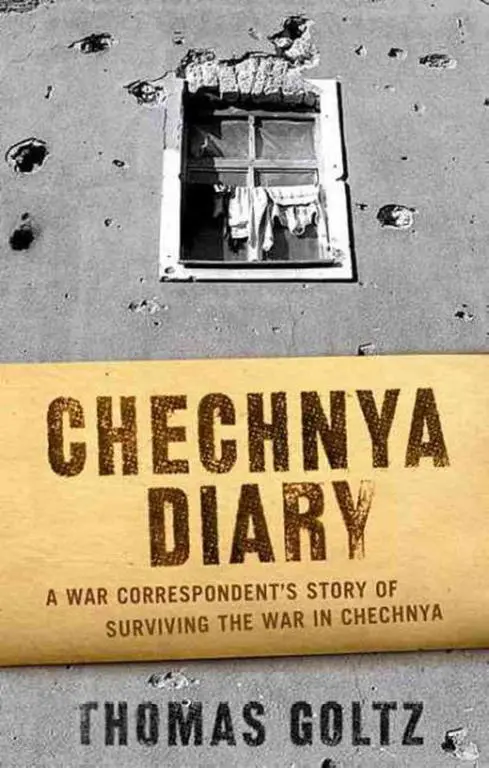
Thomas Goltz - Chechnya Diary
Здесь есть возможность читать онлайн «Thomas Goltz - Chechnya Diary» весь текст электронной книги совершенно бесплатно (целиком полную версию без сокращений). В некоторых случаях можно слушать аудио, скачать через торрент в формате fb2 и присутствует краткое содержание. Город: New York, Год выпуска: 2011, ISBN: 2011, Издательство: Thomas Dunne Books, Жанр: Биографии и Мемуары, military_history, Публицистика, на английском языке. Описание произведения, (предисловие) а так же отзывы посетителей доступны на портале библиотеки ЛибКат.
- Название:Chechnya Diary
- Автор:
- Издательство:Thomas Dunne Books
- Жанр:
- Год:2011
- Город:New York
- ISBN:0-312-26874-2
- Рейтинг книги:3 / 5. Голосов: 1
-
Избранное:Добавить в избранное
- Отзывы:
-
Ваша оценка:
Chechnya Diary: краткое содержание, описание и аннотация
Предлагаем к чтению аннотацию, описание, краткое содержание или предисловие (зависит от того, что написал сам автор книги «Chechnya Diary»). Если вы не нашли необходимую информацию о книге — напишите в комментариях, мы постараемся отыскать её.
is part of a larger exploration of the role (and impact) of the media in conflict areas. And at its heart,
is the story of Hussein, the leader of the local resistance in the small town that bears the brunt of the massacre as it is drawn into war.
This is a deeply personal book, a first person narrative that reads like an adventure but addresses larger theoretical issues ranging from the history of ethnic/nationalities in the USSR and the Russian Federation to journalistic responsibility in crisis zones.
is a crossover work that offers both the historical context and a ground-level view of a complex and brutal war.
Chechnya Diary — читать онлайн бесплатно полную книгу (весь текст) целиком
Ниже представлен текст книги, разбитый по страницам. Система сохранения места последней прочитанной страницы, позволяет с удобством читать онлайн бесплатно книгу «Chechnya Diary», без необходимости каждый раз заново искать на чём Вы остановились. Поставьте закладку, и сможете в любой момент перейти на страницу, на которой закончили чтение.
Интервал:
Закладка:
She had never spoken a word to me before.
I wanted to crow for joy; I wanted to wait for his return from wherever he was hiding
“It is really time to go.”
It was Lawrence Sheets, telling me that if I should chose to shirk professional responsibility, that was my business, but that he had to get back to Nazran to file.
Yes, time to file, to broadcast the body-based story of Samashki to the world.
“Let’s go, now.”
I tried to say something comforting or encouraging to Hussein’s mother, but she was already sitting down in a heap and was only capable of weeping.
Who else from my household survived?
“Let’s go,” said Sheets, and that time I followed him out the courtyard door to the muddy street and back into our transport and back down the high road toward the mosque and then the bridge and then the station. The armored train was there, pulling a dozen flatcars piled high with ammunition and the wheeled vehicles of war.
I tried to explain to Sheets that this was the entire reason for all subsequent events and that we needed to stop and shoot some footage of the fucking train, but Lawrence was very insistent. It was time to go before the window snapped shut with us inside the house of death.
As an insurance policy to protect our tapes, we picked up an elderly Chechen woman on our way out of town who obligingly stuffed our cassettes down her blouse.
There was no need.
“Bet you got some good material,” said the baby-faced sergeant at Post 13, poking his head in the car, smiling.
“ You’re on the air!” crowed Steve Coppen from ABC Moscow, breaking the good news to me on Sheet’s telephone. It was soon ringing off the hook with more calls for me than Uncle Larry.
“Brilliant, ” cried Gillian Findley, the throaty reporter who cut and voiced my Samashki piece for that night’s prime-time ABC World News Tonight with Peter Jennings.
“We want fifteen hundred full-color words on that massacre you talked about on the BBC,” commanded Marie Colvin at the London Sunday Times . “I am going for the front page.”
“I don’t care how you file. You can dictate the whole thing on sat phone at any cost, but we want thirty inches by tomorrow morning. We need that story!” pleaded Newsweek ’s Steve LeVine. That meant two full pages, a whole spread.
And Sonia Mikich.
“You will get on the next plane out of there now and get up to Moscow and get over to the ABC offices, and I do not care if you have to steal your tapes back, you will convert them to European system and you will deliver them here yesterday , and I will pay you a great deal of money in cash, so move! I need those tapes!!”
Remarkable how ninety seconds worth of prime-time attention can change your life for a day, maybe a week, or maybe a lifetime.
A Japanese channel copied the lot and paid me another thousand bucks, cash. Paula Robatelle of the Canadian CBS needed a couple of minutes to round out her own award-winning French language report. A Turkish channel— Star or Show? —was next in line.
I paid my bills, bought new clothes, took loyal friends out to dinner at outrageously overpriced restaurants. If not the talk of Moscow town, I was at least a temporary player.
The most satisfying moment in the whirlwind of my new life as Witness to Massacre came at the end of that frenetic week, when the Minister of the Interior and Commander in Chief of Field Operations in Chechnya, Colonel-General Anatoly Kulikov gave his first “meet the press”-style opportunity at the Raddison-Slaviskaya Hotel International Press Center on April 19. Blithely describing how federal forces had restored “constitutional order” in Samashki in accordance with the wishes of the majority of the town’s inhabitants, including the mayor and imam, General Kulikov was happy to provide the press with several letters he had received from the town, begging for intervention before the events of early April, and thanking him for the successful outcome of the operation. Still, the general had to admit that the “bandits” in town had put up a hard fight from exactly thirty-one strongholds, and that he, as a military man at war, had been obliged to order his boys to reduce those strongholds to rubble—even if it meant that his men had to throw grenades into basements to flush out militants hiding among terrified civilians in the most cowardly manner.
“In a war where the enemy hides among civilians, there will be civilian casualties,” General Kulikov stated. “In wars like this, civilian casualties outnumber military ones.”
The commander also noted that his own forces had taken a “surprisingly large” number of casualties during the course of the tough operation. That, he suggested, was the reason why those first journalists and human rights observers to visit Samashki after the battle found so many syringes littering the streets of the town; so many wounded soldiers required immediate relief. Finally, concluded the general, should anyone doubt his assessment of the liberation of Samashki from the Dudayevist bandits who had taken control of the town from its normal, peaceful inhabitants, they were encouraged to check the record of the ICRC and journalists. The former had found everything perfectly normal, given battle conditions, while the latter had been given complete and free access to the town, with the exception of those whose papers were not in order.
I did not even bother to ask a question in the face of these patent and provable lies.
“Who is the best television producer in Russia?” I demanded of ABC’s Steve Coppen.
“Kisilov,” was his one-word reply.
He was referring to Yevgenii Kisilov, founder, producer, and presenter of the award-winning (and almost revolutionary) weekly news program called Itogi, or “Agenda,” on the independent NTV station. In a few short years, the program had became something like the equivalent of 60 Minutes for Russian television viewers.
“You know him?”
“Of course.”
“Then please call him and tell him I will donate my tapes, because I hate lies.”
Iwas over at Voice of America reporter Elizabeth Arnold’s apartment when the weekly Itogi came on the next Sunday night. In addition to her fiance, a crime-busting cop named Rafi, the viewing crowd consisted of Elizabeth, myself, and a man who introduced himself as Maksharip. With a jolt, I recognized him as being the English-speaking Chechen historian-cum-guerrilla I had encountered outside Samashki back in February, before I had ever met Hussein. Having put down his gun, he was back in Moscow looking for a new “fixer” job in the Western press, selling access to the people who are thought to have abducted Fred Cuny.
The main people missing from the little press-success party were Lawrence Sheets and Sonia Mikich. The former was already back in Chechnya trying to get an interview with Djohar Dudayev in his bear lair in the mountains, while the latter was completing her future award-winning work on the Soldiers’ Mothers’ March by following the brave ladies on the most recent leg of their quest.
At nine P.M., we gathered in Elizabeth’s den and turned on the tube.
After a brief digest of the week’s events, Yevgenii Kisilov announced to his audience of millions that the bulk of the program would be devoted to events in Chechnya, and specifically the village of Samashki.
An advertisement. Maybe two. Then Colonel-General Kulikov’s press conference, with all the attendant schmooze. Commentary from Kisilov, concluding with a line something like “we’ll be back with a slightly different perspective after the break.”
Читать дальшеИнтервал:
Закладка:
Похожие книги на «Chechnya Diary»
Представляем Вашему вниманию похожие книги на «Chechnya Diary» списком для выбора. Мы отобрали схожую по названию и смыслу литературу в надежде предоставить читателям больше вариантов отыскать новые, интересные, ещё непрочитанные произведения.





Обсуждение, отзывы о книге «Chechnya Diary» и просто собственные мнения читателей. Оставьте ваши комментарии, напишите, что Вы думаете о произведении, его смысле или главных героях. Укажите что конкретно понравилось, а что нет, и почему Вы так считаете.