Thomas Goltz - Chechnya Diary
Здесь есть возможность читать онлайн «Thomas Goltz - Chechnya Diary» весь текст электронной книги совершенно бесплатно (целиком полную версию без сокращений). В некоторых случаях можно слушать аудио, скачать через торрент в формате fb2 и присутствует краткое содержание. Город: New York, Год выпуска: 2011, ISBN: 2011, Издательство: Thomas Dunne Books, Жанр: Биографии и Мемуары, military_history, Публицистика, на английском языке. Описание произведения, (предисловие) а так же отзывы посетителей доступны на портале библиотеки ЛибКат.
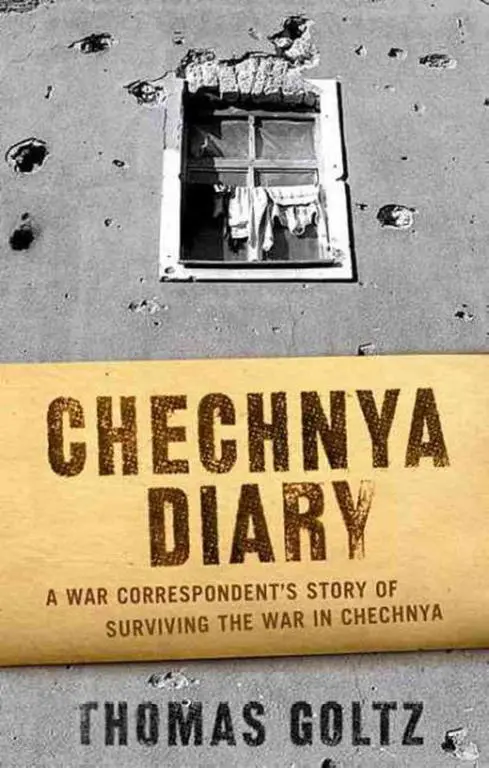
- Название:Chechnya Diary
- Автор:
- Издательство:Thomas Dunne Books
- Жанр:
- Год:2011
- Город:New York
- ISBN:0-312-26874-2
- Рейтинг книги:3 / 5. Голосов: 1
-
Избранное:Добавить в избранное
- Отзывы:
-
Ваша оценка:
Chechnya Diary: краткое содержание, описание и аннотация
Предлагаем к чтению аннотацию, описание, краткое содержание или предисловие (зависит от того, что написал сам автор книги «Chechnya Diary»). Если вы не нашли необходимую информацию о книге — напишите в комментариях, мы постараемся отыскать её.
is part of a larger exploration of the role (and impact) of the media in conflict areas. And at its heart,
is the story of Hussein, the leader of the local resistance in the small town that bears the brunt of the massacre as it is drawn into war.
This is a deeply personal book, a first person narrative that reads like an adventure but addresses larger theoretical issues ranging from the history of ethnic/nationalities in the USSR and the Russian Federation to journalistic responsibility in crisis zones.
is a crossover work that offers both the historical context and a ground-level view of a complex and brutal war.
Chechnya Diary — читать онлайн бесплатно полную книгу (весь текст) целиком
Ниже представлен текст книги, разбитый по страницам. Система сохранения места последней прочитанной страницы, позволяет с удобством читать онлайн бесплатно книгу «Chechnya Diary», без необходимости каждый раз заново искать на чём Вы остановились. Поставьте закладку, и сможете в любой момент перейти на страницу, на которой закончили чтение.
Интервал:
Закладка:
The greater issue, in fact, was how was I going to record another day in my miserable life with no place to stay in a shattered city with a shoot-on-sight curfew about to go into effect. An armored personnel carrier came roaring down the road carrying a dozen soldiers on top, rifles at the ready. I flagged it down and climbed aboard for a ride into town. A couple of shots rang out at a crossroads and the patrol threw me off, racing in the general direction of the gunfire and leaving me to my own devices. The city administration was not far away, so I trudged over, negotiating my way through the barbed wire and sandbag guard posts with the aid of my press pass, only to discover that the only people on the premises were a knot of burly, nasty guards celebrating VE-Day in a nearby bunker-cum-sauna the old-fashioned way, namely by getting totally smashed on warm vodka.
I joined them. I had no choice. Their names were Vitali and Sasha and Igor and Misha and several others too drunk to talk or pronounce their names. They were all kontraktini, or mercenaries, a mixture of policemen from the provinces who wanted to quadruple their salaries, and criminals let out of jail to serve on the front for freedom and loot. They were not nice men, but jolly or drunk enough to tolerate the presence of an American in their midst in memory of the Allies who had together with them brought Hitler to his knees exactly fifty years before. Rounding out the party was a very quiet officer who wore the FSB (renamed KGB) badge on his shoulder, and a local cossack Ataman, or clan leader, along with his daughter (or a “working girl”; it was not clear) for a night on the town with the front-line drunks.
“To us, to you, to victory!” roared Vitali, a cop from the Siberian city of Perm, lifting yet another toast.
“You are the son of a whore and a coward,” belch-mumbled a mountain of fat in the far corner, a fellow cop/mercenary, apparently. “Let’s go at it again.”
The pair had been arm wrestling the day away when not knocking back shots. Vitali won right and then won left and then won right again, and the mountain of fat collapsed back into his corner.
“You Western journalists have much more access to the other side than we do.”
It was the FSB/KGB major, quietly inquiring and assessing.
“Often,” I carefully replied.
“Do you think you could set up a meeting?”
“With whom?”
“Dudayev.”
“Why?”
“Peace.”
Was this a serious spook? And even if he were, why was he assuming that a mere Western hack like me could get him up and into the mountains and the bear-lair of the Chechen president and back out again, without him getting both himself and me executed as spies like Fred Cuny? Or was the conversation nothing but a nonsensical bluff made on the fiftieth anniversary of VE-Day in the surreal setting of bombed and shattered Grozny? I do not know and never will, because there was then another toast and then another and then a third, and as midnight neared in the bunker-cum-sauna, my new pals among the legal mercenaries in the new Russian Army loaded their guns and joined others from other bunkers emerging from their drunken dungeons, and then, with a last nasdarovia, began blasting the firearms against vacant buildings, shattered walls, and remnants of trees.
Brrrrrrrt!!!! Bam Bam Bam! Brrrrrt! WamBamBammmmmm!!!
The international press reported an intense firefight in Grozny that night; I can report with assurance that it was merely my new pals having fun with AK-47s and RPGs.
Islept in another bunker that night with a bunch of stinking, farting, snoring, and terrified Russian conscript soldiers. Maybe I was the stinking, farting, snoring, and terrified one. I was up at dawn, sharing my cowboy coffee with another early bird, a sullen kontraktni who went by the name of Kiril. He was sitting in the middle of a brick-and-sandbag bunker, guarding some chunk of the administrative building compound, cleaning his gun in the early morning light, and was grateful for the brew. I asked if I could film and he allowed me to shoot the sort of weapons-cleaning-instruction class that you don’t see everyday. When he had wiped away all the oil and made sure everything was just fine, Kiril and another monster grunt named Igor then took me on a tour of Grozny’s shattered skyline.
“Come on, Ami,” they said with nonblinking eyes. “Its time to show you our town.”
We started at the municipal post office and worked our way upward through extreme rubble to the city-center rooftops that served as snipers’ dens, ending up at a place the rebonik, or “guys” referred simply to as “the beach.” And indeed, lying in their skivvies on the tarpaper roof paper were a couple of Ruski beach bums, catching a few rays. The pair threw me a couple of shit-eating, we-just-got-caught-with-our-pants-down grins while literally hoisting up their underwear. Kiril and another sniper pal just laughed and laughed and laughed while I got it all on film.
Who were these guys?
What did they do back home?
Where was home?
Where was mine?
With VE-Day done, and Clinton, Major, and Mitterand safely out of Moscow and on their way back home, Boris Yeltsin’s unilateral cease-fire that had never really been enforced gave way to a new paroxysm of fire and steel across the murky front.
The war went on and I went with it.
I caught a mean team of Russian Military police tossing an Inguish translator into the deep-deep of the so-called filtration camps and saved his sorry ass by bargaining away a Yankee flak jacket for his life. Then I rode with the same nasty MPs on a tour of the front lines and got to experience the unique dynamic of a road collision between their eight-wheeled armored personnel carrier and a T-82 battle tank.
Whack!!!
I was sitting atop the former when the latter came lurching out of a field and smashed into us, and there was not another vehicle for miles around. Seems the tank driver was drunk on vodka and looking for more, or at least he was later when I caught the same tank prowling after hours in the town of Shali, swiveling its big gun around until the villagers produced the drink, and then crunching into a local house and killing the inhabitants beneath its treads an hour later.
I had lots of stuff on tape that never made the network news.
I was there for the siege, negotiated surrender, and then the double-cross aftermath of a lopsided battle for a cement factory that served as a sort of Soviet-style Alamo for the Chechen defenders outside a Soviet-style dump town called Chiri Yurt. The chemzavod, or cement factory, that had once supplied most of the cement and related construction materials for Soviet-style building projects from Armenia to the Crimea appeared to be almost a small city when seen from the distance. The smokestacks, burners, storage, loading, and administration buildings covered acres. Below the ground, the complex was said to be honeycombed with tunnels; some said that it doubled as a nuclear war bunker. Who knew; who knows. The main point was that the entire complex had become a death trap for the Chechen fighters dug in there, and subjected to such an intense fire from artillery, attack helicopters, and jet bombers that the thick, black column of smoke billowing from its wounds darkened the sky for miles.
Watching the brick-by-brick destruction of the complex had become a form of entertainment for the people of Chiri Yurt, many of whom had once been employed in the chemzavod . Gathering in the town square—which gave an unimpeded view of the factory across a potato field—residents would squat on their haunches like they were at a crude outdoor movie without proper benches, waiting for a real-life Arnold Schwarzennegger flick to start. The first signal that the daily show was about to commence was the monotonous droning of a high-flying helicopter, spotting targets through the smoky haze for distant gunners. These were the “trailers,” as it were: the short outtakes that preview coming attractions. Next would come the credits—the random whacking from a line of mobile howitzers positioned some two or three miles to the north.
Читать дальшеИнтервал:
Закладка:
Похожие книги на «Chechnya Diary»
Представляем Вашему вниманию похожие книги на «Chechnya Diary» списком для выбора. Мы отобрали схожую по названию и смыслу литературу в надежде предоставить читателям больше вариантов отыскать новые, интересные, ещё непрочитанные произведения.







Обсуждение, отзывы о книге «Chechnya Diary» и просто собственные мнения читателей. Оставьте ваши комментарии, напишите, что Вы думаете о произведении, его смысле или главных героях. Укажите что конкретно понравилось, а что нет, и почему Вы так считаете.